Lessons · Lesson 4 of 5
Seven correct decisions, one late order
How seven defensible decisions in six different screens spent nine days of float, and how to put a price on a day of slack before it is spent.
Lesson 4 of 5 · 24 min
The order that had nine days
VSK-2218 was a good order. 24,600 pieces of a men's full-zip sweat for Voskuil, style KZR-410, at USD 11.85 FOB. FOB means the factory's price with the goods loaded on the vessel. That is USD 291,510, at a costed margin of 10.4%, or USD 30,317.04. Voskuil's terms are unusually clear about lateness: 0.5% of order value for every calendar day past the on-board date, capped at 5%. That is USD 1,457.55 a day, and it will matter more than anything else in this lesson.
The calendar was built backwards from the vessel, using the method in course 7.1. The chain came out with 9 days of float. That is comfortable. Thelawatte has shipped worse orders than this without noticing them.
VSK-2218 shipped seven days late. The penalty was 3.5% of order value, USD 10,202.85, which is 33.7% of everything the order was ever going to earn.
There is no single cause, and this lesson is not going to find one, because there is not one to find. What there is instead is a ledger.
The ledger
Seven things happened. Each was decided by a competent person, on the information in front of them. Six of the seven would be taken again.
| Decision | Who | Where it was taken | Days | Float after |
|---|---|---|---|---|
| Voskuil adds an XXS; the size set is re-graded | The buyer | An email | 1 | 8 |
| Fabric placed with the mill quoting a longer lead time and a lower price | Sourcing | The purchase-order screen | 5 | 3 |
| Lab dips and strike-offs submitted together to save a buyer round | Merchandising | The sample log | 2 | 1 |
| The order slides later in the line plan to keep a bigger order's changeover clean | Planning | The line plan | 3 | -2 |
| Fabric held two days for a re-test on a borderline shade | Quality | The test record | 2 | -4 |
| Final inspection booked on the forecast sewing-complete rather than the plan date | Merchandising | The inspection booking | 1 | -5 |
| A public holiday added to the plant calendar in March, after this order's template was applied in February | Nobody | The plant calendar | 2 | -7 |
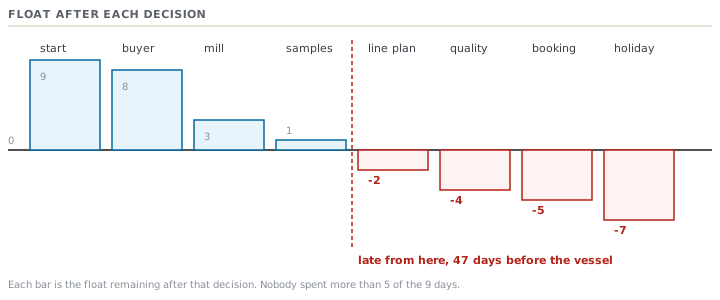
Three things in that table are worth more than the arithmetic.
The first is the Float after column. The order went negative at the fourth line, on 19 May, which was forty-seven days before the on-board date. Three more decisions were taken after that, by people who had no reason to know the order was already late. Each of those three was still defensible on its own terms.
The second is the Where it was taken column. Six different screens. Five of the seven decisions were made by people who never opened the order's calendar during the whole season. Two of them had no route to it, because sourcing's purchase-order screen and the plant calendar are not places a critical path is displayed. The float was computed correctly, and continuously, and published where the people spending it were not standing.
The third is that only one line in that table had a number attached to it at the time. Sourcing had to justify a mill choice in dollars, so sourcing was the only person anybody argued with.
What each of them bought
Slack was not thrown away. Six of the seven decisions bought something real. The seventh bought nothing, because nobody made it.
| Decision | What it bought | Cash |
|---|---|---|
| The XXS | Goodwill on an account worth four programmes a year; the buyer paid the grading fee | Nothing, and not nothing |
| The cheaper mill | 27,060 kg at USD 0.09 a kilo under the faster quote | USD 2,435.40 |
| Combined submission | One courier, and one buyer review round removed | USD 96.00 |
| The line-plan slide | A 62,000-piece order kept in one loading rather than two — two ramp days at USD 1,310 a line-day on two lines | USD 5,240.00 |
| The shade re-test | The shade came back inside tolerance. Nothing was claimed | Nothing realised |
| Booking on the forecast | The buyer's agent charges a rebooking fee | USD 340.00 |
| The holiday | Nothing | Nothing |
Total realised cash: USD 8,111.40 against a penalty of USD 10,202.85. Net USD 2,091.45 out, plus two things that were not cash: a buyer relationship, and a quality decision whose whole value is that the claim was never made. An insurance premium paid on a risk that did not land is not a wasted premium. A course that scores it as one is teaching people to stop testing borderline shades.
So the honest summary is not "seven mistakes". It is this: seven purchases were made with one asset, at a price of zero, by seven people none of whom held the account.
Pricing a day of slack before you spend it
The realised cost works out at USD 637.68 a day across the sixteen days. That number is useless for deciding anything, because you only know it afterwards. What a factory can actually do is price a day in advance, from its own history. Thelawatte has 24 months of it: 236 orders, with float measured at a fixed point sixty days before the on-board date, against whether the order shipped late and by how much.
| Float sixty days out | Orders | Late | Late rate | Mean days late, when late |
|---|---|---|---|---|
| 4 days or fewer | 47 | 26 | 55.3% | 6.4 |
| 5 to 9 days | 68 | 21 | 30.9% | 4.8 |
| 10 to 14 days | 71 | 12 | 16.9% | 3.6 |
| 15 days or more | 50 | 5 | 10.0% | 2.9 |
On a VSK-2218-shaped order at USD 1,457.55 a day of penalty, the expected cost of lateness in each band is the late rate times the mean days late times the daily penalty: USD 422.69 at fifteen days or more of float, USD 886.85 at ten to fourteen, USD 2,160.60 at five to nine, and USD 5,160.35 at four or fewer.
The price of a day is the step between the bands, spread across the five days in each:
- from fifteen-plus down into ten-to-fourteen: USD 92.83 a day
- from ten-to-fourteen down into five-to-nine: USD 254.75 a day
- from five-to-nine down into four-or-fewer: USD 599.95 a day
- below zero, where lateness is no longer a probability: USD 1,457.55 a day
A day of slack at Thelawatte costs between USD 92.83 and USD 1,457.55, depending on where in the order it is spent. That is a factor of 15.7. This is the whole reason it is not obvious to anybody deciding. There is no unit price. The first days are nearly free and the last ones cost fifteen times as much, and every decision is taken before the last one.
The seven, repriced
Now put each decision against the price at the float it was actually taken at.
| Decision | Float before | Days | Priced cost | Cash bought | Verdict |
|---|---|---|---|---|---|
| The XXS | 9 | 1 | USD 254.75 | Nothing | Fails on cash |
| The cheaper mill | 8 | 5 | USD 1,618.95 | USD 2,435.40 | Clears by USD 816.45 |
| Combined submission | 3 | 2 | USD 1,199.90 | USD 96.00 | Fails by USD 1,103.90 |
| The line-plan slide | 1 | 3 | USD 3,515.05 | USD 5,240.00 | Clears by USD 1,724.95 |
| The shade re-test | -2 | 2 | USD 2,915.10 | Not cash | Not a cash decision |
| Booking on the forecast | -4 | 1 | USD 1,457.55 | USD 340.00 | Fails by USD 1,117.55 |
| The holiday | -5 | 2 | USD 2,915.10 | Nothing | Fails |
Two of the seven clear, and they are the two with a real number on the benefit side. That is not a coincidence, and it is not a compliment to the other five. It is what happens when only one side of a trade has a price on it.
Now the honest part, because this arithmetic has a limit and it is better to say so than to be caught. Those priced costs add up to USD 13,876.40 against a realised penalty of USD 10,202.85. The model over-states the actual loss by 36%. That is not an error. It is what the model is. Each row prices a decision at the moment of deciding, across the whole range of orders that looked like this one, and most of those shipped on time. The order in front of you is a single draw. Adding seven expected values along one path that happened to go badly counts the same risk twice, and the arithmetic saying so is the arithmetic behaving correctly. Use these numbers to decide. Never use them to allocate blame afterwards.
The six days that bought USD 436
Take the four decisions that fail on cash: the XXS, the combined submission, the inspection booking and the holiday. Together they are 6 of the sixteen days. They cost USD 5,827.30 at the prices above, and they bought USD 436.00.
Remove those six days and the order finishes at minus one instead of minus seven. One day late is 0.5%, or USD 1,457.55, instead of USD 10,202.85. That is a difference of USD 8,745.30, or 28.8% of the order's entire margin.
Not one of the four was a bad decision. Two of them were made to protect the calendar. Combining the two submissions was meant to remove a buyer round, and it did, and it cost two days waiting for the slower of the two items. Booking the inspection against the forecast rather than the plan was meant to avoid a rebooking. The most expensive line in the ledger is the one nobody decided at all: a public holiday entered in March, into a template that had already been applied to an order created in February.
Check yourselfAn order shipped seven days late. No single decision consumed more than five of its nine days of float. Who caused it?Show the answer
Nobody, and looking for somebody is the expensive move. Seven decisions each fitted inside the float as it stood when they were taken, which is what makes them individually defensible and collectively fatal. The useful questions are different. At which decision did the running float first go negative, and how long before the ship date was that? Here it was the fourth, forty-seven days out. So the order was knowably late for six weeks, and three more decisions were taken inside that window by people with no way of knowing.
Check yourselfWhy is an average cost per day of slack the wrong number to give a sourcing manager?Show the answer
Because the cost is not a straight line and the average sits nowhere useful. At Thelawatte a day taken when the order has plenty of room is worth USD 92.83, and a day taken when the order is already late is worth USD 1,457.55. Same day, a factor of 15.7 apart. An average tells a manager with a comfortable order to refuse a saving worth taking, and a manager with a late one that five days are affordable. Price the day at the float the order actually has, from your own history of what float did to lateness.
Prompt · Rebuild the slack ledger for an order that went late
After a late shipment, when the review is about to settle on whoever made the largest single change.
Act as a planning manager reconstructing where an order's float went. Order facts: [QTY] pcs of [STYLE] for [BUYER], FOB [PRICE], order value [VALUE], costed margin [VALUE AND PERCENT]. On-board date agreed at confirmation: [DATE]. Actual on-board date: [DATE]. The buyer's late-delivery clause, word for word: [PASTE IT]. Total float on the critical path at confirmation: [DAYS]. Now the events, and please do not reorder them: [LIST EVERY DATE MOVEMENT IN CHRONOLOGICAL ORDER — what changed, how many days, who decided it, in which screen or system, and what the decision bought, in cash where you can put a figure on it and 'not cash' where you cannot]. Build me a ledger with a running float column after each event, and mark the event at which the running float first went negative and how many days before the vessel that was. Then say how many decisions were taken after that point and by whom. Second, from my own history — I can supply orders with their float measured at a fixed point before shipment and whether they went late and by how much: [PASTE THE BANDS OR THE RAW ORDERS] — derive the cost of one day of slack at each level of remaining float, and reprice each decision at the float it actually held when it was taken. Show which decisions cleared their own price and which did not. Third, and this matters: tell me whether the sum of those repriced costs exceeds the penalty actually paid, and explain why that is expected rather than an error. Finally, list the decisions that failed on cash, total the days and the cash they bought, and tell me what the order would have paid without them. Do not name a single cause and do not recommend disciplining anybody.
AI can make mistakes — check anything you act on.
What you own at the end of this lesson
One ledger for one order that went wrong: every date movement, who made it, in which screen, and the running float beside it. It takes about two hours to rebuild from a system log, and it is the single most useful two hours in this course. It produces the one thing an argument about lateness never has: an order of events with a running balance.
Next: doing this for forty orders in twenty-five minutes a week.