Lessons · Lesson 1 of 3
Four numbers, one shelf
Take one shelf in one shop. Separate the stock the system owns, the stock a count finds, the stock on the floor and the stock a customer can buy. Then price the difference.
Lesson 1 of 3 · 35 min
The situation
Ask how much of something a shop has. You get one number back. There are four, and they answer different questions. What the records say the shop owns. What a person counting the shelves finds. How much of that is out where a customer can reach it. And how much of that a customer actually wants. This lesson pulls the four apart, on one shelf, in one shop.
Saturday 10 October 2026, a kidswear shop on a high street. Netherby is a British kidswear basics retailer: 62 shops and a website. Almost everything it sells is a repeat line — bodysuits, vests, leggings, joggers, sleepsuits, multipacks of plain tees. None of it is fashion. All of it is bought again next season. That is why the stock numbers have to be right.
The department is Kidswear Essentials, Autumn 26. The phase runs 16 weeks, from week commencing 31 August 2026 to week commencing 14 December 2026. Yesterday closed week 6.
Ottoline Tolhurst runs inventory and allocation. She owns two things a factory-side merchandiser never owns separately: how much stock exists, and where it is. Barnaby Ardleigh manages the Rowanbank shop. It is a door of middling size. A door is one shop.
Everything in this course is Netherby's own measurement. None of it is an industry figure. Do not carry any of it into your own business. Carry the method.
Stock is not one number, and the word hides it
Ask anyone how much of a style a shop has and you get one figure. There are at least four. All four are correct answers to different questions.
- Book stock. What the system says the shop owns. This is the number the replenishment engine reads, the number that values the balance sheet, and the number in every report. Replenishment is the weekly top-up that sends stock from the warehouse to the shops.
- Physical stock. What a person counting the shop actually finds. It differs from book stock by shrink and by error. Shrink is stock the records claim and the shelf does not have.
- Floor stock. What is out on the fixture where a customer can see it. Physical stock also includes the stockroom, the returns tote and the pile behind the till.
- Sellable stock. What a customer can buy today, at the price the system thinks it is. Floor stock in a size nobody wants is not sellable. Neither is floor stock with the wrong ticket on it.
Every retail system on earth reports the first. Every sale comes out of the fourth. The distance between them is the subject of this course.
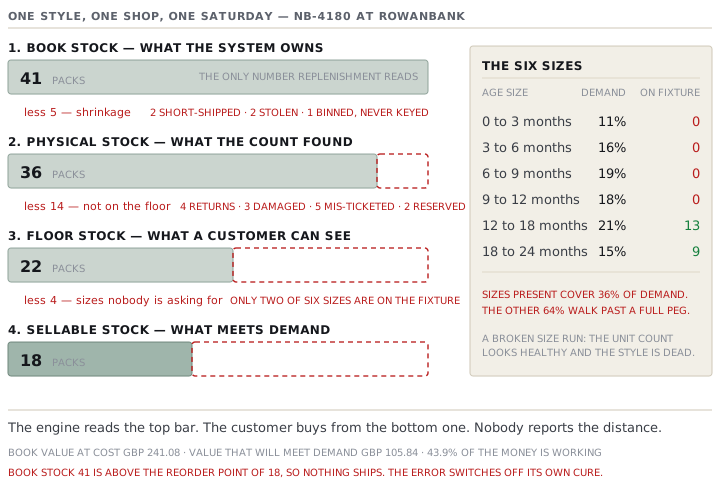
One style, one door, one Saturday
The style is NB-4180, the Essential Bodysuit 5-Pack, in six age sizes. It tickets at GBP 14.00 and costs Netherby GBP 5.88 landed. Landed cost is the price paid plus everything it takes to get the goods onto the shelf. That gives a 58.0% intake margin, which is the margin planned at the moment of buying. This department is planned at retail, so every money figure in this course is at retail unless it says at cost.
Netherby's system says Rowanbank holds 41 packs of NB-4180 this morning. Barnaby counted the style by hand before the doors opened, because Ottoline asked him to. He found 36.
Then he wrote down what the 36 were actually doing.
| Where the packs were | Packs | Can a customer buy it today |
|---|---|---|
| On the fixture, correctly ticketed | 22 | Yes |
| Mis-ticketed at a promotional price from another style | 5 | Yes, at the wrong price |
| In the returns tote, awaiting inspection | 4 | No |
| Water-damaged in transit, awaiting write-off | 3 | No |
| Held behind the till against a customer order | 2 | No |
| Counted total | 36 |
So the four numbers for this shelf are 41 on the book, 36 physical and 22 on the floor. The fourth number is not on this table at all, because it depends on sizes.
Look at what the five mis-ticketed packs do. They are sellable, so they belong in floor stock, and they will sell. They will sell at a price the system does not expect. That turns quietly into an unexplained margin gap somebody will hunt for in January. A wrong price is not an availability problem. It is a different problem sitting in the same pile.
Where the five went
The gap between 41 and 36 is not one thing either. Barnaby and Ottoline traced all five.
| Packs | What happened |
|---|---|
| 2 | A carton was receipted by scanning its label. The despatch message said six packs; the carton held four. Nobody opened it, because nobody opens cartons. |
| 2 | Taken from the fixture and out of the shop. External theft. |
| 1 | A pack was binned in week 2 after a customer's pushchair wheel went through it. The write-off was never keyed. |
| 5 | Book overstatement at this door |
Three completely different failures. One from a supplier, one from a thief, one from paperwork. All three arrive at the same place: the system believes in five packs that do not exist. Lesson 3 shows what a whole year of that looks like and what it costs. For now the point is sharper and narrower. From the engine's chair, all three are identical. It cannot see a theft, a short shipment or an unkeyed form. It sees 41.
The number a customer actually meets
Now the fourth number. Netherby measures a size curve for each style in each store grade. A size curve is the share of demand each size takes. It is measured only from weeks when a door had every size in stock, because that is the only period in which a sale tells you anything about demand. Here is Rowanbank's curve for NB-4180.
| Age size | Share of demand | Packs on the fixture |
|---|---|---|
| 0 to 3 months | 11% | 0 |
| 3 to 6 months | 16% | 0 |
| 6 to 9 months | 19% | 0 |
| 9 to 12 months | 18% | 0 |
| 12 to 18 months | 21% | 13 |
| 18 to 24 months | 15% | 9 |
| Total | 100% | 22 |
Twenty-two packs on the fixture, in two sizes, covering 36% of demand. The other 64% of the people who walk in wanting this style walk past a peg that looks well stocked and buy nothing.
This is a broken size run, and it is the most under-rated failure in retail. The unit count looks healthy. The peg looks full. The style is dead.
What the gap costs at one door
Ottoline priced the four weeks to the next count. All of it comes from the two tables above.
| Packs | At retail | |
|---|---|---|
| Forecast demand | 50 | GBP 700.00 |
| Demand the fixture can serve | 18 | GBP 252.00 |
| Demand lost to the broken run | 32 | GBP 448.00 |
| Margin lost, at 58.0% | GBP 259.84 |
Four hundred and forty-eight pounds. One style, one shop, four weeks. Netherby has 62 shops and this department carries 140 styles. Lesson 2 is about what happens when you stop looking at one of them.
Then Ottoline ran the same numbers against the balance sheet. That is where it stops being a merchandising point and becomes a finance one. The book carries 41 packs at GBP 5.88, so GBP 241.08 of Netherby's money is tied up in NB-4180 at Rowanbank. The packs that will actually meet demand in the next four weeks are 18 of them: GBP 105.84. So 43.9% of the money committed to this style at this door is working. The other 56.1% is missing, damaged, reserved, mis-priced, or in a size nobody is asking for.
That ratio, not the shrink percentage, is the one worth putting on a wall.
And the mechanism that would fix it is switched off
Netherby replenishes Rowanbank weekly from the Wraysholme distribution centre. The rule for a door of this size on this style is plain: top the shop up to a shelf target of 24 packs whenever book stock falls below 18.
Book stock is 41.
Nothing ships. Nothing will ship until the book falls below 18. The book is overstated by five packs that will never sell, and inflated by 14 more that are not on the fixture. The door will still be in a broken size run in four weeks' time, having sold what it could of two sizes. The first person to notice will be whoever runs the next count.
This is what makes inventory accuracy an operating problem rather than an accounting one. A wrong stock number does not merely misreport the shelf. It switches off the machine whose whole job is to correct the shelf. And it does so silently, because a replenishment engine that decides to send nothing produces no message, no exception and no alert. It is the loudest kind of quiet.
Write down what sellable means, once
Netherby's definition, in its stock policy, in one sentence:
A unit is sellable when it is on the shop floor, in a saleable condition, at the price the system holds for it, in a size that door's own curve says is being asked for.
Four conditions. A unit fails if it misses any one of them. The definition is deliberately awkward, and the awkwardness is the point. It forces somebody to say which of the four failed, and each one has a different owner. Condition one belongs to the shop. Two belongs to logistics and the supplier. Three belongs to pricing. Four belongs to allocation.
A single "stock accuracy" percentage lets all four of them off.
Check yourselfA store's book stock for a style matches its physical count exactly. What have you proved?Show the answer
That the total is right, and nothing else. You have proved nothing about how the units split across sizes, so the door can be perfectly accurate at style level and still have four of its six sizes empty. That is lesson 2's whole subject. You have proved nothing about condition: a counted unit includes the damaged one in the returns tote. You have proved nothing about price: a mis-ticketed unit counts the same as a correct one. And you have proved nothing about location, because a unit in a stockroom tote counts and cannot be bought. A clean count is a necessary condition for a shelf that works. It is nowhere near a sufficient one.
Prompt · Tell me what of this stock a customer can actually buy
When a store or a style looks well stocked on a report and is not selling, and you want the gap between what you own and what a customer can buy, priced.
Act as a retail inventory analyst who trusts no stock figure until it has been taken apart. Here is one style in one store. Book stock by size: [PASTE - SIZE, UNITS]. Physical count by size, if I have one: [PASTE OR SAY I HAVE NOT COUNTED]. Of the counted units, how many are in each of these states: on the fixture and correctly ticketed, on the fixture at a wrong price, in a returns or repair tote, damaged and awaiting write-off, reserved for a customer, in a stockroom tote nobody has put out. My size curve for this store, from weeks when every size was in stock: [PASTE - SIZE, SHARE OF DEMAND]. My forecast for the next four weeks: [UNITS]. Retail price [AMOUNT], landed cost [AMOUNT], and my replenishment rule is top up to [TARGET] when book falls below [REORDER POINT]. Do the following in order. First, build me the four numbers: book stock, physical stock, floor stock, and sellable stock, showing every deduction and naming it. Second, work out what share of the next four weeks of demand the sizes actually present can serve, using my curve, and give me the units and the value of the demand that cannot be served. Third, tell me whether my replenishment rule will fire at all against the BOOK number. If it will not, say so as the headline finding, not as a footnote. Fourth, express the money two ways: the cost value of the stock committed at this door, and the cost value of the stock that will actually meet demand in those four weeks, as a percentage. Fifth, tell me which of the four sellable conditions each unit failed, and who owns that condition - the shop, logistics, pricing or allocation. Do not tell me the store is well stocked because the unit count looks adequate. Do not average across sizes at any point.
AI can make mistakes — check anything you act on.