Lessons · Lesson 3 of 3
Onboarding, escalation and the priced exit
Decide what must be true before a first order, run an escalation ladder that has an end, and cost the exit before you need to threaten it.
Lesson 3 of 3 · 36 min
11 August: the order that has nowhere to go
Rules about which factories you may use are easy to hold while nothing depends on them. They get tested on the afternoon the usual factory is full. A new one can take the work. Saying no has a price. Saying yes looks free. This lesson builds a programme that has something else to say that afternoon.
Three weeks before the budget meeting in lesson 1, the autumn programme fell over.
Kavakli Konfeksiyon, Ourique's usual outerwear factory, is full. 42,000 padded jackets need to leave the factory by 6 November to make the on-shelf date, and sourcing has found a site that can take them: Perre Konfeksiyon, Bursa, Turkey. Perre holds a third-party social audit report that another buyer paid for fourteen months ago. It can take the work if the purchase order lands by 25 August.
The head of sourcing forwards the report to compliance with one line: can we get this through?
This is the moment a compliance programme is really tested. Not during an audit. On a Tuesday afternoon in August, when saying yes has an alternative with a price and saying no does not.
What must be true before a first order
The most common failure here is a programme that treats onboarding as one solid wall. Everything is required, so under pressure everything is negotiable, and what gets waived is whatever the person in the room happens not to be frightened of.
Split the list instead. Ourique's own standard — the buyer's internal policy, not a published protocol — has three tiers.
Tier one: nothing can be ordered until these five are true.
- Legal identity and business licence, in the name the purchase order will be raised against.
- A valid third-party social audit report Ourique can read in full. The report, not a certificate number and not a summary page. A certificate tells you a site passed somebody's threshold. A report tells you what was found.
- No open zero-tolerance issue.
- The site list, signed: every building, every floor, every process, every subcontractor the work will touch, with addresses. This is the gate the whole programme rests on, because you cannot rank, audit or remediate a site nobody has told you about.
- A signed code of conduct carrying the right-to-audit clause and the subcontracting clause.
Tier two: required before the first shipment, not before the first order. Ourique's own verification visit. The working-hours and wage data feed. A live grievance channel workers can actually reach. A remediation plan for any medium finding in the report.
Tier three: can wait until the second season. Training programme, worker committee maturity, environmental and energy data.
The split is the whole trick. It gives the programme something to say other than yes or no. It lets commercial pressure land on tier two, where lateness can be recovered, instead of on tier one, where it cannot.
The three paths, priced
| Path | Elapsed | Lands | Cost |
|---|---|---|---|
| Full standard onboarding | Twenty working days | 8 September | USD 92,400 |
| Expedited, tier one only | Eight working days | 21 August | USD 2,540 |
| Waive the gates and order | Same day | 11 August | Unknown, and not yours |
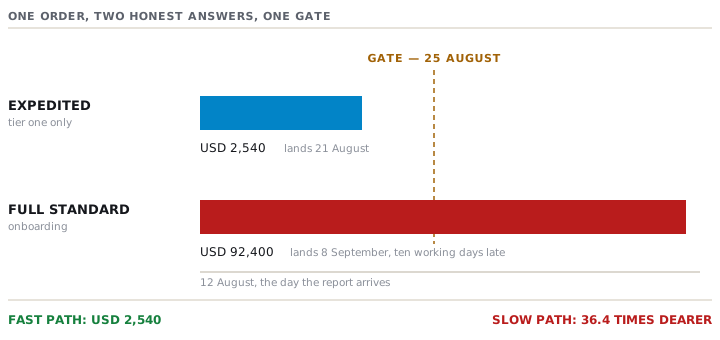
The full path. Book an audit, which takes nine working days of lead time. Then one audit day, five days for the report, three days for Ourique's review, and two days to check the site list against the report. Twenty working days from 12 August lands on 8 September, ten working days past the gate. Perre releases the slot. The work goes to the one qualified site with free capacity, at FOB USD 23.60 against Perre's USD 21.40. That is USD 2.20 a jacket, and 42,000 × 2.20 = USD 92,400.
The expedited path. Book an unannounced audit on a five-day expedite: USD 1,900 plus a USD 640 expedite fee, USD 2,540. Report in two days. Compliance reviews the five tier-one gates only, in one day. The auditor checks the site list while he is standing in the buildings, which is better evidence than checking it from a desk anyway. Eight working days from 12 August lands on 21 August, four working days inside the gate. Tier two runs during production.
Waiving. The cost has no limit, and the person who waives it does not pay it.
The number that matters here is the ratio. The honest fast path costs USD 2,540. The slow path costs USD 92,400, which is 36.4 times as much. A compliance programme that cannot produce the fast path is not being rigorous. It is forcing the business to choose between a five-figure penalty and a shortcut, and the business will eventually stop asking.
The escalation ladder
An escalation ladder is only as real as its top rung. Ourique's has four.
| Level | Trigger | What happens |
|---|---|---|
| One | A finding | Corrective action plan; verified at the next scheduled visit |
| Two | A repeat finding, or a medium not closed in sixty days | Verification visit at the supplier's cost; order placement frozen at current volume |
| Three | A zero-tolerance finding, or refusal of access | Immediate order freeze; no new purchase orders; thirty days to a verified fix |
| Four | Level three unresolved, or a second zero-tolerance finding | Exit |
Level two is where most programmes actually live, and the volume freeze is the part people skip. It is not a punishment. It is the only lever that does not damage the workers. It stops the relationship growing while the site is unproven, which is exactly what "at risk" ought to mean.
2 March: the undeclared unit
Here is where lesson 1's ranking pays for itself.
Nadi Wash and Dye is the laundry that scored 72 on a volume input of 9, and that had been audited zero times under the old plan. It got its first band-A unannounced visit on 2 March. The auditor was not looking for anything unusual. He asked to see the incoming and outgoing delivery notes for the previous fortnight.
One note routed 8,400 pieces of an Ourique style to an address that was not on Shonali Garments' declared site list.
That address is Unit 3: a rented floor with 140 workers doing overlock and finishing, with no fire certificate of its own, on Ourique's own product. Shonali is the largest supplier in the base — 640,000 units a year, 34% of Ourique's jersey capacity, 214,000 units in flight on the day the note was found.
The programme found it in a laundry, on a piece of paper, because a ranking built on exposure and likelihood had sent somebody to a laundry.
Pricing the exit
Level four is now on the table, and the first job is to find out what it costs. Not because cost decides it. Because a threat nobody has priced is not a threat.
| Item | Basis | Cost |
|---|---|---|
| Price differential on the balance of the year | 426,000 units at USD 0.46 | USD 195,960 |
| Loss on transferring fabric already at the site | USD 412,000 at book, 18% | USD 74,160 |
| Air freight to protect three launch styles | 6,200 kg at USD 4.85 | USD 30,070 |
| Qualifying and auditing the replacement | USD 3,900 | |
| Total | USD 304,090 |
Now price the alternative: declare Unit 3, bring it into the programme, and fix it.
| Item | Basis | Cost |
|---|---|---|
| Unannounced audit and verification of Unit 3 | USD 2,680 | |
| Ourique's contribution to egress and fire certification | From the remediation line | USD 18,000 |
| Moving Unit 3's volume back to Unit 1 for nine weeks | 8,400 pieces a week at USD 0.31 overtime premium | USD 23,436 |
| Three further verification visits | USD 2,340 | |
| Total | USD 46,456 |
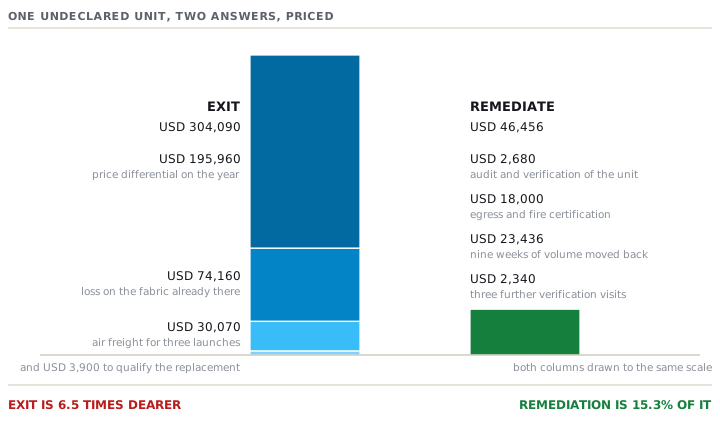
Remediation costs 15.3% of what exit costs. Exit is 6.5 times dearer.
Why the cheaper answer is the dangerous one
Read those two tables the obvious way and you get the wrong lesson. "Remediation is cheaper, therefore remediate" is an argument that works every single time, at every supplier, forever. Which is another way of saying it is not an argument at all. A programme that reasons that way has no level four, and within two seasons everyone in the building knows it. Then level three stops working, because a freeze is only frightening if the next rung exists. Then level two stops working. A ladder rots from the top.
Two things make level four real, and neither of them is a willingness to burn a supplier.
The exit is priced and pre-authorised. USD 304,090 is signed off by the commercial director before the conversation with Shonali, not after. That is what lets the compliance manager sit in a meeting and say a number. A supplier negotiating with someone who has costed the exit, and been given the authority to take it, is having a completely different conversation from one negotiating with someone who is hoping not to be asked.
Remediation is chosen for the workers, not for the invoice. Exit removes Ourique from Unit 3 and leaves 140 workers in an uncertified building with one fewer buyer who has any standing to fix it. That is the reason to remediate — not the USD 257,634 the company keeps. Keep those two sentences in that order, in the paper, in writing. A programme that writes the money first will eventually reach a case where the money says exit and the workers say stay, and by then it has trained itself to read only one column.
And remediation has to be earned, not claimed. Unit 3 comes back into production when a verification visit says the egress work is done and the payroll for those 140 workers has been reviewed. Not when Shonali sends a photograph. That is lesson 2's rule, arriving where it matters.
What the merchandiser owes the programme
Three things, and all three are cheaper than any audit in this course.
The declared subcontractor. Ourique's site list grew from 34 to 103 because merchandisers were asked, at purchase-order stage, which building each process happens in. Twenty-two second units surfaced in the first month. Nobody had been hiding them. Nobody had been asked.
The honest lead time. Take the Perre order. 42,000 jackets, standard allowed minutes of 31.4, target efficiency 74%. That is 42,000 × 31.4 = 1,318,800 standard minutes, and at 74% it becomes 1,782,162 clocked minutes, or 29,703 hours. A line of fifty-four people at the code's ceiling of sixty hours a week gives 3,240 hours a week. So the sewing alone needs 9.17 weeks, or sixty-four days. Add twelve days from fabric arriving to first output, and six days of finishing and packing. Eighty-two days.
From a purchase order on 25 August to leaving the factory on 6 November is seventy-three days. The gap is nine days.
| Value | |
|---|---|
| Work required | Eighty-two days |
| Calendar available | Seventy-three days |
| Uplift needed | 12.3% |
| Weekly hours implied | 67.4 |
| Above the code ceiling by | 7.4 hours a week, for eleven weeks |
Nobody at Perre will refuse the order. They will work 67.4 hours. In March an auditor will write an excessive-hours finding, and the audit line will pay to discover a fact that could have been worked out in August from three numbers the merchandiser already had.
The order that does not force overtime. The control is a capacity-and-hours check at purchase-order stage: standard minutes, efficiency, headcount, calendar. It costs nothing. It is the cheapest compliance control in the programme, and it lives in the merchandising system, not the compliance one. A programme that does not own it is buying audits to find the consequences of orders it could have queried.
Check yourselfYour exit from a supplier is costed at USD 304,090 and remediation at USD 46,456. Which do you choose, and what makes the answer defensible?Show the answer
Usually remediation, but not because of the numbers. Remediation is defensible when it leaves the workers better off and when coming back is gated on verified evidence rather than a photograph. The exit costing exists so it can be signed off in advance and level four stays credible. The moment remediation becomes automatic because it is cheaper, the ladder has no top and every rung below it goes soft.
Prompt · Price the exit before you threaten it
Before an escalation meeting, when you need to know what walking away actually costs and who has to sign it off.
Act as a senior sourcing and compliance director. I may have to exit a supplier and I need the decision costed before I go into the meeting. Facts: supplier [NAME], [UNITS] units a year, [SHARE] of my capacity in this product category, [UNITS] units currently in flight, my price with them [PRICE] per unit. The next best qualified site quotes [PRICE] per unit and needs [WEEKS] weeks to qualify. Fabric already at the supplier: [VALUE] at book. Committed launch dates I cannot move: [LIST]. The finding that triggered this: [DESCRIBE IT, INCLUDING WHETHER IT IS A ZERO-TOLERANCE ISSUE, A REPEAT, OR A REFUSAL OF ACCESS]. Do the following. First, cost the exit for the first year: price differential on the balance, loss on transferring or writing off fabric, air freight to protect the launches, and the cost of qualifying and auditing the replacement. Give me a total. Second, cost the remediation alternative, including any contribution I would make, the cost of moving volume while the work is done, and the verification visits needed to confirm it. Give me a total. Third, tell me plainly which is cheaper and then argue the case AGAINST simply choosing the cheaper one — specifically, what happens to the credibility of every lower rung of my escalation ladder if exit is never taken. Fourth, tell me what happens to the workers under each option, and say which option leaves them better off. Fifth, write the re-entry gate: the specific verified evidence, not an assertion or a photograph, that would let this site take orders again. Sixth, tell me who in my organisation has to authorise the exit number BEFORE the meeting for my position to be credible.
AI can make mistakes — check anything you act on.