Lessons · Lesson 1 of 5
A field is a claim, and it has three parts
Break one number into its three parts: the definition, the owner and the moment. Then write a field definition a stranger can use.
Lesson 1 of 5 · 18 min
The situation
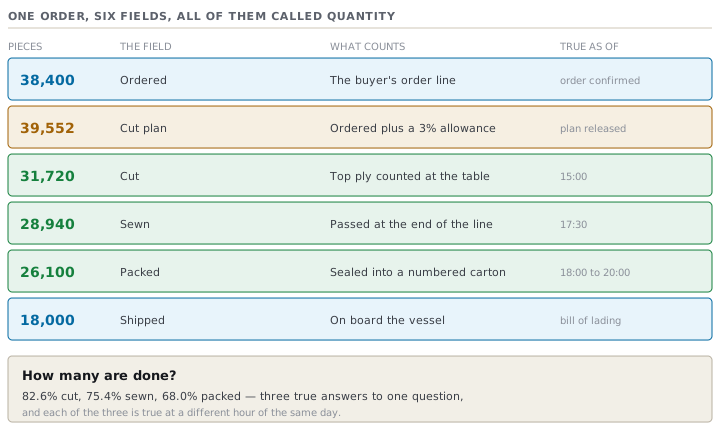
Tuesday, 06:40. Nasseef Apparel runs eight sewing lines. It is halfway through purchase order THG-90142 for the Thurlestone Group: 38,400 pieces of TH-4180, a men's cotton chino, at FOB USD 7.40 a piece. FOB means the price with the goods loaded and ready to leave the factory's port.
Rowaida Guindi is the merchandiser. Every Tuesday she is asked the same question.
How many are done?
She has four answers on her screen. Every one of them is correct.
| What the number counts | Pieces | Against the ordered quantity |
|---|---|---|
| Cut | 31,720 | 82.6% |
| Sewn and passed at end of line | 28,940 | 75.4% |
| Packed into cartons | 26,100 | 68.0% |
| Shipped | 18,000 | 46.9% |
There is a fifth number nobody asked for. The production order says the quantity is 39,552. The cutting room is allowed to cut 3% over the ordered 38,400. So six numbers sit on one order. All of them are called quantity. None of them is wrong.
This lesson is about why that is not a filing problem.
A field is not a fact
You expect a field on a screen to hold a fact about the world. It does not. A field holds somebody's claim about the world, made under a definition, at a moment. Take away any one of those three and the number cannot be compared to anything.
- The definition. What counts and what does not. Does cut include pieces that were cut, then cut again because of a fabric fault? Does packed include cartons that were packed and then opened again to add a retail price ticket?
- The owner. The person who can make the value true. Not the person who typed it. Lesson 4 is all about that difference, because that is where records really fail.
- The as-of. The moment the claim was true. 82.6% was true at 06:00 on Tuesday. At 06:00 on Thursday the cut stood at 33,910 pieces, which is 88.3%. The Tuesday number was now a statement about the past. It still looked like a statement about now.
A number with all three parts is a field. A number with only two of them is a rumour in a box.
The word is not the definition
Here is the part that costs money. It is the reason this is lesson 1 and not an appendix.
Two fields with the same name are not the same field. Nothing on either screen says so. The buyer's system and the factory's system both have a box labelled quantity. They agree on the label. Nobody ever asked them to agree on the definition. A label is what a person reads. A definition is what nobody wrote.
Last month Clare Halloran, Thurlestone's merchandiser, read Rowaida's weekly report. She saw 82.6% and told her distribution centre the order was 82.6% ready to ship. She was not careless. The progress field in her own system means packed. So 82.6% meant packed to her, exactly as it meant cut to Rowaida.
The distribution centre reserved twelve inbound slots for the week the sum implied. Four were used. Eight were released late. Thurlestone's warehouse charges USD 85 for an unused reserved slot. That is USD 680, for one word.
USD 680 is not a disaster. Hold on to it anyway. Lesson 3 follows a second undefined field on the same order, and that one costs more than the whole order's margin. The two fields were undefined in exactly the same way. What differed was how many decisions used them before anybody looked again. That is the subject of lesson 3. It is also why you cannot judge a field's danger by looking at the field.
Writing a definition that survives a stranger
A definition is not a paragraph. It is one sentence that somebody who has never met you can apply on their own. It has four parts: what is counted, when it starts counting, what is left out on purpose, and in what unit.
Rowaida wrote five of them in one afternoon. Here are two.
Cut quantity. Pieces of the top ply counted at the end of the cutting table, in pieces, counted once when the bundle ticket is written. It excludes re-cut replacements, which are counted in re-cut. It excludes the allowance the cutting room is authorised over the ordered quantity.
Packed quantity. Pieces sealed into a carton with its carton number assigned, in pieces. A carton opened for any reason returns its pieces to packed only when it is sealed again.
Read those and notice what is missing. There is no reason, no policy, no "this is important because". A definition that argues for itself cannot be used by somebody who disagrees with the argument. At that point it stops being a definition and becomes a memo.
The as-of is part of the value
The commonest thing you do with a number is compare it. To last week. To the plan. To what the buyer was told. Every one of those comparisons is invalid unless both numbers were true at the same kind of moment.
At Nasseef this shows up in an ordinary way. Cut is recorded at the end of the cutting shift, which ends at 15:00. Sewn is recorded at the end of the sewing shift, which ends at 17:30. Packed is recorded when the finishing supervisor closes the day, and that happens somewhere between 18:00 and 20:00.
So the three numbers on Rowaida's Tuesday screen are true at three different times. The gap between them is not all a gap in the work. Some of it is a gap in the clock. Work out pieces sewn but not yet packed from that screen and you get a difference that contains two and a half hours of nothing.
The fix is not a better system. It is one line beside the number: the moment it was true. A number carrying its own as-of can be compared safely by a stranger. A number without one cannot be compared safely by anybody, including the person who wrote it.
What you actually own
Rowaida's order record has 62 fields. She types into about forty of them in a normal week. She can make nine of them true by herself.
That gap is between the fields you touch and the fields you own. Being honest about it early is the most useful thing you can do. It is not a complaint about your job. It is a map of where you have to ask somebody else, and asking is cheap. Lesson 4 draws the map.
Prompt · Write the definition of a field
When two people report different numbers for the same thing and neither of them is wrong.
I am a merchandiser in a garment factory. I am going to give you the name of a field from my order record and a short description of how it is used. Write me a one-sentence definition of it that a person from another department could apply on their own, with no training and no argument.

The definition must say: exactly what is counted, the moment at which it starts counting, what is deliberately excluded and where those excluded things are recorded instead, and the unit. It must NOT contain any reason, policy or justification for why the field matters — a definition that argues for itself cannot be applied by somebody who disagrees with the argument.

Then do three more things. First, list the questions a stranger would still have to ask me before they could produce the number; those questions are the missing half of the definition. Second, name the other fields in a typical order record that could be confused with this one, and give me one sentence per field saying how a reader tells them apart. Third, tell me who is likely to be the OWNER of this field — meaning the person who can go and find out the true value and change it with authority, not the person who types it — and say what evidence they would use.

Here is the field:
AI can make mistakes — check anything you act on.
Check yourselfYour buyer's report and your production report both say 74%. Is that agreement?Show the answer
Not on its own. Agreement means the same definition, the same owner's authority and the same as-of moment produced the same number. Two figures that match by accident are more dangerous than a visible disagreement. One counts cut against ordered on Monday, the other counts packed against a cut plan on Wednesday. A visible disagreement gets investigated. A coincidence gets reported to the buyer. Ask what each one counts and when it was true. Only then ask whether they agree.
What belongs to other courses
This course stays on the record itself. The system the record lives in is course 10.2's subject. Running dates across many orders inside one system is 10.3's. The report built on top is 10.4's. The spreadsheet beside it is 10.5's. Naming, permissions and several people working on one record are 10.6's. Everything a machine or a shop-floor terminal records belongs to courses 24.1 and 24.2, and this course does not repeat them.