Lessons · Lesson 3 of 5
One wrong field, followed all the way
Follow one correct number typed into the wrong field through six decisions, price each one, and find the decision that sets your real deadline for catching it.
Lesson 3 of 5 · 20 min
The situation
18 May. Thurlestone's purchase order for THG-90142 arrives and Rowaida accepts it. Near the bottom it says:
Delivery date: 12 October 2026
She copies 12 October into the factory's ex-factory date field. That is the field the factory plans everything from. It is the obvious thing to do, it takes four seconds, and it is the only mistake anybody makes in this lesson.
Thurlestone's delivery date means the day the goods are available in its own distribution centre. The order goes by sea: 24 days on the water, plus three days of port and inland handling. So the goods must be on board 27 days earlier, on 15 September, and out of Nasseef's gate five days before that.
The true ex-factory date was 10 September. The field said 12 October. The gap is 32 days. Nothing on either screen was wrong.
The number was correct in both systems
This is worth a pause before the money starts. It is what makes the case general instead of a story about carelessness.
Rowaida did not mistype. 12 October was the correct value of Thurlestone's field, and it is still the correct value of Thurlestone's field today. What she did was assume that a field called delivery date and a field called ex-factory date refer to the same event. A purchase order is a document about delivery, and a factory delivers.
That assumption is lesson 1's subject, arriving with an invoice. A missing definition created the defect, and a correct value committed it. No validation rule catches this. 12 October is a perfectly good date: in range, in the future, in the right format.
It surfaced on 3 August, eleven weeks later, when Thurlestone's shipping department asked which vessel the goods were booked on.
What eleven weeks of consumption cost
By 3 August, six decisions had been taken off that field. Each one was taken by a competent person who read the value in front of them and did their job correctly.
| The decision | Taken on | What reversing it cost |
|---|---|---|
| Fabric booked against a cut date of 21 September | 2 June | Mill's earlier slot, 58,200 m at USD 0.11 a metre expedite: USD 6,402.00 |
| Line 6 given to another order for four weeks | 11 June | 14 line-days recovered on overtime, 35% premium on USD 1,180: USD 5,782.00 |
| Sea booking taken for the 30 September sailing | 26 June | 12,600 pieces flown, USD 3.16 a piece over sea: USD 39,816.00 |
| The credit's latest shipment date set from the field | 3 July | One amendment: USD 180.00 |
| Final inspection booked for 6 October | 9 July | One abandoned visit: USD 420.00 |
| Thurlestone's promotion week fixed from the landed date | 14 July | 5,800 pieces landing after it, markdown allowance USD 1.20: USD 6,960.00 |
The fabric figure is the cut plan of 39,552 pieces at 1.47 m of consumption, rounded up to full rolls. The credit line is a bank charge and nothing more. What a documentary credit is, and what an amendment does to it, belongs to track 13.
Total: USD 59,560.00.
Purchase order THG-90142 is 38,400 pieces at FOB USD 7.40, which is USD 284,160.00. Nasseef costed it at an 11.4% margin, which is USD 32,394.24. One field, correct in both systems, cost 1.84 times the whole order's margin.
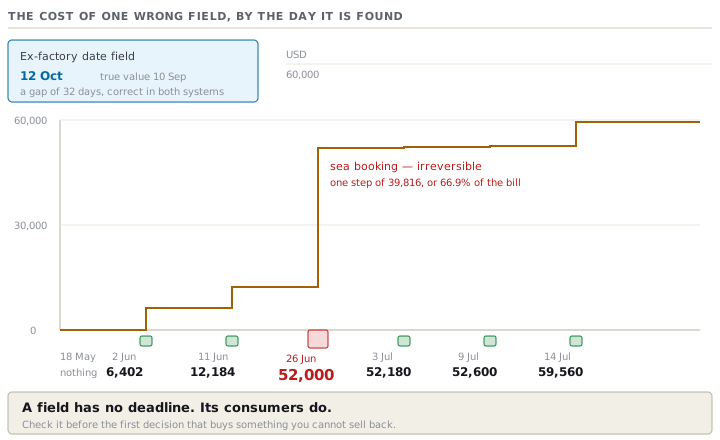
The cost is a step, not a curve
Now the part that changes how you work. It is not in any textbook, because it needs the dates as well as the amounts.
Line the six decisions up in the order they were taken and read the running total.
| Found on | Decisions already taken | Cost to put right |
|---|---|---|
| 18 May, at PO acceptance | none | nothing at all |
| 5 June | 1 | USD 6,402.00 |
| 15 June | 2 | USD 12,184.00 |
| 1 July | 3 | USD 52,000.00 |
| 5 July | 4 | USD 52,180.00 |
| 10 July | 5 | USD 52,600.00 |
| 3 August, when it was found | 6 | USD 59,560.00 |
You expect an error to get steadily more expensive the longer it lives. It does not. It sat under USD 12,200.00 for five weeks. Then on 26 June it jumped by USD 39,816.00 in a single afternoon. That one decision is 66.9% of the entire bill, and all it did was buy space on a ship.
Everything before that decision was a booking that could be moved. The freight decision was the first one that turned the wrong date into something the outside world had already sold to somebody else. After that the only remedy left was a faster ship, which does not exist. So the remedy was an aeroplane.
A field does not have a deadline. Its consumers do. For every field you rely on, there is one decision downstream that turns it into a commitment you cannot take back. The date of that decision is your real deadline for checking the field. Everything after it is damage control. Everything before it is free.
Once Rowaida saw this table, her second question was the right one. Which of her fields have an irreversible consumer, and when does it fire? On this order there were four: the freight booking, the fabric colour approval, the carton mark artwork and the final inspection call. None of them had ever been written down.
The four minutes
Nasseef costs a merchandiser's time at USD 9.60 an hour. On 18 May, asking Clare Halloran one question would have taken about four minutes. Your 12 October: is that the day it leaves us, or the day it lands with you? Four minutes is USD 0.64.
USD 59,560.00 divided by USD 0.64 is 93,063.
That ratio is not a flourish, and it is not really about this order. It is what the fan-out does to any prevention cost. The cheap act happens before any consumer exists. The expensive act happens after all of them do. The value of asking a question about a field falls very fast, from the moment somebody else starts using the answer.
Prompt · Find the fan-out before you correct it
The moment you discover a wrong value in a field somebody else has already read.
I have found a wrong value in a field on a live order and I have not corrected it yet. Before I touch it, help me map what has already been decided from it.

I will tell you the field, the wrong value, the correct value, the date the wrong value was entered and today's date. Ask me for the order's stage if you need it.

Give me back a list of every decision in a garment factory and its buyer's office that would plausibly have been taken from that field between those two dates. For each one, tell me: who takes it, roughly when it would have been taken, and whether reversing it is free, costs money, or is impossible because something has been bought from a third party.

Then mark the FIRST decision in that list that is irreversible, and say what date it would have fired. That date, not today, was my real deadline for checking this field, and I want it stated plainly.

Finally, give me two short lists: the people I have to go and speak to today in the order I should speak to them, and the three things I should write onto the record before I change the value — what it held, what it now holds, and who says so — so that in four months anybody can see why the decisions taken from the old value were reasonable at the time.
AI can make mistakes — check anything you act on.
Check yourselfYou find a wrong value in a field this morning. Before you correct it, what is the first thing to establish?Show the answer
Who has already used it, and whether any of them has bought something. Correcting the field takes seconds and changes nothing that has already been decided from it. The work, and all of the cost, is in the decisions downstream, and some of those may now be irreversible. List the consumers before you touch the value. The moment you correct it you lose the ability to ask what this field said when the booking was made, and that is the question every one of those people is about to ask you.