Lessons · Lesson 4 of 5
From when? The three answers nobody chose between
Price the three legitimate meanings of an effectivity date, and see why the one most factories actually mean can be expressed by neither system.
Lesson 4 of 5 · 24 min
A question with three correct answers
Go back to 3 January and Wildersmoor's change to the content-and-care label. Lesson 2 followed what happened to the stock balance. This lesson goes back to the decision that was never made.
The instruction was clear. The new wording is required on goods shipped on or after 1 April. On 10 January, Meranti held 41,200 old labels at USD 0.041, and had three orders in front of it.
| Order | Pieces | Ships |
|---|---|---|
| Larkfall, delivery 1 | 17,700 | 22 March |
| Larkfall, delivery 2 | 6,900 | 19 April |
| Hartsop gilet | 22,400 | 8 May |
| Total | 47,000 |
From when does the change apply? There are three answers. Real factories use all three, and all three can be defended.
- By ship date. Anything leaving on or after 1 April carries the new label. This is the buyer's own wording, read literally.
- By order. The change applies from the next order raised. Orders already in flight run as they were specified.
- By stock. Use the old labels up, then start the new ones.
Nobody at Meranti chose. The picking list issues the oldest stock first, so the third rule was applied by default, by software, on behalf of nobody. Sit with that for a moment. An effectivity rule with real money and a compliance exposure attached to it was chosen by a warehouse convention that exists for a completely unrelated reason.
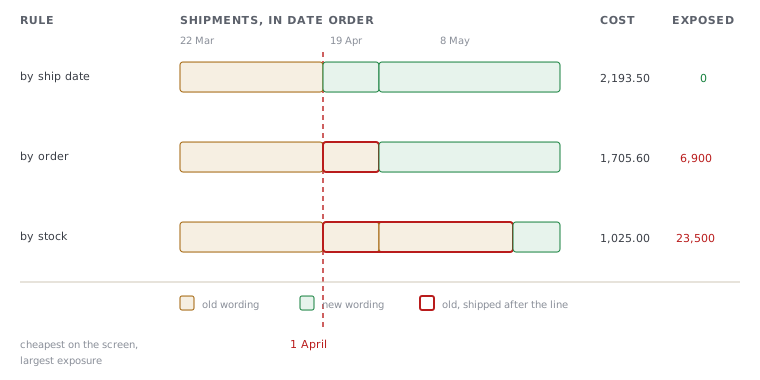
Price all three
| Old labels used | New labels bought | Write-off | Visible cost, USD | Garments shipping after 1 April on old wording | |
|---|---|---|---|---|---|
| By ship date | 17,700 | 30,000 at USD 0.041 | 23,500 at USD 0.041 | 2,193.50 | 0 |
| By order | 24,600 | 25,000 at USD 0.041 | 16,600 at USD 0.041 | 1,705.60 | 6,900 |
| By stock | 41,200 | 25,000 at USD 0.041 | None | 1,025.00 | 23,500 |
Vantry Trims sells this label in multiples of 5,000, with a minimum of 25,000. That is why the middle and bottom rows both buy 25,000. The by-stock rule needs only 5,800, and it cannot buy 5,800.
Now read the last two columns together, because they are the lesson.
The visible ranking is the exact reverse of the true one. By stock is the cheapest thing on the screen, and it leaves 23,500 garments carrying superseded wording past the buyer's date. By ship date is the most expensive on the screen, and it leaves none. A finance review that sees only the fifth column will choose the bottom row every time. It will be choosing the largest exposure in the table while believing it has saved USD 1,168.50.
Put a number on that exposure. Use Meranti's own re-labelling rate from lesson 2: USD 0.1968 of labour and USD 0.041 of label a garment, plus USD 550.00 for each re-inspection visit.
- By stock, if it is found on both shipments: 23,500 garments, USD 6,688.30. True cost USD 7,713.30, which is 3.52 times the rule that looked most expensive.
- By order, if it is found: 6,900 garments, USD 2,190.82. That is the number lesson 2 actually paid.
And that is only the arithmetic of being caught. The by-stock rule also splits a single shipment down the middle: 16,600 old and 5,800 new labels inside one 8 May delivery. That is the version of this that costs a buyer's confidence rather than a buyer's money.
The rule everybody means is the one neither system can hold
Ask a merchandiser what they mean by an effectivity date. Most of them describe the middle row: this change starts with the next order, and what is already in production runs as it was bought. That rule matches how the commercial world actually works, because an order is the unit a buyer and a factory have both agreed to.
Now try to express it.
- The definitions system can say from 1 April or from revision C. It is built around dates and versions. It has no idea what an order is, because it has never met one. It cannot say "from the next order", because it holds no orders.
- The commitments system knows every order intimately, and has nowhere to write a change to a definition. What it has is a picking rule. That produces the by-stock answer as a side effect of how a store is emptied.
So the two available answers are the two nobody means. The one everybody means needs a link between a change in one system and a commitment in the other. That link is the seam. It is the same missing thing as lesson 3's missing revision stamp, arriving from the other direction.
| Rule | Expressible in the definitions system | Expressible in the commitments system |
|---|---|---|
| By ship date | Yes, natively | Only as a manual instruction |
| By stock | No | Yes, as the default consequence of picking |
| By order | No. It holds no orders | No. It holds no changes |
What to do on Monday
The fix is not software, and it is smaller than the problem.
- Make somebody choose, and write the choice on the change. A change request that arrives without an effectivity rule is incomplete, in the same way a purchase order without a price is incomplete. One line: by ship date, by order, or by stock, with a name against it.
- Where the rule is not by-stock, break the picking default physically. Lesson 2 ended with a store keeper who knew which boxes held which labels. Make exactly that official: a separate location, a separate bin card, and a note on the material issue. It costs a morning, and it beats an interface, because it works during the six months before anybody funds one.
- Price the exposure column before the meeting, not after. Nobody at Meranti was arguing in bad faith. They were arguing about the only column that had been drawn.
Check yourselfYour buyer's change says from 1 April. Your systems can express it as a date and your store empties oldest-first. What is the single cheapest control?Show the answer
Separate the superseded stock physically, and issue the new material from a different location. That converts the default rule from by-stock to by-ship-date, without changing an item code, an interface or a report. It puts the distinction in the one place that can actually hold it, which is the shelf. It also fails loudly instead of silently. A picker who finds an empty location asks a question. A picker taking the older of two identical-looking boxes does not.