Lessons · Lesson 3 of 5
The seam: the day a specification becomes an order
Follow one handover from bill of materials to purchase order, price what it cost when a fact arrived after the copy was taken, and build the control that catches it.
Lesson 3 of 5 · 26 min
The handover is a moment, not a link
In every order there is one instant when a description turns into a debt. Somebody runs a material requirement against a bill of materials and a quantity. What comes out the other side is a purchase order with a supplier's name on it.
That instant does three things to the data. All three lose information.
| Conversion | What goes in | What comes out | What is lost |
|---|---|---|---|
| Per garment becomes a total | 1.86 m a piece | 48,500 m | The multiplier, the allowance and the rounding leave no trace |
| A definition becomes an item | Fabric at tech-pack revision C | Item code, no revision | Which version of the spec this order was bought against |
| A provisional value becomes a commitment | An assumed price and lead time | An agreed price and a promised date | That some of it was a guess |
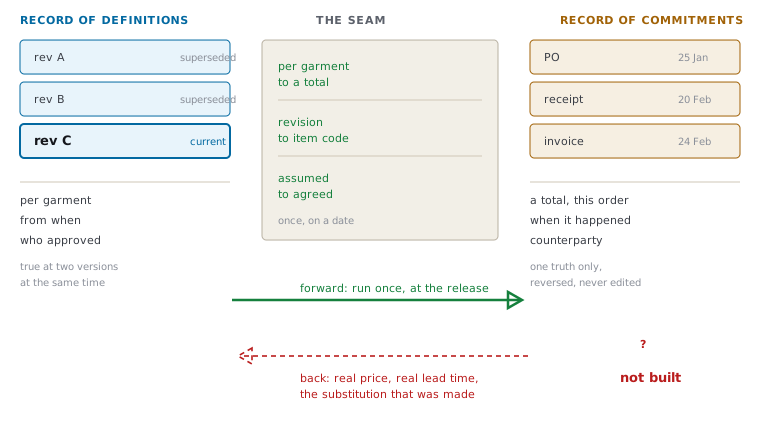
Notice what the drawing does not contain: an arrow back. The forward copy runs once, on a date. Everything the order goes on to learn stays where it happened. The real price, the real lead time, the substitution that had to be made: none of it travels back. Lesson 5 is about that missing arrow. This lesson is about the forward one being taken at the wrong instant.
Eleven days
Here is what happened on order WM-8814. Read the last column first: nobody did anything wrong.
| Date | What happened | Where it was recorded | Was it correct? |
|---|---|---|---|
| 9 Jan | Fit session on proto 2. Body length up by 2.5 cm, back yoke added | Definitions, approved and dated | Yes. That is what a fit session is for |
| 14 Jan | Pattern amended, marker re-planned at 148 cm. New marker gives 1.94 m | Pattern room, in the marker plan | Yes |
| 16 Jan | Tech pack released at revision C, with the yoke and the new measurements | Definitions | Yes |
| 25 Jan | Material requirement run against the released bill of materials | Commitments, as purchase order FB-3391 | Yes. You run it against the released revision |
| 25 Jan | 48,500 m ordered from Amberdene Mills at USD 3.42 | Commitments | Yes. The arithmetic on the number in front of him was right |
| 2 Mar | Cut plan drawn from the current marker. It needs 2.037 m a piece | Neither | The first moment anybody could see it |
Revision C describes the Larkfall completely and correctly, except in one respect. Its bill of materials still says the cloth consumption is 1.86 m. That is because consumption is not a description of the garment at all. It is an output of the marker. It is calculated in the pattern room and typed into the specification by hand.
That is the diagnosis, and it goes well beyond fabric. A derived value stored as if it were a definition, with no link to the thing it came from, will go stale silently. It will do so at exactly the moments when everything else is being updated properly. Chaminda Silva ran the requirement on 25 January. He was eleven days downstream of the marker that made his number wrong, and nothing on his screen could have told him.
What eleven days cost
At 1.94 m net, plus Meranti's 5% cutting allowance, a Larkfall needs 2.037 m of cloth. The order needs 24,600 of them: 50,110.2 m. The purchase order was for 48,500 m.
The first 23,809 pieces came out of the original dye lot. The cloth for the remaining 791 did not exist.
Amberdene's minimum dye lot is 3,000 m. So the shortfall of 1,610.2 m had to be bought as 3,000 m, and it had to fly to hold the ship date. Now price it honestly. That means separating what this mistake cost from what Meranti was always going to spend.
Had the consumption been right on 25 January, the purchase order would have been for 50,500 m in one lot. Instead it was 48,500 m plus 3,000 m: 51,500 m. So the surplus cloth caused by the error is 1,000 m. It is not the 1,389.8 m left over at the end. Most of that was ordinary rounding, and it would have happened anyway.
| Line | Working | USD |
|---|---|---|
| Surplus cloth caused by the split buy | 1,000 m at USD 3.42, in a buyer-exclusive yarn-dyed check | 3,420.00 |
| Air-freight premium on the second lot | 932.4 kg at USD 4.10 rather than USD 0.34 by sea | 3,505.82 |
| Lot-segregated handling | 791 pieces at 0.9 minutes, plus 0.06 minutes across the order, at USD 0.082 | 179.41 |
| Chasing it | 26 hours across three people at USD 9.40 loaded | 244.40 |
| Total | 7,349.63 |
Meranti's contribution on WM-8814 is USD 40,776.96. So the eleven days took 18.0% of it. Every rate above is Meranti's own: its air and sea quotations for that week, its costed minute, its office hour. They are not rates to reuse.
Two things about that table are worth more than the total.
The line everybody panics about is the smallest. A second dye lot means a shade difference, and shade is what makes a merchandiser's stomach turn over. It cost USD 179.41, which is 2.4% of the total. Bethan Coyle approved the second lot as a within-band variation, on one condition: whole garments had to come from one lot. The factory could do that with bundle control.
The unpriced risk was the whole order. She was not obliged to approve it. Had she refused, Meranti could either short-ship 791 pieces or re-dye. Either one is an order-sized number, not a five-figure one. That risk cannot be priced honestly, so it is not in the table. But a control that costs three hundred dollars is being justified against a risk that was never really USD 7,349.63.
The control, and what it costs
After a week like this, the instinct is to ask for the two systems to be integrated. That is the expensive answer, and it does not solve this problem. A live interface copying the same wrong consumption figure faster would have produced the identical purchase order on the same day.
What was missing is smaller. The requisition did not record which revision it was run from.
Two changes, both inside systems Meranti already owned:
- Every requisition and purchase order stores the bill-of-materials revision it was calculated against. One field, filled automatically.
- When a pattern or marker change is approved, the definitions system lists every open requisition and purchase order raised against an earlier revision, and puts them in front of a named person.
Dilan Perera built both in 14 hours, at USD 21.50 an hour: USD 301.00, once. Against the USD 7,349.63 this one order lost, that pays back 24.4 times over in a single season. The more useful part is not the ratio. It is the date. The flag would have appeared on 16 January, when the fix was to add 2,000 m to a purchase order that had not yet been confirmed, at no premium of any kind.
Prompt · Audit one handover from bill of materials to purchase order
Before a material purchase order is confirmed, and every time a purchase turns out to have been made against a superseded specification.
Act as a sourcing manager who has been burned by a stale consumption figure, and who now audits the handover rather than the arithmetic. I want one purchase examined. Facts: style and order [CODES], order quantity [NUMBER], the material [DESCRIBE IT], the consumption figure used and where it came from [PASTE IT AND SAY WHO TYPED IT], the wastage or cutting allowance applied and who owns that rule [NUMBER AND NAME], any rounding to a supplier's pack, roll, lot or minimum [DESCRIBE IT], the specification revision current on the day the requisition ran [NUMBER AND DATE], and every approved change to the pattern, marker, construction or measurements in the ninety days before that date [LIST THEM WITH DATES]. Do the following. First, rebuild the ordered quantity from the consumption figure, step by step. Show the multiplication, the allowance and the rounding as three separate lines. Then tell me which of those three lines is recorded in a system, and which exists only in somebody's habit. Second, place every approved change on a timeline against the date the requisition ran, and flag any change that landed before it whose effect on consumption was never re-derived. Third, where a gap exists, quantify it in the material's own units and then in money. Separate what the factory would have spent anyway from what the gap actually costs. Show both figures and label them. Fourth, price the recovery honestly: the extra material at the supplier's minimum, the freight premium if the date must be held, any handling caused by a second lot, and the hours spent chasing it. Fifth, name any risk you cannot price and say why, rather than leaving it out. Sixth, tell me the earliest moment at which this was knowable, and what would have had to exist for somebody to know it. Do not propose an integration.
AI can make mistakes — check anything you act on.
Check yourselfWould a real-time integration between the two systems have prevented this?Show the answer
No, and that is the point worth carrying away. The consumption figure in the released bill of materials was wrong, and an interface copies what it is given. Copying a stale value faster produces the same purchase order on the same day, with more confidence attached to it. The defect was not latency. It was that a derived value had gone stale, and nothing pointed from it back to the thing it came from. Integration projects are often sold against symptoms of this shape, which is why the diagnosis has to come first.