Lessons · Lesson 4 of 5
The month that moved without any work moving
Choose a reporting period's date basis and declare it, and price what the boundary itself costs once people start working towards it.
Lesson 4 of 5 · 20 min
Three Marches
Velanthur's March shipment plan was 148,000 pieces. Anitha Kaverin, the planning manager, was asked at the April review why the month had missed. She had already been asked the week before why it had hit.
Both questions were about the same eleven containers.
| Consignment | Pieces | Left the factory | On board | Invoiced |
|---|---|---|---|---|
| C1 | 12,600 | 27 March | 30 March | 28 March |
| C2 | 9,400 | 29 March | 2 April | 30 March |
| C3 | 14,800 | 30 March | 4 April | 31 March |
| C4 | 7,200 | 31 March | 3 April | 2 April |
| C5 | 11,300 | 31 March | 6 April | 4 April |
| C6 | 6,900 | 1 April | 5 April | 3 April |
| C7 | 10,500 | 2 April | 8 April | 6 April |
| C8 | 8,800 | 24 March | 27 March | 26 March |
| C9 | 5,600 | 26 March | 29 March | 31 March |
| C10 | 13,100 | 28 March | 31 March | 1 April |
| C11 | 4,900 | 3 April | 7 April | 9 April |
Everything else Velanthur shipped that March — 65,200 pieces, gone before the twenty-fourth — falls in March on any basis anybody uses. So the month is 65,200 plus whichever of the eleven you count. And which of the eleven you count depends entirely on which date you decided a shipment happens on.
| The month is measured on | March pieces | Against a plan of 148,000 |
|---|---|---|
| The date the goods left the factory | 148,000 | 100.0% |
| The date the goods were on board | 105,300 | 71.1% |
| The date the invoice was raised | 116,400 | 78.6% |
A swing of 42,700 pieces, and 28.9 points of plan, from eleven containers that were exactly where they were. No garment moved. No date changed. Nobody made a decision. Three teams inside one company reported three different Marches, and each of them was right.
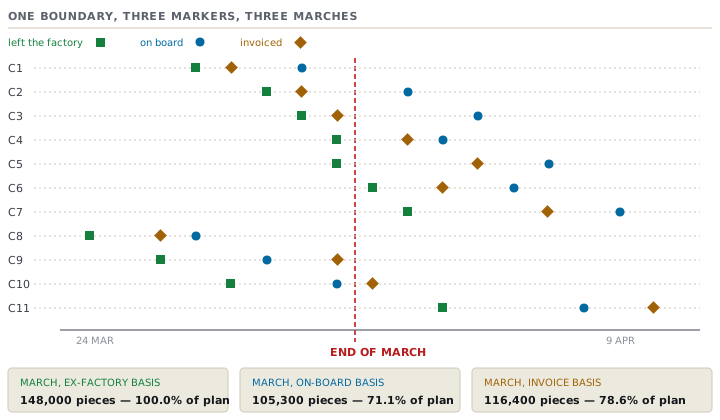
None of the three is wrong, and that is the problem
The temptation is to declare one basis correct. Do not. The three answer different questions.
- What did the factory produce and get out of the gate? The ex-factory date. It is the only basis that measures the plant, and it is the one a production bonus belongs on.
- Did the buyer get what it was promised? The on-board date. That is the date the buyer's own system holds, and the date its terms are written against. Course 12.1 owns the documents this date lives on. This course cares only that it is a different day.
- What did the company earn? The invoice date, subject to accounting rules about when control of the goods passes. Those rules follow the delivery terms. Course 8.3 owns them. Do not settle the question in a reporting meeting.
So a company genuinely needs all three. The defect is never that three bases exist. The defect is a page that carries two of them without saying which is which. That is exactly how Anitha came to be asked both questions in eight days.
What the boundary costs once people work towards it
Velanthur's shipping bonus was paid on the ex-factory basis, monthly. That is a defensible choice, because it is the basis that measures the factory. It also creates a cliff at midnight on the last day of the month, and people work towards a cliff.
Measured over twelve months:
- 38.4% of a month's pieces left the factory in the last five working days. An even month would put 23.8% there.
- Those five days carried an average of 2,180 overtime hours, against 1,040 for the other sixteen working days combined.
- Final inspection failed 6.4% of lots presented in those five days, against 2.1% in the rest of the month.
Two costs come out of that, and only one of them is the obvious one.
Overtime. In the three months of the year where a public holiday forced a level run, the same output needed about 1,960 overtime hours in total. Against the usual 3,220, the push costs roughly 1,260 hours a month at a premium of USD 0.62 an hour: USD 781.20 a month, USD 9,374.40 a year.
Quality. Velanthur presented 412 lots for final inspection over the year, 158 of them in the last five working days of a month. At the rates above, that is 10 failures in the push and 5 in the rest. At the ordinary rate those 158 lots would have produced 3. Seven extra failed lots a year, each costing USD 2,840 in full sorting and re-presentation: USD 19,880.
USD 29,254.40 a year, and the year's output is exactly the same. That is the sentence to keep. The boundary does not make or lose a single garment. It rearranges when garments are made, and it charges for the rearrangement.
Why it never breaks, which is worse than if it did
You would expect a monthly pull-forward to compound. March borrows from April, so April starts short and has to borrow harder from May.
It does not. It settles. Velanthur's last-five-days share sat between 36% and 41% for four years running, because the push is limited by how much work can physically be pulled forward. Once it reaches that limit, the factory simply lives there.
That is worse than compounding, because nothing ever breaks and so nothing is ever investigated. A cost that explodes gets a project. A cost that sits still for four years gets a budget line and a shrug. The overtime was in the accounts every month of those four years, correctly coded, and nobody had ever asked what it was for.
The repair: report on a period that has no cliff
Velanthur did two things, and only the second one was hard.
One line on every page. Every report carrying a period now names its basis in the header: shipments, ex-factory basis. It costs nothing, it took an afternoon, and it ended the kind of argument Anitha had been having for years.
The bonus moved to a rolling thirteen weeks. A rolling window moves forward by one week at a time, so there is no midnight to push towards. Pulling a container into this week pulls it out of the window in thirteen weeks' time, so the pull earns almost nothing. The calendar month stayed in the pack as a comparison, because auditors, buyers and the finance team all need it.
The effect on the reporting itself is worth seeing, because it is the argument that persuaded Kemal:
- On the calendar-month basis, the twelve months ran from 71.1% to 118.4% of plan, a range of 47.3 points, almost all of it boundary.
- On the rolling thirteen-week basis, the same twelve months ran from 94.2% to 105.6%, a range of 11.4 points.
The trend survived. The noise did not. And two quarters after the bonus moved, the share of pieces leaving in the last five working days fell from 38.4% to 27.9%, which is close to the 23.8% an even month would give.
Check yourselfYour factory hits its shipment plan every month by a small margin, and the last week of every month is chaos. What is the cheapest thing to measure?Show the answer
The share of the month's pieces that leave in the final five working days, over twelve months, against the share an even month would give. It is one query, it needs no new data, and it turns a thing everybody already knows into a number with a comparison attached. Then put the overtime hours and the inspection failures for those same days beside it. Those are what the pattern actually costs, and neither is visible in the shipment report.