Lessons · Lesson 2 of 6
The traceability file, tier by tier
Build the evidence file for one order hop by hop, check it by weight, and find the exact place the chain stops being able to answer.
Lesson 2 of 6 · 18 min
Five hops, and only one of them has a contract in it
A traceability file is not a folder of certificates. It is a chain of records. Each link is tied to the next by a quantity, a date and a document number. That way a stranger can walk from the container back to the field without taking anybody's word for it.
PO TOL-9145 has five hops. Tolbury has a contract with exactly one of them.
| Hop | Party | The record that ties it to this order | Who holds it |
|---|---|---|---|
| Garment | Bahnasa Knitwear, Menouf | Cutting tickets and sewing output by PO and shipment | Your supplier |
| Fabric | Mirsal Textiles, Ashmoun | Knitting and dyeing batch cards, delivery notes to Bahnasa | Their supplier |
| Yarn | Rashwan Spinning, Kafr Dawoud | Yarn issue records by count and delivery date | Their supplier's supplier |
| Fibre | Corven Fibre Trading and one grower group | Purchase contracts, weight notes, gin records | Nobody you can telephone |
| Field | Unknown | Grower or gin declarations tied to a purchase parcel | Nobody |
Read the right-hand column again. Almost all the evidence you are asked for is held by parties you cannot instruct and cannot audit. Two of them you cannot even name. That is not a failure of your sourcing. It is the ordinary structure of a cotton supply chain. It is also why this subject is hard rather than just tedious.
The spine of the file is a weight, not a signature
Every hop in a textile chain turns one weight into another at a known rate. That is what lets somebody who was not there check the file. It is the single most useful idea in this course.
Start at the garment and work back.
- TQ-318 weighs 0.205 kg finished.
- Cutting waste on this marker runs 14%. A marker is the cutting plan laid out on the fabric. So each piece takes 0.238 kg of fabric.
- Knitting and dyeing lose about 5% between yarn and finished fabric. So each piece takes 0.250 kg of yarn.
- The order is 38,400 pieces. So it takes 9,600 kg of yarn. The detained container alone is 3,200 kg.
- Rashwan turns lint into yarn at 78.0%. Lint is the ginned cotton fibre before spinning. So 9,600 kg of yarn came from 12,308 kg of raw cotton.
Nothing in that chain is a matter of opinion. Each rate sits on somebody's own records, and each one can be checked against them. It also gives you the number the rest of the file has to reach: 12,308 kg. If the fibre purchase contracts behind this order do not account for that weight, the file has a hole in it. The size of the hole is arithmetic, not argument.
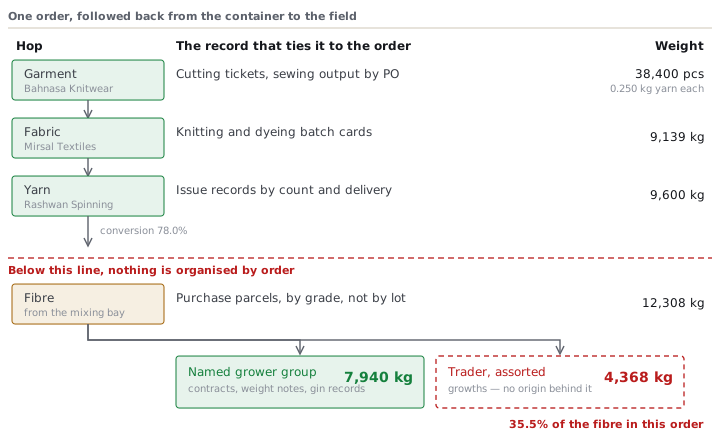
Where TOL-9145 went dark
Rashwan spun the yarn for TOL-9145 in week 14, on two machines, against a mill order for a single count. Its records show the yarn issued, the count, the dates and the delivery notes to Mirsal. Those tie cleanly.
The fibre behind it does not. Rashwan draws from a mixing bay, and the bay is refilled from whatever bales are in store. A spinner's store is organised by grade and count, not by lot. That is what a spinning plant needs to know to run consistently. The bales that fed week 14 came from two purchase parcels:
- 7,940 kg from a grower group Rashwan has bought from directly for six years, with contracts, weight notes and gin records that name the fields.
- 4,368 kg bought through Corven Fibre Trading. The contract describes the goods as assorted growths. That is a normal, lawful commercial term. It means the trader has pooled lots and is selling to a grade rather than to an origin.
7,940 plus 4,368 is 12,308. The arithmetic reconciles perfectly. And 35.5% of the fibre in this order has no origin behind it that anybody can name. The file proves that as rigorously as it proves everything else.
What makes a record evidence rather than paper
Three properties. A document missing any one of them is decoration.
- Made at the time. Written on the day, for an operational reason, by the person doing the work. A batch card written that day beats a summary written for you later. The person writing it was not thinking about you, and that is the point.
- Granular to the lot. It names a quantity, a date and an identifier that also appears on the record either side of it. A statement about a year, a site or a normal practice cannot be tied to your order. So it cannot support a claim about your order.
- Reconcilable. The weights and quantities across the hops add up, within a stated tolerance for moisture and waste. This is what lets a stranger check the file without trusting anybody in it. It is also the property most often missing.
The clock: after, against before
Ines started assembling this file on the day of the hold. Here is what it took.
| After the hold | Before shipment | |
|---|---|---|
| Getting the supplier to understand the question | 6 days | Part of onboarding |
| Mill batch cards for the relevant lots | 4 days | Issued with each delivery |
| Spinner's issue records | 9 days | Issued with each delivery |
| Fibre purchase contracts | 11 days, and incomplete | Requested at contract |
| Reconciling and writing the response | 4 days | Half a day per order |
| Elapsed | 34 days | 46 hours across the order |
Same documents. Same people. Same goodwill. The difference is what you are asking for. Afterwards you are asking four companies to interrupt production for a problem that is not theirs. Beforehand you are asking them to hand over a copy of something they are printing anyway.
Prompt · Build the evidence file for one order, tier by tier
Before you need it. Take one order that has already shipped, and see how far back you can actually get, in writing, in one working day.
Act as a supply chain traceability analyst working for me, not for my supplier. I want to build an evidence file for ONE order and find out where it stops being able to answer. Order facts: buyer [BUYER], supplier [FACTORY AND TOWN], PO [NUMBER], style [CODE], garment [DESCRIBE IT], fibre content by weight [PERCENTAGES], quantity [PIECES], finished garment weight [KG], cutting waste [PERCENT], fabric supplier [MILL], yarn supplier if known [SPINNER], fibre source if known [WHO]. Do the following in order. First, list every hop between the container and the field for this product. For each hop, name the SPECIFIC operational record that would tie it to this PO. Not a certificate: an operational record. Say who physically holds it. Second, work the weights backwards from the finished garment to the raw fibre using my figures. Show each conversion and each loss rate, and give me the total raw fibre weight the order must account for. Third, tell me which of those records I have a contractual right to and which I do not. For the ones I do not, tell me what route exists to get them. Fourth, ask me, one at a time, whether each record exists and whether it is granular to a lot or only to a period. Stop after each answer. Fifth, when we finish, write a one-page statement of what the file can prove, what it cannot, and the exact size of the gap in kilograms and as a percentage. Do not fill any gap with a supplier declaration or a certificate, and tell me plainly when I try to.
AI can make mistakes — check anything you act on.
Check yourselfA supplier sends you a fibre-origin declaration covering the calendar year, signed by the mill's managing director. What can you do with it?Show the answer
File it, and treat it as an assertion about the mill's normal buying. It is not evidence about your order. It fails the granularity test: it names a period, not a lot, so nothing ties it to the yarn in your container. It is still worth having. A supplier willing to sign it will usually also hand over the batch cards underneath it. But on its own it cannot be reconciled to a weight, and a claim that cannot be reconciled to a weight is one a border can set aside without arguing with anybody.