Lessons · Lesson 3 of 6
What a hold costs, and what preventing one costs
Price one detained container line by line, find the day the expensive part stops being controllable, and compare it with the cost of building the file in advance.
Lesson 3 of 6 · 18 min
The bill for thirty-four days
The container was held on 2 May and released on 5 June: 34 days. Every figure below is Selvig Logistics' own quoted tariff, Tolbury's own broker rate and Tolbury's own cost of money. They are not market rates. They are not anybody else's rates. The point of showing them is the shape of the bill, not the size of it.
| Line | How it is charged | Amount |
|---|---|---|
| Terminal storage | 5 days free, then 145 a day to day 15, then 290 | 6,960.00 |
| Carrier container detention | 7 days free, then 95 a day | 2,565.00 |
| Examination, transfer to a bonded facility, unstuff and restuff | Quoted per movement | 3,180.00 |
| Broker's charge for the response | 36 hours at 150 | 5,400.00 |
| Cost of money on goods already paid for | 8.5% a year on 82,176 for 34 days | 650.65 |
| Tolbury's and the mill's own time | 176 hours at 34 | 5,984.00 |
| Direct cost of the hold | 24,739.65 |
That is the bill people expect. It is not the bill.
The season is the expensive line, and it is not on the invoice
TQ-318 was a spring option, planned to sell from mid-April. It was released on 5 June. The container reached the shops seven weeks into a nine-week window.
Tolbury planned to sell 78% of these 12,800 pieces at a full retail price of 24.00, and clear the rest at 12.00. Arriving in June, it sold 31% at full price.
| On plan | Released 5 June | |
|---|---|---|
| Pieces at full price | 9,984 | 3,968 |
| Pieces cleared | 2,816 | 8,832 |
| Revenue | 273,408.00 | 201,216.00 |
72,192.00 of revenue, gone. Nobody invoices for it. No line on the customs file mentions it. That is exactly why it gets left out of the argument about whether traceability is worth the trouble.
Put the two halves together.
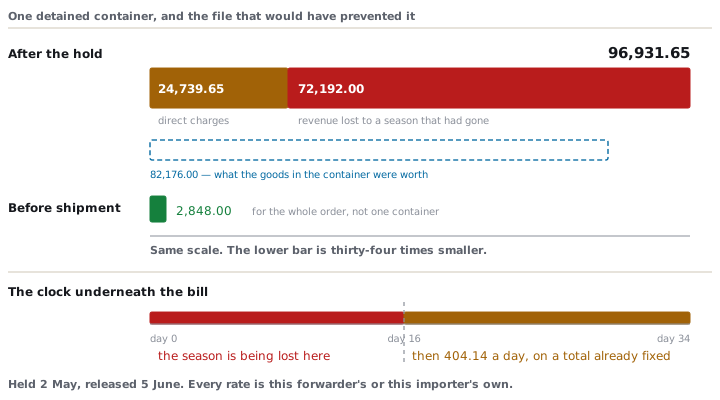
Direct cost 24,739.65 plus lost revenue 72,192.00 is 96,931.65. The goods in the container were worth 82,176.00 FOB. The hold cost 118.0% of the value of what was in the box. That is 7.5728 a garment, on a garment that cost 6.42 to buy.
The day the expensive part stopped being controllable
Here is the decision this lesson exists for. It is not the one people reach for.
From day 16, waiting costs 385.00 a day in storage and equipment, plus 19.14 a day in financing. That is 404.14 a day. It is the number a manager stares at, and the number that generates the phone calls. By the middle of the hold it is also nearly irrelevant.
The season loss was fixed long before. Once the release date was going to fall past the middle of May, the full-price window was gone whatever happened next. 72,192.00 of the 96,931.65 was already spent. From that point the only live question is 404.14 a day against the value of eventually getting the goods at all. That value is real. It is also small change beside a number that stopped moving three weeks earlier.
The rule generalises: in a hold, the controllable money runs out early, and the largest cost is set by a date you cannot negotiate. So the decision that matters is taken before the goods ship. And the useful question on day 3 is not how do we get it out faster. It is will this clear before the season does, and if not, what else do we do with these garments.
What the same file cost before shipment
While the second container sat, the third had not yet sailed. Tolbury held it at Alexandria at Selvig's quoted 62.00 a day for 21 days, which is 1,302.00. It used the time to build the file properly. That container cleared in normal time.
Building it properly, for the whole order, cost this:
| Line | Amount |
|---|---|
| Rashwan's quoted premium to segregate and record identified lots, at 0.09 a kg on 9,600 kg | 864.00 |
| Mirsal's one-off charge for batch cards written against the PO | 420.00 |
| Tolbury's own time, 46 hours at 34 | 1,564.00 |
| Total, for 38,400 pieces | 2,848.00 |
2,848.00 against 96,931.65. The hold cost 34 times what preventing it cost. Per garment, prevention is 0.0742, or seven and a half cents on a 6.42 FOB. Of that, the part you have to negotiate with suppliers rather than simply do is 0.0334 a piece, which is 0.52% of FOB.
Say it that way to a sourcing director and the conversation is short. Say we should improve traceability and it runs for two years.
Prompt · The first two days of a hold
When a shipment has been stopped and everyone is on the telephone. It sorts the questions that decide the money from the ones that only feel urgent.
Act as an import compliance manager who has handled detentions before. My shipment has been held and I need a plan for the next forty-eight hours, in priority order. Facts: goods [DESCRIBE], quantity [PIECES], value [AMOUNT AND TERM], arrived [DATE], notice received [DATE], what the notice asks for [PASTE OR SUMMARISE], destination market [MARKET], selling window for these goods [DATES], planned full-price sell-through [PERCENT], retail [PRICE], clearance price [PRICE]. My forwarder's tariff: free storage [DAYS], then [RATE] a day, stepping to [RATE] a day after [DAYS]; container detention free [DAYS] then [RATE] a day. My cost of money [PERCENT] a year. Do this. First, tell me the ONE question I must get answered in writing today, and who can answer it, and explain why it outranks the storage clock. Second, model the cost of the hold at three release dates I will give you. Split direct charges from lost margin, and show the arithmetic line by line. Third, tell me the date after which the selling window is lost whatever happens, and what each further day costs after that point. Fourth, list the documents to start collecting now, ordered by how long they take to obtain rather than by how they appear in the notice. Fifth, name the decisions that belong to my merchandiser rather than to me, and what I have to give them to make each one. Be blunt about what is already sunk.
AI can make mistakes — check anything you act on.
Check yourselfA container is held on the first day of a nine-week selling window. Your forwarder offers to move it to a cheaper off-dock yard, saving 120 a day. Take it?Show the answer
Probably, because it is free money. Just do not let it become the project. At 120 a day it is worth about 3,600 over a month. The season loss in this course's example was 72,192.00. The first hour of the response belongs to a different question: will the goods clear in time to sell at full price? The answer decides whether you are running a clearance operation or a customs one. Save the storage as well, by all means. Do not confuse it with the decision.