Lessons · Lesson 3 of 7
- 01 · Two kinds of question, and why the answer sounds the same
- 02 · The four things it did well, measured here
- 03 · The fact nobody wrote down
- 04 · When 95% right is worth less than no answer
- 05 · Ten tasks, sorted by the wrong column
- 06 · Five ways to be confidently wrong
- 07 · The four questions, and what Meskala kept
The fact nobody wrote down
Sort one real week of a merchandiser's questions by where the answer lives, and find why the group no system can reach is also the group that changes decisions.
Lesson 3 of 7 · 16 min
Ninety questions, one week
Lesson 2 showed that these systems answer well when the raw material of the answer is inside what you hand over. That is a statement about tasks. Souad wanted a statement about her factory's work. So she asked Imane to keep a log for one week: every question she was asked, and every question she asked herself and had to go and answer.
Ninety questions in five days. Souad then sorted them by one test only — where does the answer physically live? — into three piles.
| Where the answer lives | Questions | Share | Example from the log |
|---|---|---|---|
| In a document she could hand over | 34 | 37.78% | What ship date does the Kessendal PO give for MT-2280? |
| In a record that exists but is not in any file she can hand over | 21 | 23.33% | Has Tamesna ever delivered a dye lot late? |
| Written down nowhere at all | 35 | 38.89% | Will the Kessendal technologist accept the sleeve as sewn? |
The first pile is where an assistant works today, with no project, no integration and no money. The second is a data-plumbing question. The facts exist, in the purchase-order history and the goods-receipt records, and connecting them is a normal piece of software work with a cost and an owner.
The third pile is the subject of this lesson, and it is bigger than the first.
Three ways for a fact to be unwritten, and only one of them can be fixed
They are not the same problem and they do not have the same answer.
It happened and nobody recorded it. Line 4 ran at an efficiency nobody was happy with on the Tuesday. The reason — the mechanic was away, and a trainee set up the feed-off-the-arm machine — is known to about nine people and written in no system. This kind is recordable: you could decide to record it. Whether you should is a real question with a real cost, and course 24.1 prices exactly that, in the minutes it takes from the person who has to do the recording. Do not assume the answer is yes.
The fact does not exist yet. Nobody knows whether the Kessendal technologist will accept the sleeve, because she has not looked at it. Nobody knows whether Tamesna will ship on the 14th, because Tamesna's planner has not yet decided what to run. No system can retrieve a fact that has not been created, and no improvement in any technology changes that. It is not a limit of the tool. It is a property of the future.
It is recorded where no system can reach. The sealed sample in the cupboard. The marker on the cutting table. The photograph in a supervisor's phone. The sentence a buyer said on a call. This kind fools people, because the fact is recorded — just not in text, not in a system, and often not in a language.
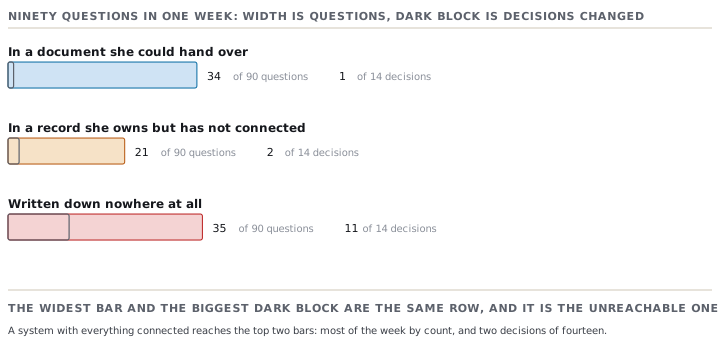
The reversal: the ceiling by count, and the ceiling by consequence
Imane's log had a second column, and it is the one that turned this from an interesting exercise into a decision. Against each question she marked whether the answer changed what anybody did. Most did not. They were confirmations, restatements, "which PO was that again".
Fourteen of the ninety changed something. Here is where those fourteen sat.
| Where the answer lives | Questions | Changed a decision |
|---|---|---|
| In a document she could hand over | 34 | 1 |
| In a record that exists but is not connected | 21 | 2 |
| Written down nowhere at all | 35 | 11 |
Count the ceiling two ways.
By question count, an assistant with no project reaches 37.78% of her week. One with the records connected reaches 61.11%. Those are respectable numbers, and they are the numbers a business case gets written on.
By decisions changed, the same two systems reach 7.14% and 21.43%. And 78.57% of the questions that changed something had no written answer anywhere in the factory.
The two rankings do not just differ in size. They point in opposite directions. The pile that matters most is the one no system can touch. The pile that is easiest to serve is the one that changed almost nothing.
Why this is not bad luck, and what to do with it
It would be comforting to think Imane had an unusual week. She did not, and the reason is structural.
A question is routine precisely because somebody already wrote the answer down. Ship dates, order quantities, colour codes and PO numbers are written down because they recur, and things that recur get forms. A question changes a decision when the situation is new: a supplier behaving unusually, a buyer's tolerance being tested, a machine failing in a way it has not failed before. New situations are, by definition, the ones nobody has yet written anything about.
So the useful conclusion is not "assistants are disappointing". It is this:
The ceiling on what these systems can do for you is set by your records, not by the technology. Everything above the ceiling is a recording decision, and recording decisions are yours.
That changes what to spend money on. It also puts three different things on the table that are usually confused into one.
- Serving the 34 is free today and worth having for what it is: less typing, faster restating, drafts in two languages.
- Serving the 21 is a connection project. You already own the facts. It has a price and it can be bought.
- Serving the 35 is not a purchase at all. It is a decision to record something you do not record, taken one fact at a time, with the cost of recording weighed against the value of having it. Course 24.1 is where that arithmetic is done properly.
Prompt · Sort a week of questions by where the answer lives
After you have logged a week of the questions you were asked and the ones you had to go and answer. This is deliberately a restating task, not a judgement one. You supply the questions and the three buckets, and it does the sorting. Check every row it puts in the first bucket, because that is the bucket it will tend to over-fill.
Below is a list of questions a garment-factory merchandiser had to answer in one week. Sort every question into exactly one of three buckets, and do not invent a fourth.

1. ANSWER IS IN A DOCUMENT — the answer could be read off a document I could hand you (a purchase order, a tech pack, a supplier confirmation, an email).
2. ANSWER IS IN A RECORD I HOLD — the answer exists in a system or a file at the factory (order history, goods receipts, inspection results) but is not in any single document I would hand you.
3. ANSWER IS WRITTEN NOWHERE — the answer is in somebody's head, in a physical object, in a conversation, or it does not exist yet because nobody has decided it.

For each question give: the question, the bucket number, and one short clause saying which document, which record, or whose head. If you are unsure between bucket 1 and bucket 2, choose 2 and say why. Return it as a table, then give me the count and the percentage in each bucket.

Here are the questions:
AI can make mistakes — check anything you act on.
Check yourselfA colleague says: 'give it access to everything and it will answer anything.' Using the log above, what is the strongest reply?Show the answer
Connecting everything Meskala actually holds would move the second pile: 21 questions of 90, and 2 of the 14 that changed a decision. It is worth doing and it is a normal software project. It would not touch the 35 questions whose answers exist in nobody's writing, and that is where 11 of the 14 decision-changing answers were. "Access to everything" means access to everything that was written down, and the log measures how much that is.