Lessons · Lesson 1 of 7
- 01 · Two kinds of question, and why the answer sounds the same
- 02 · The four things it did well, measured here
- 03 · The fact nobody wrote down
- 04 · When 95% right is worth less than no answer
- 05 · Ten tasks, sorted by the wrong column
- 06 · Five ways to be confidently wrong
- 07 · The four questions, and what Meskala kept
Two kinds of question, and why the answer sounds the same
Meet the two kinds of system you will be offered, and the one fact this course is built on: a wrong answer is made the same way as a right one, and it arrives in the same voice.
Lesson 1 of 7 · 14 min
A number that was wrong in the right voice
Meskala Confection makes woven bottoms and workwear in Settat. Six lines, 310 operators. On 4 March its merchandiser, Imane Skalli, was costing a repeat order from Kessendal Stores: 4,800 pairs of MT-2280, a men's cotton-twill work trouser, in one colour, across five sizes.
She had spent a fortnight with an assistant open beside her inbox. It had been genuinely useful. So she asked it what the fabric consumption for MT-2280 was.
It answered 1.33 m a pair. It gave a method too: a fabric width, a marker efficiency, an allowance for shrinkage. (A marker is the cutting plan that shows how the pattern pieces are laid on the cloth.) The arithmetic inside the answer held together. The numbers it quoted did multiply out to the number it gave.
Meskala's own marker for MT-2280 is cut and hanging in the cutting room. It gives 1.42 m.
That is nine centimetres a pair. Across 4,800 pairs it is 432 m of twill. At the 3.85 a metre Tamesna Mills charges, that is 1,663.20. The shortfall was found at spreading, not at costing, so the top-up roll came by express freight for a further 486.80. Call it 2,150.00 for one question, asked in good faith and answered fluently.
Here is the part that matters, and it is not the money.
The wrong answer did not look different from the right ones. It was not vague. It was not hedged. It did not say "approximately" or "you should check". It came in the same voice, at the same length, with the same air of having been worked out, as the forty useful answers Imane had already had that fortnight. The warning sign she was waiting for does not exist.
Everything else in this course follows from that.
Two kinds of system, described without naming anything
This course names no product, no supplier, no model and no version. That is deliberate. A course that named one would be wrong within a year. Worse, a reader would repeat the name in a meeting as though it were a fact about the world. What does not date is the kind of thing, and there are two kinds a merchandiser will meet.
A system that continues text. Give it some writing and it produces the words most likely to follow. It was fitted to an enormous quantity of text to learn what usually follows what. Everything you meet as "an assistant" is this kind, dressed up as a chat. Its aim is a plausible continuation.
A system trained on labelled examples to sort. Show it thousands of examples somebody has already labelled — this image has a stain and this one does not, this line of a document is a delivery date and this one is not — and it learns to put a new example into one of those buckets. Every automated inspection camera and every document-reading tool is this kind.
They are built differently. For our purposes they fail in the same way. Both produce the output that fits the pattern of what they were fitted to. Neither has a separate step where the output is compared against the world.
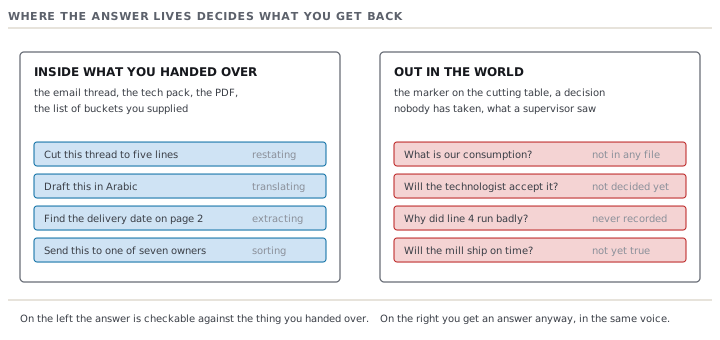
There is no truth step, and that is not a fault waiting to be fixed
When a colleague gives you a wrong answer, you usually get a warning with it. They slow down. They say "I think" or "from memory" or "let me check the file". That signal is real, and you have been reading it your whole working life. That is exactly why it is dangerous here. The signal is missing, and its absence feels like confidence.
It is worth being clear about why. The reason is not that these systems are careless or arrogant. Nothing inside them does the thing you do when you say "hold on, let me look". Fluency is what they are built for. Truth comes along with it, because the text they were fitted to is mostly true. That is why the answers are so often right, and why the wrong ones are wrong in a very particular way. Lesson 6 measures the shapes that wrongness takes at Meskala. The largest group was answers that were true of garment factories in general and false of this one.
Where every number in this course comes from
You are about to read a lot of figures: accuracy rates, catch rates, costs per document. Every one of them is Meskala Confection's own measurement, on Meskala's own documents, in one month, with one tool. They are here because the arithmetic that uses them is what you should take away, and arithmetic needs numbers. They are not a claim about any system anywhere else. The number that matters at your factory is the one you measure at your factory. Lesson 4 shows how small that measurement can be and still settle something. Lesson 7 tells you what Meskala's own measuring cost.
That is also why this course refuses published accuracy figures, benchmark results and supplier claims. Not because they are lies. Because an accuracy figure means nothing without the documents it was measured on, and the documents in the demonstration are never yours.
The two questions that do most of the work
By the end of this course you will apply a four-question test to any proposed use. Two of the four are already visible in the story above. They are the two that remove most bad ideas before any money moves.
- Where does the answer live? The answer to Imane's question sat in a marker file in the cutting room. The system had never seen that file and could not reach it. No amount of improvement to the system changes that. Lesson 3 sorts one week of a merchandiser's real questions by this test alone, and finds that the answer to the useful ones lives in the worst possible place.
- What does a wrong answer cost, and what finds it? The consumption error cost 2,150.00. It was found by a spreader, in the cutting room, three weeks after it was made. A wrong Arabic draft of a supplier chase is found by the supplier's reply the same afternoon, and costs the time to rewrite it. Those two tasks look similar on a list of things an assistant could do. They are not the same decision at all.
Check yourselfImane's assistant was right about forty times that fortnight and wrong once. Why is the ratio the wrong thing to look at?Show the answer
Because the forty right answers and the one wrong answer were not the same size. The right ones saved a few minutes each. The wrong one cost 2,150.00 and went unnoticed for three weeks. A ratio treats every answer as worth the same. The whole of lesson 4 is the arithmetic of what happens when they are not, including the case where a system that is right most of the time is worth less than one you never asked.