Lessons · Lesson 1 of 3
Backwards from the trading date
Build a retail season calendar backwards from the day a customer can buy the thing, and sort the dates the business can move from the ones it cannot.
Lesson 1 of 3 · 40 min
The desk
Most people who make clothes think the deadline is the day the goods leave the factory. For a shop it is not. The real deadline is the day a customer can walk in and buy the thing. By then it needs a price ticket, a window built around it, and an advertisement already running. This lesson builds a season's calendar backwards from that morning. Then it sorts every date into two piles: the ones the business can move, and the ones it cannot.
A buying office above an old bank in Shrewsbury. Ellesmoor is a British clothing retailer. It has 214 stores, and an online business that takes about a third of its unit sales. Its own-brand range is designed, bought and named in this building. Twenty-six suppliers in six countries make it.
One word first, because the same job title means two different things and this track uses one of them. On the supply side, a merchandiser is the person inside a factory who gets the order made. In UK and European retail, a merchandiser is the numbers role: open to buy (the budget a department is allowed to spend), phasing, allocation, and the weekly sales and stock figures. The buyer picks the product. This course sits with both of them, on the retailer's side of the table. When it says the buying office, it means those two people and the director they report to.
The season is SS27, phase 2. That is the spring range that lands after the transitional drop and before summer. Fourteen options. We follow one of them all the way:
- EW-2740, a women's linen-blend shirt dress, 55% linen and 45% viscose
- 18,400 units in three colours: Oyster 7,360, Cornflower 6,440, Slate 4,600. Sizes 8 to 20
- Made by Beykonak Tekstil, Izmir
- Retail GBP 45.00. VAT is 20%, so the net retail is GBP 37.50
- Landed cost GBP 11.25. That is an intake margin of 70.0%, and GBP 26.25 of cash margin a unit
- GBP 483,000 of intake margin on the whole buy
Two of those words matter later. Landed cost is what the dress costs Ellesmoor once it has been paid for and brought into the country. Intake margin is the share of the net retail price that is left over after the landed cost.
A retail calendar has one anchor, and it is not the ship
Course 7.1 builds a critical path from the factory's chair. It anchors on the vessel: on board on a named day at a named port, because the factory's job ends at the ship's rail. Course 27.3 builds one across a whole order book from a brand's chair. It anchors on the distribution centre door, because that is where the brand's job starts. Both are right for what they are doing. Read 7.1 before this one if you have not. It owns the sewing arithmetic, the port cut-offs and the material clock, and this course does not repeat any of it.
A retailer's calendar has a different anchor, and it sits further forward than either of those. It is the trading date: the day a customer can walk into a shop or open an app and buy the garment, with everything the business has spent to make her want it already running. Not the day the goods land. Not the day they are picked. The day they are sellable, with a price ticket, a window, a photograph and a campaign behind them.
Everything else on the calendar is worked out from that one date by subtraction. That is all 47 milestones on Ellesmoor's range plan. So if the trading date is wrong, all 47 are wrong. And each of them looks perfectly correct on its own.
The chain, backwards
Here is Ellesmoor's SS27 phase-2 calendar from the factory gate onwards, as issued in June 2026. It is written the only way it should ever be written: from the end.
| Milestone | Date | Days before trading |
|---|---|---|
| Trading date — campaign live, phase 2 on the floor and on site | Sat 27 Mar 2027 | 0 |
| Stores set and merchandised, in-store complete | Fri 26 Mar 2027 | 1 |
| Store delivery wave begins, 214 stores over five days | Mon 22 Mar 2027 | 5 |
| Available to pick, Lutterworth DC | Mon 15 Mar 2027 | 12 |
| DC goods-in complete: counted, quality-gated, put away | Mon 8 Mar 2027 | 19 |
| Containers delivered to the DC | Tue 2 Mar 2027 | 25 |
| Vessel arrives, Felixstowe | Wed 24 Feb 2027 | 31 |
| Sails, Izmir | Sat 6 Feb 2027 | 49 |
| Ex-factory | Tue 2 Feb 2027 | 53 |
Ex-factory is the day the finished goods leave the factory. DC is the distribution centre, the warehouse that feeds the shops.
Read the bottom row, then read it again. The last stitch goes into EW-2740 fifty-three days before anybody can buy it, and the factory owns none of those fifty-three days. Nineteen of them are inside Ellesmoor's own warehouse and shops. This is the first thing a factory-side merchandiser gets wrong about retail. It is also the first thing a new buyer gets wrong about their own business. The ex-factory date is nowhere near the finish line. A week saved on the sewing floor has to survive fifty-three days of other people's processes before it turns into a week of trading.
The half of the calendar that comes before a purchase order
Beykonak quotes 95 days from a confirmed purchase order to ex-factory. That covers fabric and trims, cut and make, finishing, inspection and packing. Ninety-five days before Tue 2 Feb 2027 is Fri 30 Oct 2026. That is the date on Ellesmoor's calendar for issuing the purchase order.
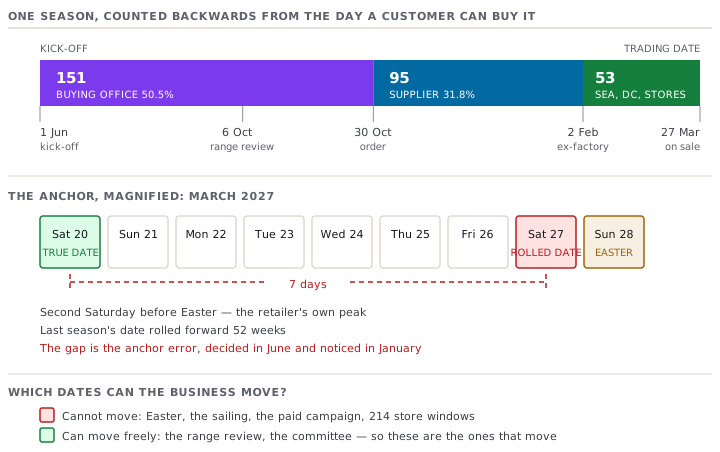
Behind that sits an internal calendar. It begins with the season kick-off on Mon 1 Jun 2026. Lesson 2 counts it milestone by milestone. For now, take the three totals:
| Stretch | Owner | Days | Share |
|---|---|---|---|
| Kick-off to purchase order | The buying office | 151 | 50.5% |
| Purchase order to ex-factory | Beykonak Tekstil | 95 | 31.8% |
| Ex-factory to trading | Sea, port, DC and stores | 53 | 17.7% |
| Kick-off to trading | 299 |
Just over half the season happens before a supplier has been told the order exists.
Which dates can the business actually move
Every calendar has dates on it. Not every date is the same kind of thing. The most useful thing a buyer can do with a range plan is sort it into two piles.
A date is immovable if any one of three things is true of it:
- It is set outside the business. A bank holiday. Easter. A weekly sailing. The school term. You do not negotiate with these. You plan around them.
- It is attached to money already spent. A media booking. A printed catalogue. A photo shoot with a crew and a location.
- A large number of people have to reach it at once. Two hundred and fourteen store teams changing a window on the same night is not a date. It is an operation, and it moves at the speed of a rota.
A date is movable if it lives in one person's diary.
| Date | Set by | Movable? | Cost of moving it |
|---|---|---|---|
| Easter Sunday, 28 Mar 2027 | The church calendar, outside the business | No | Not available at any price |
| The two pre-Easter trading weekends | The customer | No | Not available at any price |
| Campaign live: national press, paid social, 214 store windows | Media booked and paid on 12 Nov 2026 | Inside eight weeks, at a rebooking fee of 15% of the spend | GBP 6,150 |
| Store window change-over | Store operations rota, one crew per region | Only to the next scheduled change-over, three weeks later | GBP 4,494 to send crews out of rota |
| Weekly sailing from Izmir | The carrier's schedule | No. Miss it by an hour and you wait seven days | Seven days |
| DC receiving slot | The DC's own booking diary; peak weeks are blocked | A day or two, never into the blackout | Nothing, up to GBP 2,900 |
| Range review with the buying director | An internal diary | Yes | Nothing |
| Buying committee | Fortnightly, alternate Tuesdays | Yes, but only in steps of fourteen days | Fourteen days |
Read the last two rows against all the rows above them. The only dates this business can move freely are the ones inside it. So those are the ones it moves. Nobody ever moved Easter. Everybody has moved a range review. Lesson 2 is about what that costs.
The anchor that moved itself
Now the part of this lesson that is worth the other thirty-nine minutes.
Ellesmoor's spring phase 2 trades on the second Saturday before Easter Sunday. That is not a superstition. It is the retailer's own measured trading pattern. The two weekends before Easter carry the largest share of full-price spring selling in its year. The range has to be complete, priced and photographed for the first of them.
In 2026, Easter Sunday fell on 5 April. So phase 2 traded on Sat 28 Mar 2026, and it went well.
The SS27 calendar was built in June 2026 the way retail calendars are always built, and the way they should be: by rolling last season's forward 52 weeks. That is the right instinct, and the reason is in this lesson's fact below. A retail calendar is counted in weeks rather than months so that like compares with like. The same number of Saturdays, the same number of paydays, the same trading shape. Rolling a date forward 52 weeks also keeps its day of the week, which is what matters for almost everything on the plan.
Sat 28 Mar 2026 plus 52 weeks is Sat 27 Mar 2027. That is the trading date on every one of the 47 milestones you have just read.
In 2027, Easter Sunday falls on 28 March. The second Saturday before it is Sat 20 Mar 2027.
So the calendar is seven days late against its own anchor, and no one made an error. Easter is a moveable feast. It is the Sunday after the first church full moon on or after 21 March, so it wanders across five weeks of the spring. It moved eight days earlier between 2026 and 2027. A method that is right for every date measured in weeks is wrong for the one date this whole calendar hangs from. And nothing in the process compares the two, because the calendar is checked against last year's calendar rather than against next year's Easter.
Here is the consequence, in June 2026, before a single sample exists. The range will be complete for the second of the two peak weekends and will miss the first. Seven days. Lesson 3 works out the daily cost of this style as GBP 2,484. Seven days at that rate is GBP 17,388 of margin, decided by a spreadsheet formula and noticed by nobody.
Prompt · Re-anchor a season on its trading date
Before you accept a range calendar that was built by rolling last season's forward, and every time a launch is pegged to a date that moves.
Act as a retail merchandiser who builds season calendars for a mid-market clothing retailer. I want my calendar re-anchored and stress-tested. Season facts: [SEASON AND PHASE], department [DEPARTMENT], [NUMBER] options, the largest of them [STYLE CODE] at [UNITS] units, retail [PRICE], landed cost [COST], intake margin [PERCENT]. The trading date on my plan is [DATE], and it was set by [HOW — ROLLED FORWARD FROM LAST SEASON, COPIED FROM A TEMPLATE, CHOSEN BY MARKETING, OTHER]. Downstream intervals as my plan has them: ex-factory to sailing [DAYS], sea transit [DAYS], port to DC [DAYS], DC goods-in [DAYS], available to pick [DAYS], store delivery wave [DAYS], stores set [DAYS]. Supplier lead time from PO to ex-factory [DAYS]. My internal milestones and their dates: [PASTE THEM]. Do the following. First, tell me what my trading date SHOULD be. Name the thing that actually fixes it: a moveable feast, a bank holiday, a school term, a competitor's launch, a paid media booking. If my plan's date and that date differ, say by how many days. Second, rebuild the whole calendar backwards from the corrected date, and give me every milestone with its new date and the number of days before trading. Third, sort my dates into immovable and movable using three tests: set outside the business, attached to money already spent, reached by many people at once. Fourth, for every movable date, say what a week of movement costs in cash or in margin, and say which figure you had to assume. Fifth, list every date on the plan that is pegged to something which does not follow a weekly cycle, and check each one against next year's real date. Sixth, tell me the earliest date on which a bulk-quality garment must physically exist for somebody outside the buying office, and whether my plan can produce one by then. Do not give me a range where a date is possible. List every assumption at the end.
AI can make mistakes — check anything you act on.
Check yourselfYour SS28 calendar is built by rolling SS27 forward 52 weeks. Which dates on it are now wrong, and how do you find them without rebuilding the plan?Show the answer
Everything measured in weeks is right and stays right. Lead times, approval cycles, DC intervals, the length of the trading phase. What breaks is anything pegged to a date that does not follow a weekly cycle. Easter and everything downstream of it. Ramadan and Eid, where they matter to your customer or to your supplier's factory. Chinese New Year at the supply end. Half-term and school holidays. A national event. And the 53rd week, when your own retail year has one. Do not rebuild the plan. Take the handful of anchors, look up next year's real dates, and compare each one with the rolled date. It is twenty minutes of work. It is also the highest-value twenty minutes in the whole calendar, because every other date is worked out from these.
What you should be able to do now
Take any range plan in front of you and do three things to it. Write the trading date at the top and work every downstream milestone backwards from it, so the plan states what it really needs rather than what somebody hoped. Add a column naming who fixed each date and what a week of movement costs, so the next re-plan starts from the cheapest end instead of the softest. And check the anchor itself against a calendar rather than against last year's plan. A season built on a rolled-forward date is not wrong once. It is wrong 47 times, and every one of those times looks correct.