Lessons · Lesson 2 of 3
The internal half nobody counts
Count the days a season spends inside a buying office before a purchase order exists, watch a one-week slip become a two-week one, and find the deadline that belongs to nobody.
Lesson 2 of 3 · 40 min
The half of the calendar with no supplier in it
Every business measures the parts of a job that somebody else is doing. A supplier's weeks are written into a contract, counted and chased. The weeks a company spends on its own decisions are on nobody's clock. In a buying office they are usually the larger half of the calendar. This lesson counts them. Then it shows two ways they quietly multiply. It closes on a deadline that belongs to no department at all.
Lesson 1 ended with a purchase-order date: Fri 30 Oct 2026, ninety-five days before an ex-factory of Tue 2 Feb 2027. Everything in this lesson happens before that Friday.
Here is the internal calendar exactly as Ellesmoor's range plan carries it. Nothing in this table is unusual, and nothing in it is padded. This is a normal, well-run own-brand range process at a mid-market retailer.
| Date | Milestone | Who |
|---|---|---|
| Mon 1 Jun 2026 | SS27 kick-off; open to buy by department issued | Merchandising |
| Tue 16 Jun 2026 | Customer and competitor review; direction agreed | Buying and design |
| Tue 7 Jul 2026 | Option plan v1: fourteen options, unit and margin targets | Buyer and merchandiser |
| Tue 21 Jul 2026 | Design handover; protos requested from four suppliers | Design |
| Tue 18 Aug 2026 | Proto review; EW-2740 selected over two alternatives | Buying director |
| Wed 2 Sep 2026 | Fabric selected, mill quotes in, lab dips requested | Buyer |
| Tue 15 Sep 2026 | Costing round 1: Beykonak quotes USD 11.85 against a target of USD 11.20 | Buyer |
| Tue 29 Sep 2026 | Costing round 2 closed: self-fabric belt replaced by matching webbing, USD 11.20 achieved | Buyer |
| Tue 6 Oct 2026 | Range review: the buying director signs the range off | Buying director |
| Thu 15 Oct 2026 | Committee pack cut-off | Merchandiser |
| Tue 20 Oct 2026 | Buying committee: open to buy released against the signed range | Committee |
| Thu 22 Oct 2026 | Price and terms agreed | Buyer |
| Fri 30 Oct 2026 | Purchase order issued to Beykonak | Merchandiser |
151 days. Against 95 at the factory and 53 in transit and in the shops, that is 50.5% of the whole season, spent before a supplier has been told an order exists. Track 17 owns how the open to buy in the first row is actually built. This course takes it as given and cares only about the date it arrives.
Nobody counts these days. They are not on a critical path, because in most buying offices a critical path is understood to start when the order is placed. They are not measured, because there is no supplier to measure. And they are not escalated, because everybody in the table works for the same person.
A seven-day slip that cost fourteen days
On Tue 6 Oct 2026 the range review did not happen. The buying director was at a fabric fair. It had been in her diary since April, and nobody had checked the range calendar against it. The review moved to Tue 13 Oct 2026. Seven days, and everybody involved thought that was a good outcome. A week is nothing.
Watch what happens next. It is arithmetic, not bad luck.
The committee pack is not a formality. Costs are re-checked, the margin is recut at the signed specification, samples are photographed and the competitor board is rebuilt. It takes five working days after sign-off. From Tue 13 Oct that lands on Tue 20 Oct, which is the day of the committee itself. And the pack cut-off is the Thursday before, Thu 15 Oct.
So the pack misses the cut. The buying committee meets fortnightly, on alternate Tuesdays: 20 Oct, then 3 Nov, then 17 Nov. There is no committee on the 27th to fall back to.
The range goes to committee on Tue 3 Nov 2026 instead of Tue 20 Oct. Price and terms are agreed on Thu 5 Nov. The purchase order is issued on Fri 13 Nov 2026 instead of Fri 30 Oct.
| Planned | Actual | Slip | |
|---|---|---|---|
| Range review | Tue 6 Oct 2026 | Tue 13 Oct 2026 | 7 days |
| Buying committee | Tue 20 Oct 2026 | Tue 3 Nov 2026 | 14 days |
| Purchase order issued | Fri 30 Oct 2026 | Fri 13 Nov 2026 | 14 days |
Here is the general rule, and it is worth carrying out of this course. A gate that meets every fourteen days turns any slip into a multiple of fourteen days. A one-day slip and a thirteen-day slip cost exactly the same. There is no partial credit, and there is no such thing as being nearly ready for a fortnightly meeting.
That leads to a management conclusion most people find backwards. If your committee is fortnightly, the highest-value hour in the whole season is not spent shortening any activity. It is spent protecting the two or three dates that feed the gate. Or it is spent adding a standing exception route, so that a range signed off three days late can still be released. Ellesmoor has neither. What it has is a fortnightly committee and a range calendar that assumes every step lands on its date.
The order was late before it was placed
Do the subtraction on Fri 13 Nov 2026, the day the purchase order was raised.
Required ex-factory: Tue 2 Feb 2027. Days available: 81. Beykonak's quoted lead time, unchanged, agreed, and entirely reasonable: 95 days.
The order was fourteen days short at the moment it was issued. The only person in the world who could have known that was the person pressing send. Beykonak received a purchase order with a delivery date it could not meet, from a customer who had not mentioned that anything had changed.
This is the shape worth recognising, because it happens every season in every buying office. The supplier had a perfectly normal lead time and could not possibly have made it. No factory was slow. No machine broke. The order was arithmetically late in Shrewsbury, in October, at a meeting about something else.
Here is what Beykonak actually did. It booked the fabric against the buyer's email rather than waiting for the signed purchase order. It ran the size set and the pre-production sample side by side instead of one after the other. And it put the finishing and packing hall on overtime for the last ten days. It recovered 5 days of the 14. Ex-factory landed on Thu 11 Feb 2027.
The deadline that belongs to nobody
There is one more date, and it is on nobody's critical path.
Ellesmoor's SS27 phase 2 needs two sets of photographs. Both were booked in November 2026, months before anybody thought the season was in trouble:
- The campaign shoot, Thu 21 Jan 2027. A location day with a crew, a photographer, models and a stylist. What it produces feeds national press, paid social and the printed graphics that go into 214 store windows. All of those have production deadlines of their own.
- The e-commerce shoot, Thu 11 Feb 2027. A studio day covering 340 styles across the phase. It feeds retouching and the web build, which freezes ten working days before the site goes live.
Both need the same thing: a garment in bulk fabric, bulk colour and bulk trim. Not a fit sample. The photograph is the promise the customer buys against. A promise made in the wrong shade, or with the wrong belt, is one the delivered garment cannot keep.
On the original plan, the pre-production sample was approved on Wed 6 Jan 2027, comfortably ahead of both shoots. After the fourteen-day slip it was approved on Wed 20 Jan 2027. That is one day before the campaign shoot, in Izmir, with a three-day courier between it and a location in Kent.
Nobody moved the shoot, and they were right not to. A location day with a crew booked costs more to postpone than the whole problem appeared to be worth, and the date was set by the print deadlines behind it. The sample room sent the only garment that existed, which was the fit sample from September. It was made in a lab-dip length of an earlier fabric lot. And it carried the self-fabric belt that had been value-engineered out on Tue 29 Sep 2026 to hit the target cost.
Every one of those decisions was correct on its own. The result was a national campaign showing a dress the customer could not buy. Here is what it cost:
| Line | Basis | GBP |
|---|---|---|
| Reverse logistics on the extra returns | 588 units at GBP 3.90 | 2,293 |
| Returns that came back unsellable at full price | 241 units at GBP 15.00 of lost margin | 3,615 |
| Belt reinstated on the units not yet cut | 12,900 units at GBP 0.49 landed | 6,321 |
| Total | 12,229 |
Here is the returns arithmetic. Online is 34% of the buy, so 6,256 units. The style's online return rate ran 9.4 percentage points above the phase average, which is 588 units. And Ellesmoor's own returns data says 41% of returns on a spring dress come back too late or too creased to sell at full price. The belt was put back on the buying director's instruction after the campaign ran, because the advertisement had promised it. That takes the landed cost from GBP 11.25 to GBP 11.74, and the intake margin from 70.0% to 68.7%.
GBP 12,229, for three dresses that were not couriered. The courier would have cost about GBP 62, and it appears on no plan in the building. The shoot date lives in marketing's production schedule. The sample dates live in the buying office's range plan. Those two documents have never been on the same page.
Prompt · Count the days before the order exists
When a season is late and the conversation has already become a conversation about the factory.
Act as a retail merchandiser auditing a buying office's own calendar, not a supplier's. I want the internal half of my season counted, and the delay broken down by where each day was created. Give me no sympathy and no supplier-blaming. Facts: season [SEASON], kick-off [DATE], purchase order issued [PLANNED DATE] planned and [ACTUAL DATE] actual, supplier's quoted lead time [DAYS], required ex-factory [DATE], actual or forecast ex-factory [DATE], trading date [DATE]. My internal milestones with planned and actual dates: [PASTE THEM]. My decision gates and how often each one meets: [LIST — RANGE REVIEW, BUYING COMMITTEE, COLOUR SITTING, FIT SESSION, DESIGN SIGN-OFF, WITH THEIR CADENCE]. Cost of a day of late trading on the affected style, if I have it: [AMOUNT]. If I do not, ask me for units, retail, landed cost and planned full-price sell-through and work it out. Do the following. First, count the days from kick-off to purchase order, from purchase order to ex-factory, and from ex-factory to trading, and give each as a share of the whole season. Second, for every gate that meets on a cycle rather than on demand, work out what a slip of one, three, seven and thirteen days actually costs, and show that they are often the same number. Third, on the day the order was issued, do the subtraction: days available against days quoted. Say plainly whether the order was already late at issue. Fourth, break the total lateness into days created inside the buying office and days created or recovered at the supplier, as a waterfall, and value each step at my daily cost. Fifth, tell me which single internal date would have saved the most days if it had been protected, and what protecting it would have taken. Sixth, name every date on my plan that is owed to somebody outside the buying office — photography, media production, catalogue print, store operations — and say which of them my plan does not contain. Show your arithmetic and name every assumption.
AI can make mistakes — check anything you act on.
Assembling it
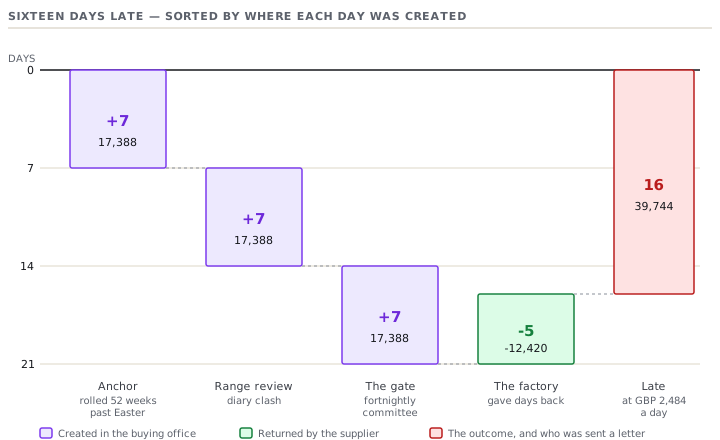
Against the trading date the calendar claimed, Sat 27 Mar 2027, the goods are 9 days late. Against the trading date the season actually needed, Sat 20 Mar 2027, they are 16 days late. Those sixteen days break down exactly:
- +7 days from the anchor. A calendar rolled forward 52 weeks past a moveable Easter, decided in June 2026 by nobody.
- +7 days from the range review moving around a diary clash.
- +7 days from a fortnightly gate, which turned the first seven into fourteen.
- −5 days given back by Beykonak Tekstil, which was handed 81 days of calendar for 95 days of work and did it in 90.
Twenty-one days were created inside a buying office. Five were returned by a factory. Lesson 3 prices what can be done about the balance on 7 Jan 2027, and then looks at which of the two parties received a letter.
What you should be able to do now
Count your own internal calendar in days and state it as a share of the season. The number is usually a shock, and it is always the cheapest place to find time. Find every gate that meets on a cycle rather than on demand, and write next to it the cost of missing it, which is the cycle length and not the size of the slip. And for every range you plan, find the earliest date on which a bulk-quality garment must exist for somebody outside the buying office. Put that date on the plan, owned by a person, before it becomes the only date that matters.