Lessons · Lesson 1 of 3
The week the decision closes
Work out the last week each of three supply routes can still be changed, price what each route costs a set, and find the week the season stopped being changeable.
Lesson 1 of 3 · 40 min
The situation
Everyone in a buying office knows how long a supplier takes to deliver. Very few can name the other date. It is the last day on which the quantity could still be changed. That date governs a whole season. This lesson works it out three ways: a distant mill shipping by sea, a nearer maker sending lorries, and a printer working at home.
Monday 7 September 2026. Prestwold is a British home retailer. It has 54 shops, a website that takes just over a quarter of its bedlinen units, and one distribution centre at Sarnesby. Today is the first trading day of the Bedlinen, Autumn/Winter 26 phase. The phase runs 16 weeks, to the week beginning 21 December 2026.
Three people own different parts of what follows. Tobias Wraycott is the buyer. He chose the product and the supplier. Freya Ackland is the merchandiser. She owns the money, the quantity and the intake calendar, which is the plan of what arrives and when. Dermot Vasey runs supply chain and the Sarnesby building. Nobody in this course does anything foolish. By the end of lesson 3 the department is 2,770 sets over.
The phase is three lines. A SKU is one sellable item: one colour in one size.
| Line | What it is | SKUs a shop | Ticket | Landed cost | Intake margin |
|---|---|---|---|---|---|
| PW-300 Marlbeck | Plain-dyed duvet set, 6 colours × 4 sizes | 24 | GBP 30.00 | GBP 12.60 | 58.0% |
| PW-712 Ellerdine | Printed duvet set, 3 designs × 4 sizes | 12 | GBP 45.00 | GBP 18.00 | 60.0% |
| PW-118 Denbray | Housewife pillowcase pair, 6 colours | 6 | GBP 12.00 | GBP 4.20 | 65.0% |
Say the basis once. Everything in this course is in units and at landed cost, unless a line says ticket or retail. Both of those mean the price on the label. Landed cost is what the goods cost delivered into Sarnesby and booked in: the mill's price, freight, duty, insurance and inland carriage. Intake margin is the margin the buy was signed at, before anything is marked down. Course 17.2 keeps the same department's money sheet at retail. This is a supply-chain course, so it lives at cost. Mixing the two is the most expensive typing error in retail planning.
The buy Freya committed is 63,300 units, GBP 670,680 at landed cost: 27,000 Marlbeck sets, 12,900 Ellerdine sets and 23,400 Denbray pairs. It arrives in four deliveries.
| Delivery | Booked in at Sarnesby | Marlbeck | Ellerdine | Denbray | Units |
|---|---|---|---|---|---|
| 1 — launch | Trading week 1, 7 September | 12,000 | 8,400 | 10,000 | 30,400 |
| 2 | Trading week 5, 5 October | 8,000 | — | 7,000 | 15,000 |
| 3 | Trading week 6, 12 October | — | 4,500 | — | 4,500 |
| 4 | Trading week 10, 9 November | 7,000 | — | 6,400 | 13,400 |
Three rungs, and the clock on each
Prestwold can buy a duvet set three ways. All three are real routes it has used. The third is the one it has never used at scale.
- Kotri Loomworks is a long-lead mill. It buys its own yarn and ships deep-water in containers. Quantities may be cut or cancelled up to 8 weeks before the ex-factory date, which is the day the goods leave the factory. After that the cloth is committed and the make-up is on the line. From ex-factory to booked in at Sarnesby is 7 weeks: four at sea, one for the port and customs, two for inland carriage and goods-in.
- Honaz Home Textiles is a near-shore maker shipping by road. Notice is 4 weeks before ex-factory. Transit plus goods-in is 2 weeks.
- Hardacre Finishing is a printer and make-up house at home in Britain. It works on cloth Prestwold owns. Prestwold buys undyed base cloth from Kotri on Kotri's own clock, holds it at Hardacre, and calls off print, make-up and delivery with 2 weeks' notice plus 1 week to print, sew, pack and drive it to Sarnesby.
Now price the same Ellerdine set on each.
| Kotri | Honaz | Hardacre | |
|---|---|---|---|
| Cloth | included | included | GBP 8.40 |
| Print, make-up, pack, freight, duty, inland | included | included | GBP 14.50 |
| Landed cost a set | GBP 18.00 | GBP 20.70 | GBP 22.90 |
| Booking fee on reserved capacity | none | none | GBP 0.50 a set |
| Notice before ex-factory | 8 weeks | 4 weeks | 2 weeks |
| Ex-factory to booked in | 7 weeks | 2 weeks | 1 week |
The gaps are the whole lesson. Honaz is GBP 2.70 dearer a set than Kotri. Hardacre is GBP 4.90 dearer. Across the 12,900-set Ellerdine buy that is GBP 34,830 and GBP 63,210. Both are real money against a line whose entire landed cost is GBP 232,200, and neither premium is obviously worth paying yet.
The lock is not the lead time
Here is the move the whole course turns on. A buyer talks about lead time, which is how long it takes from order to delivery. A merchandiser needs a different number, and nobody writes it on the supplier record:
commitment lock = delivery week − transit weeks − notice weeks
The lock is the last week in which the quantity can still be changed. Everything after it is a fact you will trade with, whatever happens in the shops. For Kotri that is 7 + 8 = 15 weeks before the goods are booked in. For Honaz, 2 + 4 = 6 weeks. For Hardacre, 1 + 2 = 3 weeks.
Apply the three ladders to the four deliveries Prestwold actually scheduled.
| Delivery | Booked in | Kotri, 15 weeks | Honaz, 6 weeks | Hardacre, 3 weeks |
|---|---|---|---|---|
| 1 — launch | week 1, 7 Sep | 25 May 2026 | 27 Jul 2026 | 17 Aug 2026 |
| 2 | week 5, 5 Oct | 22 Jun 2026 | 24 Aug 2026 | trading week 2 |
| 3 | week 6, 12 Oct | 29 Jun 2026 | 31 Aug 2026 | trading week 3 |
| 4 | week 10, 9 Nov | 27 Jul 2026 | trading week 4 | trading week 7 |
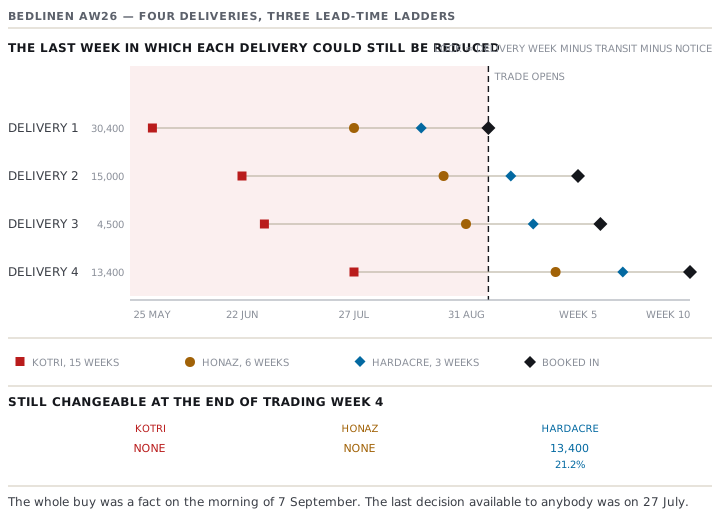
Read the Kotri column first, because that is what Prestwold bought. All four deliveries closed before the phase opened. The last decision available to anybody was on 27 July 2026, six weeks before a single set was sold. From the morning of 7 September, the department's whole buy of 63,300 units and GBP 670,680 was a fact.
That is not a criticism of Tobias or Freya. It is arithmetic nobody did. The supplier record at Prestwold says lead time: 15 weeks, and that is true. Nobody had written down what 15 weeks does to a phase whose first useful sales reading arrives in week 3.
Buying a faster rung is not the same as using it
Now the part that catches people who do do the arithmetic. Look at the Hardacre column. Prestwold pays GBP 4.90 a set, which is 27% over Kotri, for a three-week lock. What does that buy on this calendar?
Delivery 2 closes in trading week 2. Delivery 3 closes in week 3. Delivery 4 closes in week 7. So at the end of trading week 4, when Freya has four weeks of real sales in front of her, exactly one delivery is still open: 13,400 units, 21.2% of the buy. She has paid a 27% premium for the right to change a fifth of the season.
The reason is not the supplier. The delivery calendar was drawn for a 15-week lead time and nobody redrew it. Deliveries were placed in weeks 1, 5, 6 and 10 because that is when a container ordered in May and June arrives. A three-week lock has no use for those dates.
Redraw the calendar around the lock instead. Keep the launch delivery where it is, because the shelves have to be full on day one. Put the rest into two later drops.
| Delivery | Booked in | Units | Hardacre lock | Still open at the end of trading week 4 |
|---|---|---|---|---|
| 1 — launch | week 1, 7 Sep | 30,400 | 17 Aug 2026 | no |
| 2 | week 7, 19 Oct | 15,000 | trading week 4 | decided that week |
| 3 | week 11, 16 Nov | 17,900 | trading week 8 | yes |
52.0% of the buy is now in play in trading week 4. That is 15,000 units to decide that week and 17,900 still open behind them. As the calendar was actually drawn the figure was 0%. On the fast supplier with the old dates it was 21.2%. The supplier changed nothing on its own. The calendar did the work.
Speed is bought where the doubt is, and nowhere else
Prestwold never considered a fast rung for Marlbeck or Denbray, and it was right not to.
A plain white double duvet set and a pair of plain pillowcases sell at a rate Prestwold has measured for eleven years. The uncertainty is a few per cent either way. A few per cent of a thing you are sure about is worth almost nothing to be able to change. Paying a premium a set so you can re-decide a quantity you already know is a straight transfer from Prestwold to its supplier.
The Ellerdine line is the opposite. Three prints were chosen in a range meeting in March, and all three were bought at exactly 4,300 sets each, because there was no evidence to buy them unequally. That equal split is not laziness. It is the honest expression of not knowing. It is also the single largest piece of genuine doubt in the phase: GBP 232,200 of landed cost sitting on three guesses.
Pay for speed on the units you are unsure about, in the quantity you are unsure by. Everything else is a price rise.
That sentence sounds obvious and is routinely ignored. Speed is usually bought as a supplier relationship rather than as a quantity. Prestwold would have negotiated Hardacre for "the printed programme", all 12,900 sets, and paid GBP 63,210 for it. Lesson 3 works out what the right quantity was. It is a great deal smaller than the part of the buy Tobias was unsure about.
What a fast rung cannot do
Three limits, stated now so lesson 3 is not read as more than it is.
- It cannot create demand. The next two lessons are about buying fewer of the wrong thing. A responsive supply chain sells more only when the alternative was running out, and Prestwold does not run out this autumn.
- It is not free when you do not use it. Hardacre holds Prestwold's cloth. If the call never comes, Prestwold still owns the cloth and has still paid the booking fee. Speed has a standing charge.
- It does not survive a calendar nobody redrew. This is the finding above, and it is the commonest way a speed project delivers nothing. The supplier is changed, the intake weeks are inherited, and the lock lands where it always did.
Check yourselfYour supplier offers to cut lead time from 14 weeks to 8. Your deliveries are in trading weeks 1, 4 and 9, and your notice period is 5 weeks either way. What has actually changed for you?Show the answer
Work the lock, not the lead time. Before: 14 + 5 = 19 weeks, so the week-9 delivery closed 10 weeks before the phase opened and nothing was ever changeable. After: 8 + 5 = 13 weeks, so the week-9 delivery closes four weeks before the phase opens. That is still before you have a single sales reading. Nothing has changed for you at all. The offer becomes worth something only if you also move that delivery later. At 13 weeks of lock, a delivery booked in trading week 14 closes in trading week 1, and one booked in week 18 closes in week 5. So ask for the shorter lead time and then redraw the intake calendar. Otherwise you have bought a faster supplier and the same season.
Prompt · Build my commitment-lock calendar and tell me what is still mine
Before you sign an intake calendar, or the moment trade goes off plan and you need to know what can still be changed.
Act as a retail merchandiser who does not care what a supplier's lead time is and only cares when a quantity stops being changeable. Here is my phase. It runs [NUMBER] weeks from [DATE OF TRADING WEEK 1], my department is [DEPARTMENT], and my intake calendar by delivery is: [PASTE - DELIVERY, WEEK BOOKED IN, UNITS, VALUE AT COST, SUPPLIER]. For each supplier my terms are: reduction or cancellation permitted up to [NUMBER] weeks before the ex-factory date, and ex-factory to booked-in is [NUMBER] weeks - here they are per supplier if they differ: [PASTE]. Do the following, in order, and show the subtraction every time. First, compute the commitment lock for every delivery as delivery week minus transit minus notice, and give me the actual calendar date, not a week number on its own. Second, list every delivery whose lock falls BEFORE trading week 1, with its units and its value, and total them as a percentage of the whole buy - if that total is 100%, say so as the first line of your answer. Third, build me a running column: at the end of each trading week from 1 to [NUMBER], how many units and what value are still changeable. Fourth, tell me the first trading week in which I will have a sales reading I would actually act on - assume that is week [NUMBER] unless I have told you otherwise - and say plainly how much of the buy is still open at that point. Fifth, if the answer to the fourth question is small, redraw the intake calendar for me: keep the launch delivery where it is, consolidate the rest into as few later drops as the locks allow, and show what share of the buy would then be in play at my decision week. Do not suggest I negotiate a shorter lead time until you have shown me what the current one would be worth with a redrawn calendar, because those are different recommendations and only one of them is free.
AI can make mistakes — check anything you act on.