Lessons · Lesson 2 of 3
The bay does not care what you sold
Read the same three lines per unit, per shelf metre-week and per pallet, find the ranking that inverts, and price a swap on a fixture that cannot grow.
Lesson 2 of 3 · 40 min
Two ceilings nobody in the range meeting mentioned
A shop's shelving does not get longer because trade is good. Every product competes for a fixed width of wood. Behind it, products compete for a fixed number of pallet spaces in the warehouse. Yet the argument about what to stock is nearly always about the profit on one item. That figure says nothing about how much room the item takes up while it waits. This lesson reads the same products three ways.
The Bedlinen AW26 buy was signed in June against a money plan and a sales plan. Both were sound. Neither contained the two numbers that decided how the phase actually went.
The first is in the shops. Every one of Prestwold's 54 shops carries the same bedlinen module: five shelves, 2.60 m wide, 13.00 shelf metres in total. It is the same module in Truro and in Perth. It is bolted to the wall, and there is no version of this phase in which it becomes 14 metres. A facing is the front of one pack, the part a customer can see. A duvet-set bag faces 0.34 m and the shelf takes four packs deep behind it. A pillowcase-pair pack faces 0.11 m and takes ten deep.
The second is at Sarnesby. Bedlinen has 120 pallet positions: a pick face and its reserve racking. Above that, stock goes to a third-party site on Prestwold's overflow contract at GBP 5.40 a pallet a week, plus GBP 14.00 a pallet for the handling out and back.
Neither ceiling appears on a WSSI, which is the weekly sales, stock and intake report. Neither appears on a range plan or a cost sheet either. Both of them bind.
The same three lines, read three ways
Start with what the range meeting saw: the gross margin one unit makes.
| Line | Ticket | Landed cost | Gross margin a unit |
|---|---|---|---|
| PW-712 Ellerdine printed set | GBP 45.00 | GBP 18.00 | GBP 27.00 |
| PW-300 Marlbeck plain set | GBP 30.00 | GBP 12.60 | GBP 17.40 |
| PW-118 Denbray pillowcase pair | GBP 12.00 | GBP 4.20 | GBP 7.80 |
Now read the same three lines against the metre they occupy. Prestwold's plan is 24,000 Marlbeck sets, 12,000 Ellerdine sets and 21,000 Denbray pairs across the 16 weeks. 74% of bedlinen units go through the shops and the rest through the website, so the store figures below are 74% of each line's plan. The shelf column is the line's facings in one shop multiplied by 54 shops.
| Line | Store units | Store gross margin | Facings a shop | Shelf metres, chain | GM a shelf metre | GM a shelf metre-week |
|---|---|---|---|---|---|---|
| PW-300 Marlbeck | 17,760 | GBP 309,024 | 8.16 m | 440.64 m | GBP 701.31 | GBP 43.83 |
| PW-712 Ellerdine | 8,880 | GBP 239,760 | 4.08 m | 220.32 m | GBP 1,088.24 | GBP 68.01 |
| PW-118 Denbray | 15,540 | GBP 121,212 | 0.66 m | 35.64 m | GBP 3,401.01 | GBP 212.56 |
Check one row before you accept the rest. Denbray: 21,000 planned units × 0.74 = 15,540 store units; × GBP 7.80 = GBP 121,212. Six colours at 0.11 m is 0.66 m a shop, and 0.66 × 54 = 35.64 metres across the chain. GBP 121,212 ÷ 35.64 = GBP 3,401.01 a metre for the phase, and ÷ 16 weeks is GBP 212.56 a metre-week.
The ranking inverts. Read by the unit, Ellerdine is the best line on the fixture and Denbray is the worst, by a factor of 3.46. Read by the metre, Denbray is the best, by a factor of 3.13 over Ellerdine and 4.85 over Marlbeck. It is the same three lines, the same season and the same money. Only the denominator changed.
Cube, and why home textiles is not apparel
A rail measures a coat in centimetres of hanging space, and that is nearly the whole story. Bedlinen is a solid. It has a face on the shelf and a volume in the building, and the two are not proportional. A case pack is the number of units in one carton, and the carton is what fills a pallet.
| Line | Case pack | Cases a pallet | Units a pallet | GM a pallet held |
|---|---|---|---|---|
| Duvet set, either line | 12 | 11 | 132 | Marlbeck GBP 2,296.80 · Ellerdine GBP 3,564.00 |
| Denbray pillowcase pair | 50 | 24 | 1,200 | GBP 9,360.00 |
A duvet set occupies 9.09 times the pallet space of a pillowcase pair and earns 2.23 times the margin. That ratio, not the margin percentage, is what a warehouse ceiling actually charges you.
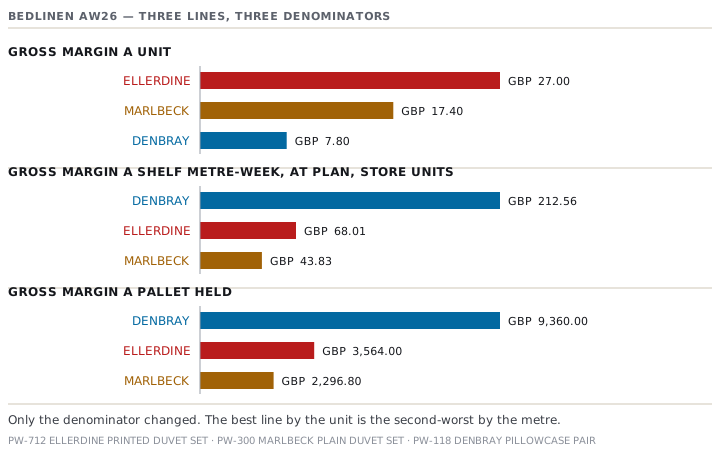
Both constraints put the lines in the same order here, and that is worth saying out loud rather than leaving as luck: Denbray first, Ellerdine second, Marlbeck last, on the shelf and in the racking. They would disagree the moment a line had a narrow face and a bulky pack. A boxed duvet rated 15 tog is the classic case, since tog is the warmth rating and a warm duvet is thick: 0.20 m of facing and a third of a pallet a dozen. When the two constraints disagree, you have to say which building you are short of. Prestwold is short of both, in the same season, which is lesson 3.
Pricing a swap on a fixture that cannot grow
Here is the decision the arithmetic can actually settle. Freya wants three more Denbray facings, a second facing on the three colours that sell fastest, which is 0.33 m. There is no spare metre. Something has to leave.
The candidate is one Marlbeck colour-size, 0.34 m, which is one of that line's 24 SKUs.
- One Marlbeck SKU across the chain is 0.34 × 54 = 18.36 metres, held for 16 weeks, which is 293.76 metre-weeks.
- Marlbeck's planned store margin divided across its 24 SKUs is GBP 309,024 ÷ 24 = GBP 12,876 for the phase. Cross-check it the other way: 293.76 metre-weeks × GBP 43.83 = GBP 12,875.50, the same figure to the rounding on the rate. The two routes agree, which is the point of keeping a per-metre-week rate at all.
So the swap costs GBP 12,876 of planned margin, and it buys 0.33 m a shop of Denbray facing.
The line you cannot cut
Now the uncomfortable half. Marlbeck is the worst line on the fixture per metre, per metre-week and per pallet. It is also the largest single block of margin in the department: GBP 309,024, against Ellerdine's GBP 239,760 and Denbray's GBP 121,212. It occupies 8.16 of the 12.90 faced metres because plain white and plain grey bedlinen in four sizes is what people come to Prestwold to buy. A shopper who cannot find a plain double set in white does not buy a printed one instead. They leave, and they do not buy the pillowcases either.
Space arithmetic cannot see that. A planner who acts on the per-metre column alone will cut the destination line and wonder why the department fell. Per-metre productivity is an input to the decision, not the decision. What it is genuinely good for is the marginal metre. Not "should Marlbeck exist", which is settled, but "what is the last metre on this fixture doing, and is there anything better to do with it".
At Prestwold the last metre on the bedlinen fixture belongs to the third Ellerdine print. Lesson 3 is what it did with it.
Where the stock physically is
One last piece of plumbing, because lesson 3 runs on it. A unit Prestwold owns is in exactly one of three places, and only two of them are useful.
- On the shelf. Marlbeck holds 24 facings × 4 deep = 96 sets a shop. Ellerdine holds 12 × 4 = 48. Denbray holds 6 × 10 = 60 pairs.
- In the shop's stockroom. Prestwold's rule of thumb is three times the shelf holding, so the estate can physically hold 384 Marlbeck sets, 192 Ellerdine sets and 240 Denbray pairs a shop. Across 54 shops that is 20,736, 10,368 and 12,960 units.
- At Sarnesby, in the 120 positions, or in overflow at GBP 5.40 a pallet a week.
Prestwold's allocation rule sends each shop five weeks of cover at the rate that shop is currently selling, capped by what it can hold. Cover is how many weeks the stock in the shop would last at the current selling rate. That rule has a property nobody notices while trade is good and everybody feels in a bad autumn: when sales slow, the shops take less, so the warehouse holds more. The building fills up precisely when the season is going wrong. That is the worst possible moment to be paying for space, and it is why lesson 3's pallet curve looks the way it does.
Check yourselfA supplier offers you a 3% price reduction if you take the season in one delivery instead of three. Your line runs at GBP 90 a shelf metre-week and the buy is GBP 400,000 at cost. What do you need to know before answering?Show the answer
Three things, and the price reduction is the least of them. First, what the single delivery does to the space. One drop means you own the whole season from week one, so your peak pallet requirement is roughly the whole buy rather than a third of it. You need to know whether that fits in the building or goes to overflow at your own contracted rate. Second, what it does to the lock. Three deliveries usually mean three decision points, and consolidating them into one moves every unit's commitment to the earliest date. You are being paid 3% to give up the right to change two thirds of the buy. Third, what it does to the fixture. A single delivery does not give a shop more metres. So the extra stock sits in stockrooms where it cannot be seen, cannot be reallocated cheaply, and is the first thing to be marked down. GBP 12,000 is a real saving. Work out the other three numbers before you decide it is a net one.
Prompt · Read my range per unit, per metre and per pallet
When the fixture is full, somebody wants space for a new line, and the only number in the room is margin percentage.
Act as a retail planner who treats shelf space and warehouse cube as scarce resources with a price. Here is my department. Lines: [PASTE - LINE, TICKET PRICE, LANDED COST, PLANNED UNITS FOR THE PHASE, NUMBER OF SKUS]. My fixture: each shop carries [NUMBER] metres of shelf for this department, a pack of [LINE] faces [NUMBER] metres and sits [NUMBER] deep, and I have [NUMBER] shops. My channel split is [PERCENT] of units through shops. My phase is [NUMBER] weeks. My warehouse: [NUMBER] units of [LINE] fit a pallet, I have [NUMBER] pallet positions for this department, and overflow costs me [AMOUNT] a pallet a week plus [AMOUNT] a pallet handled. State whether my figures are at cost or at retail and use one basis throughout. Do the following. First, gross margin a unit for every line. Second, gross margin a shelf metre and a shelf metre-week, using store units only, and show me the division. Third, gross margin a pallet held. Fourth, put the three rankings side by side and tell me explicitly where the order INVERTS, because that is the finding - if it does not invert, say so rather than manufacturing a contrast. Fifth, price the swap I am actually considering: I want [NUMBER] metres for [LINE OR NEW LINE], taken from [LINE]. Tell me what that costs in planned margin, and express it as the rate per metre-week the new use has to beat. Do NOT tell me the new facings will earn the incumbent line's average rate - a second facing is not a first facing - and say so in one sentence. Sixth, name any line whose per-metre figure is poor but which I should not cut anyway, and say why in terms of what a customer came in for. Seventh, tell me which single measurement I am missing, and it is probably what a marginal metre earns after a swap.
AI can make mistakes — check anything you act on.