Lessons · Lesson 4 of 6
What waiting buys, and what it costs
Price a deferred decision against committing and against staging, put a ceiling on what any wait can be worth, and tell a deferral apart from a refusal with no name on it.
Lesson 4 of 6 · 20 min
One decision, three answers, and the obvious two are both wrong
Programme G buys seats and training for 3D sampling. Its case is built on Meriden Row, the one buyer of four that has agreed to judge a first fit on a screen: USD 19,200 a year at today's scope. Course 22.5 owns that agreement, including which rounds a factory owns, which belong to the buyer, and what a written eligibility rule looks like. Nothing here re-opens it. This lesson owns the question 22.5 does not ask: what is it worth to wait for the next agreement rather than to buy for it?
Because there is one coming. Quilloway, Wanagiri's largest buyer, is running a group review of its approval policy that concludes in week 48. If it adopts screen approvals, Wanagiri's addressable rounds roughly treble and programme G is worth USD 54,300 a year. If it does not, G stays at USD 19,200 and three seats is two seats too many.
Retno went looking for a probability rather than guessing one. Over eleven years Wanagiri has been party to 9 Quilloway policy reviews of this kind, of which 4 changed a requirement. That is 44.4%, on nine observations. It is the softest number in this lesson, but it is a record rather than a feeling, and it can be argued with, which a feeling cannot.
The two answers everybody reaches for
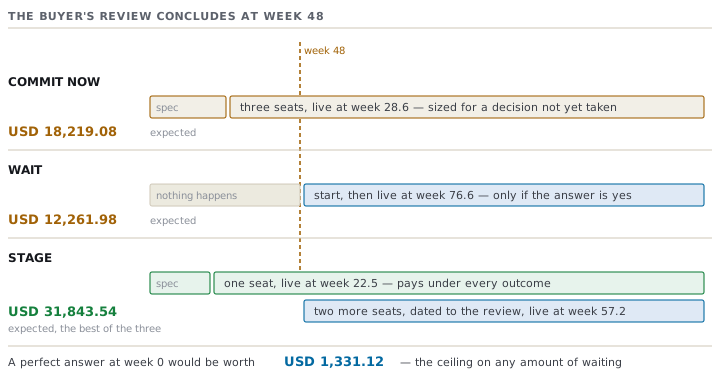
Commit now. Three seats, USD 44,000 of capital, USD 6,400 a year to run, 128 of Retno's hours. Live at week 28.6.
- If Quilloway adopts: USD 58,719.08
- If it does not: minus USD 14,180.92
- Expected: USD 18,219.08
Wait for the review. Nothing starts until week 48. Then buy what turns out to be right.
- If Quilloway adopts: three seats, live at week 76.6, worth USD 27,589.44
- If it does not: one seat, live at week 70.5, worth minus USD 1,383.95, so you would decline, and the branch is worth nothing
- Expected: USD 12,261.98
So waiting is USD 5,957.10 worse than committing. A meeting that has only these two options in front of it will commit, correctly, and never discover what it left on the table.
The third answer: buy the part that pays either way
Split programme G where the uncertainty falls. One seat pays under both futures, because Meriden Row's agreement exists today and is not affected by anything Quilloway decides. The two further seats are entirely a bet on the review.
Stage it. One seat now: USD 25,400, USD 3,900 a year, 96 of Retno's hours, live at week 22.5. That is earlier than the three-seat version, because it needs less of her.
- One seat, on its own: USD 12,739.12
- The expansion, decided at week 48 and live at week 57.2, adds USD 42,984.93 when it happens
- Expected: USD 12,739.12 plus 44.4% of USD 42,984.93 = USD 31,843.54
| Expected value | Against staging | |
|---|---|---|
| Commit to everything now | USD 18,219.08 | minus USD 13,624.46 |
| Wait for the review | USD 12,261.98 | minus USD 19,581.56 |
| Buy one seat now, date the rest | USD 31,843.54 |
Staging beats committing by USD 13,624.46 and waiting by USD 19,581.56, and it does it without knowing anything the other two do not know. The general form is worth memorising: the option to wait is not an option on a programme. It is an option on the part of the programme whose value depends on the unresolved fact. Waiting on the whole thing pays for information about a part that did not need any.
The ceiling: what the information could possibly be worth
There is a number that settles arguments about waiting, and it takes two minutes. Ask what you would do if you knew the answer today, for certain, and price it.
- If you knew Quilloway would adopt: commit to three seats now, worth USD 58,719.08
- If you knew it would not: buy one seat now, worth USD 12,739.12
- Weighted at 44.4% and 55.6%: USD 33,174.66
That is the value of a perfect answer, available instantly and free. Subtract the best you can do without it, which is staging at USD 31,843.54:
The Quilloway answer is worth USD 1,331.12. Waiting for it costs USD 19,581.56, which is 14.71 times what it can possibly be worth.
This ceiling is the most useful single calculation in the lesson, because it applies before you have designed any option at all. If the whole uncertainty is worth USD 1,331.12, no arrangement of waiting, piloting or phasing can recover more than that, and any proposal claiming otherwise has an error in it somewhere.
The register that makes a deferral real
A dated decision needs four fields, and the fourth is the one always missing.
- The fact you will know that you do not know now, in one sentence a stranger could check.
- The date you will know it, and how you will find out.
- The person who brings it back to the table on that date.
- The default, which is what happens if the fact never arrives.
Without the fourth, a deferral becomes permanent by silence. Quilloway's review could be postponed to next year. Wanagiri's register says that if week 48 passes with no decision, the expansion is declined and re-proposed only on a written change from the buyer. That sentence costs nothing to write, and it is the only thing standing between a dated decision and an item that quietly stops existing.
Check yourselfYour owner wants to postpone a purchase for a year because 'prices always come down and we will know more'. How do you turn that into an argument you can settle?Show the answer
Make both halves specific. Name the fact the year will supply and how you will learn it. If nobody can, the year supplies nothing and the postponement is a decline. Then put a ceiling on it. Work out what you would do if you knew the answer today under each outcome, weight those by a rate from your own history, and subtract the best you can do without knowing. That number is the most any amount of waiting can be worth. Compare it with a year of forgone benefit, and the discussion stops being about temperament.
Prompt · Price a decision I want to postpone
When somebody proposes holding a purchase until something is clearer.
Act as a decision analyst working for a factory owner, not for a supplier. A purchase here is being postponed. The purchase: [WHAT IT IS, CAPITAL, ANNUAL RUNNING COST, EXPECTED ANNUAL BENEFIT AT TODAY'S SCOPE, AND THE HOURS IT NEEDS FROM MY MOST COMMITTED SPECIFIER]. The reason given for postponing: [THE REASON, IN THE WORDS IT WAS GIVEN IN]. Do the following. First, test whether this is a deferral at all: state in one sentence the FACT that will be known at the end of the wait and was not known at the start, the DATE it will be known, and how I will find out. If you cannot fill all three from what I gave you, say so plainly and tell me the wait is a refusal that nobody has to defend, then price the benefit forgone and stop. Second, if it is a real deferral, split the purchase into the part that pays under EVERY outcome and the part whose value depends on the unresolved fact. Third, price three options over a [NUMBER]-year horizon: commit to everything now, wait for the fact, and buy the sure part now while dating the rest. Show the arithmetic for each branch separately before weighting them. Fourth, get the probability from my own record rather than your judgement: ask me how many times a comparable question has been decided here and how many went each way, and say how many observations the figure rests on. Fifth, compute the ceiling. Take what I would do knowing the answer for certain under each outcome, weight it, and subtract the best I can do without knowing. Then tell me the ratio between the cost of waiting and that ceiling. Sixth, write the register entry: the fact, the date, the person who brings it back, and what happens by default if the fact never arrives.
AI can make mistakes — check anything you act on.
What to take away
- Commit, wait and stage are three options, and a meeting usually sees two of them. Wanagiri's staged answer beat both by USD 13,624.46 and USD 19,581.56.
- Split a programme where the uncertainty falls. Buy the part that pays under every outcome and date the part that does not.
- Waiting is an option on the uncertain part only. Waiting on the whole thing buys information about a part that never needed it.
- Price the ceiling: what you would do knowing the answer, weighted by your own history, minus your best action without it. Quilloway's answer was worth USD 1,331.12 against a wait costing 14.71 times that.
- Take the probability from your own record rather than your instinct, and say how many observations it rests on.
- A deferral needs a fact, a date, a name and a default. Missing the fact makes it a refusal. Missing the default makes it permanent.