Lessons · Lesson 5 of 6
The item with no supplier
Trace every candidate on a proposal list back to whoever put it there, build a candidate list from your own losses instead, and price the two best items at one factory, neither of which anybody had proposed.
Lesson 5 of 6 · 20 min
A question about the list rather than about the items
For fourteen months Wanagiri argued about which of seven programmes to do. Retno eventually asked a different question, and it took an afternoon to answer: where did each of these seven come from?
| Programme | Who first raised it | What they sell | |
|---|---|---|---|
| A | Line-end capture | A terminal supplier at a trade fair | Terminals |
| B | Planning replacement | A software reseller | Licences and implementation |
| C | Machine data on the specials | A sensor integrator | Sensors and installation |
| D | Defect capture by operation | The same reseller as B | An additional module |
| E | Fabric store barcoding | A warehouse software supplier | Licences and scanners |
| F | Meriden Row's supplier portal | The buyer | The buyer's own saving |
| G | Seats for 3D sampling | A design software reseller | Seats and training |
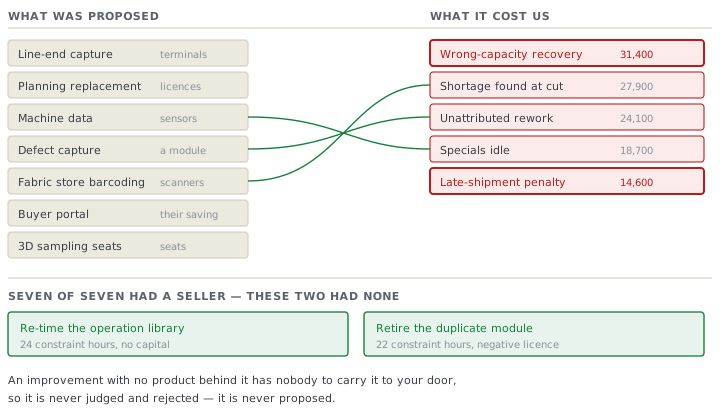
Seven of seven were proposed by somebody with something to sell. Nobody was misled and nothing was mis-sold. Every one of those suppliers made a reasonable case for a real product. But the list is not what Wanagiri believed it was. It is not a list of Wanagiri's best opportunities. It is a list of what is currently being sold to factories of this size in this country, sorted by who got a meeting.
An idea reaches a shortlist because somebody carried it there, and carrying costs money: a stand, a demonstration, a lunch, a follow-up call. An improvement with no product behind it has nobody to pay that cost, so it is not proposed. Not because anyone judged it and rejected it, but because it never entered the process that produces judgements.
The list built the other way round
Wanagiri keeps a recovery log, because Sundari has always insisted that anything costing money outside the cost sheet gets written down. Ranked by money, last year:
| Loss | A year | Addressed by |
|---|---|---|
| Recovery on orders booked to the wrong capacity | USD 31,400 | nothing on the list |
| Fabric shortage discovered at the cutting table | USD 27,900 | E |
| Rework on a defect class nobody can attribute | USD 24,100 | D |
| Special machines idle waiting for work | USD 18,700 | C, once B is live |
| Late-shipment penalty, one buyer | USD 14,600 | nothing on the list |
| Total | USD 116,700 |
The obvious objection is that the planning replacement surely answers the first line. It does not, and the reason is the subject of the rest of this lesson. It would re-book the same orders against the same standards, faster and with better screens. A system that computes a wrong number more efficiently is not an answer to the wrong number.
Three of the seven proposals point at a named loss. Four point at nothing on the ledger at all. That does not make them worthless, but it does mean their benefit has to be argued from first principles rather than pointed at. And the largest loss in the building is answered by nothing anybody proposed.
What answers it, and why no salesman has ever mentioned it
Orders are booked against Wanagiri's operation library: 1,140 records, each carrying a standard minute value, last reviewed in full six years ago. Retno re-timed a sample of 40 operations. The library is not randomly wrong, which would matter less. It is biased, in two directions at once:
- operations that have gained an attachment, a folder or a guide since they were timed run 7.4% below the library
- operations on the heavier twills introduced in the last three years run 11.9% above it
Course 5.4 owns how a time study is done and this course will not repeat a word of it. What belongs here is what the library is doing to the portfolio. Every plan B will produce, every efficiency A will display and every utilisation figure C will compute is a comparison against this library. It is not the eighth item on the list. It is a coefficient on four of the other seven.
Re-timing everything is not the job. 187 operations, which is 16.4% of the records, carry 82.4% of the year's standard minutes. At 1.9 hours each that is 355.3 hours of work-study time. Wanagiri has a work-study officer, Dwi Anggraeni, with roughly 480 uncommitted hours a year. The scarce resource, Retno's diary, is touched for 24 hours of review and sign-off.
| Work-study hours, 187 operations at 1.9 | 355.3 |
| At USD 8.40 an hour | USD 2,984.52 |
| Retno's hours, at USD 12.00 | USD 288.00 |
| Capital | none |
| One-off cost | USD 3,272.52 |
| Benefit a year, 58% of the recovery bill | USD 18,212.00 |
| Three-year net | USD 48,696.34 |
That is USD 2,029.01 for every hour it takes from the constraint, against USD 801.96 for the best of the seven. It is 2.53 times as much, on an item that cost nothing to buy and had no champion.
The same shape again, pointing the other way
The second-best item on the list Wanagiri eventually built was to switch something off. The attendance system carries a production module that duplicates part of what A now does, and the two disagree, so somebody reconciles them: 6.5 hours a week, 338 hours a year at USD 8.40. Retiring it saves that plus USD 4,200 of licence, which is USD 7,039.20 a year, for a one-off USD 3,400 of data extraction and archiving and 22 of Retno's hours. Three-year net USD 16,562.15, or USD 752.82 an hour of the constraint, which puts it third out of everything.
Nobody proposed it either, for two reasons that generalise. No supplier proposes the removal of their own licence. And internally, the person who would own a decommissioning gains nothing visible and carries the whole risk if a number somebody depended on goes missing. So the incentive to raise it is negative, which is worse than absent. Course 24.3 owns taking a number off a screen. This is one step up, retiring a whole system, and the reason it never gets raised is the same one.
Check yourselfYour improvement list has nine items and every one of them has a named supplier. Is that a problem?Show the answer
It is a reliable sign that the list was received rather than made. Nothing on it need be bad, but a process that only produces items somebody is selling cannot produce the ones nobody is: fixing master data, retiring a system, changing a rule, stopping a report. Those are usually cheap, need no capital, and take very little of your scarcest people. That is exactly why they rank well, and exactly why nobody carries them to your door. Build the list from your losses first, decide what would address each, and only then ask what is for sale.
Prompt · Build the candidate list from my losses
Before a steering group meets on a shortlist that arrived from suppliers.
Act as an industrial engineer who is not selling anything and will not name a product. Here is the shortlist of digital improvements in front of me, and beside each one, who first raised it: [LIST EACH PROPOSAL AND WHO RAISED IT, INCLUDING WHETHER THEY SELL SOMETHING AND WHAT]. Here are the losses I actually recorded in the last twelve months, ranked by money, from my recovery log rather than from memory: [LIST THEM WITH AMOUNTS]. Do the following. First, draw the mapping: which proposal addresses which recorded loss, and be strict — if a proposal only addresses a loss after some other programme is live, say so and mark it conditional. Second, report two lists: losses no proposal reaches, and proposals that reach no recorded loss. Do not soften either. Third, for each unreached loss, propose what would address it WITHOUT assuming any purchase: a change to master data, a rule, a report retired, a system switched off, a decision moved to a different person, a check added. For each, estimate the hours and say whose hours they are. Fourth, look specifically at my master data: ask me when my operation standards, my bills of material and my routings were last verified against a measurement rather than copied forward, and tell me which of the proposals on my list compute against them. Fifth, rank everything — proposals and your own additions — by three-year benefit divided by hours of my most committed specifier, and show that ranking as a table. Sixth, tell me plainly if my shortlist contains no item without a supplier, and what that implies about how it was assembled. Do not recommend buying anything you cannot map to a loss on my list.
AI can make mistakes — check anything you act on.
What to take away
- Trace every candidate to whoever raised it and what they sell. All seven of Wanagiri's had a seller.
- A shortlist made of proposals is a market survey. It cannot contain an improvement with no product behind it, however good.
- Build the list from your own recorded losses instead. Four of Wanagiri's seven proposals pointed at nothing on its ledger, and its largest loss was answered by nothing proposed.
- Master data is a coefficient on every programme that reads it. Wanagiri's operation library was biased 7.4% one way and 11.9% the other, and four of the seven programmes computed against it.
- Re-timing 16.4% of the records covered 82.4% of the minutes, cost USD 3,272.52, and returned 2.53 times the best proposal per hour of the constraint.
- Switching something off is the same shape: no supplier will raise it and no internal owner is rewarded for it. Wanagiri's was third on the whole list.