Lessons · Lesson 1 of 3
What a vendor base is, and how much of a factory you are
Screen an approved supplier list against one real order, and measure your weight at each factory in both directions.
Lesson 1 of 3 · 42 min
The morning the list stops being a list
Most companies that buy clothes keep a list of factories they are allowed to use. They treat the length of that list as a measure of choice. It is not.
This lesson screens one such list against a single order. Which of those factories could actually make this garment, in this quantity, in the weeks available? Then it turns the question round. How large a customer are you to each of them?
3 February, a buying office in Zwolle. Duinhoven is a mid-market clothing retailer. It has 214 stores in five countries and a web shop that takes about a third of the volume. The autumn range was signed off yesterday: 41 styles and 612,000 units, of which six styles and 118,000 units are outerwear.
The style this course follows is DH-7420. It is a women's padded hooded jacket: recycled-polyester shell, filled with wadding, quilted body panels, a two-way front zip and a drawcord hood. 18,400 pieces in three colours — Bark 8,600, Slate 6,200, Ink 3,600.
It was costed into the range at FOB USD 21.50 against a retail price of USD 79.95. FOB means the factory's price with the goods loaded at the port of shipment. The buyer pays the freight and the duty from there.
The dates: out of the factory 24 July, into the distribution centre 26 August, in stores for the week 38 launch.
Lieke Verhoek is the sourcing merchandiser who owns outerwear. She opens the vendor master and sees 22 approved suppliers. By eleven o'clock she knows the real answer is five. This lesson shows how she got there, and why the arithmetic underneath decides more than the quote does.
An approved list is not a vendor base
An approved list answers one question: who have we cleared to work with.
A vendor base answers a harder one: who can take the work I have, in the window I have it, at a quality and a status I can ship. The two are related the way a phone book is related to your friends.
Verhoek's screen took four filters and about ninety minutes.
| Screen | Left | Fell out because |
|---|---|---|
| On the approved vendor master | 22 | — |
| Placed an order in the last 18 months | 17 | 5 approved and dormant: no order since 2025 |
| Social-compliance audit valid today | 13 | 4 lapsed; two of those had lapsed for over a year |
| Has made padded outerwear in the last 24 months | 8 | 5 are jersey, shirting or trousers houses |
| Can take 18,400 pieces in the window, at or above its minimum | 5 | 2 too small for the quantity, 1 fully booked |
Three things in that table are worth more than the table.
Five suppliers are approved and dormant. Nobody decided that. Each was approved for a reason, then a season went past, then another. Lesson 3 puts a number on what each one cost to acquire, and what it costs to bring one back.
The audit filter is a veto, not a preference. A factory that fails it is not more expensive. It is unavailable. And the screen Verhoek ran, "valid today", is quietly the wrong screen. Lesson 2 shows what that cost.
Capability is not one fact. "Can make padded outerwear" hides four separate questions. A base that has only been asked the first one will surprise you.
Capability is four separate facts
Machines. A padded jacket needs a quilting line for the body panels. Quilting is the stitching that holds the filling in place so it cannot shift. It needs bar tacks at the hood cord and the pocket mouths. A bar tack is a short, dense stitch that stops a seam tearing at a stress point. It needs a filling and blowing station, or an outside quilter. And it needs a needle-detection pass before packing, because a filled garment cannot be opened up again to look for a broken needle. A trouser factory with 14 flat-lock lines has none of that, however many sewing machines it owns.
Category experience. Not the machine. The miles. Ask it as a quantity and a period: how many pieces of this category have you made in the last 24 months, and for whom. An answer in styles is not an answer. Six styles at 400 pieces each is not experience. It is six attempts.
Minimum. Two numbers, not one: the minimum per style and the minimum per colour. Your 18,400 pieces are not 18,400 pieces to a factory. They are 8,600, 6,200 and 3,600, and it is the 3,600 that decides.
Capacity, and the difference between capacity that exists and capacity you hold. This is the one that costs seasons. It is the subject of the rest of this lesson.
The booking that was not a booking
On 14 November, Duinhoven's outerwear planner emailed Tarkhan Apparel in Nubaria: "Please hold three lines, weeks 18 to 27, for our autumn outerwear." Tarkhan's planning manager replied the same afternoon: "Noted, thank you."
On 3 February, Verhoek went to put DH-7420 into that block. Weeks 18 to 27 were full. On 9 January another buyer had placed 62,000 pieces into those lines, with a style, a quantity, dated deliveries, a signed order and a deposit against fabric.
Nobody did anything wrong.
Look at what the November email actually contained. No style. No product class. No quantity. No delivery dates. No price. And no consequence for either side if it evaporated. It reserved an intention.
Tarkhan's planner held a real order in one hand and an intention in the other, and filled the lines. Here is the arithmetic that made that decision inevitable rather than rude.
A Tarkhan sewing line is 36 operators. A line-day is one sewing line running for one working day. Tarkhan's own fixed cost for an idle line covers supervision, rent, depreciation, and the operators it will not lay off for ten weeks. That comes to USD 640 a line-day.
Weeks 18 to 27 is ten weeks, and Tarkhan works 5.5 days a week. Three lines for ten weeks is 165 line-days. Holding them empty against an intention would have cost Tarkhan USD 105,600.
No factory carries that for a sentence in an email. If you would not carry it, do not expect a supplier to.
The consequence is the part buyers flinch at. It is also the cheapest thing on the list.
DH-7420 needs 956,800 standard minutes. A standard minute is the work content of one minute at a normal pace, and it is how a factory measures its own capacity. A Tarkhan line-day earns 10,649 of them. So the style is about 90 line-days, which is USD 57,600 of Tarkhan's line cost.
A capacity block written with a 25% cancellation liability would have exposed Duinhoven to USD 14,400, and only if it walked away. Duinhoven did not want to walk away. It wanted the capacity.
A cancellation liability on capacity you intend to use costs you nothing. It is also the only thing that makes a supplier hold a line against a better offer.
How much of a factory are you
Every buyer knows roughly what a supplier is worth to them. Very few can say what they are worth to the supplier. That second number decides whether a telephone call on a Tuesday moves anything.
Here are the four suppliers that matter to Duinhoven's outerwear, measured in both directions. The capacity figures are each factory's own: operators on sewing lines, working days, minutes in a shift, and the efficiency it actually runs at. Together those give the standard minutes it can earn in a year.
| Tarkhan | Balteem | Girga | Meltem | |
|---|---|---|---|---|
| Sewing lines | 9 | 5 | 14 | 6 |
| Operators | 324 | 160 | 420 | 156 |
| Earned minutes a year, million | 27.99 | 14.53 | 35.03 | 11.98 |
| Duinhoven pieces a year | 34,000 | 186,000 | 18,400 | 16,000 |
| Duinhoven's share of their capacity | 5.7% | 60.1% | 2.7% | 5.9% |
| Their share of Duinhoven's outerwear | 13.4% | 73.1% | 7.2% | 6.3% |
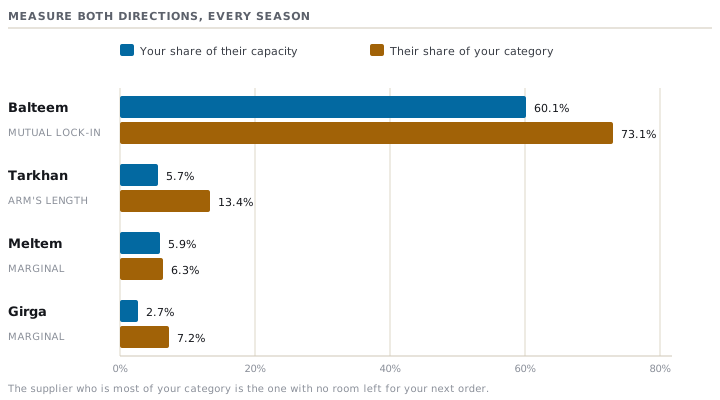
Read the two percentage rows against each other. The base stops being a list of names.
Balteem, at 60.1% and 73.1%, is not a supplier. It is a joint venture nobody signed. Duinhoven pays Balteem about USD 3.61 million a year. On Balteem's own prices that is roughly 60% of a turnover of about USD 6.0 million. The monthly payment run averages USD 300,700, and Balteem's deposits on next season's fabric are drawn against it.
That has a consequence most buyers never connect to themselves. When Duinhoven pays late, Balteem's capacity falls. The fabric order that fills the line in nine weeks is placed out of this month's receipts. Your payment behaviour is one of your supplier's production inputs.
Tarkhan, at 5.7%, cannot be moved for you. That is arithmetic, not attitude. On 6 February Verhoek asked Tarkhan to bring a 4,000-piece delivery forward by two weeks. The answer was no. Those two weeks belonged to a buyer holding 31% of Tarkhan's year. Nothing about the relationship was wrong. There was simply somebody heavier in the queue.
Meltem, at 5.9% and 6.3%, is small in both directions. Quick, flexible, never a priority, and easy for either side to lose without noticing. That is not a criticism. Lesson 3 argues that a supplier in this position can be the most valuable thing in the base, and prices it.
The direction nobody measures
Buyers measure supplier concentration in money: what share of my spend goes to whom. Very few measure it in units of a category. That is the measure that decides what happens when a site stops.
Balteem is 73.1% of Duinhoven's outerwear. Suppose Balteem loses a week to a fire, an audit stop, a customs seizure, or a bank refusing a letter of credit for fabric. A letter of credit is a bank's promise to pay the supplier once the shipping documents are correct, and a mill will not release yarn without one. Duinhoven then loses roughly three quarters of a category. Not three quarters of a supplier.
The two directions also interact in a way that catches people out. The supplier who is 73.1% of your category is the one who cannot take your new order. That is precisely because you have already given them everything they can hold. Balteem could not quote DH-7420: its minimum is 25,000 pieces a style, and its lines were full of Duinhoven's other outerwear.
Concentration does not only add risk. It removes the option you would use to manage the risk.
Check yourselfDuinhoven is 60.1% of Balteem's capacity. Does that make Duinhoven safe there?Show the answer
It makes Duinhoven important there, which is not the same thing. It buys priority in the queue and fast decisions. It also means Balteem's solvency, its fabric deposits and its audit status are now Duinhoven's exposure as well as Balteem's. There is no exit that does not cost a season. And it does not create one extra minute of capacity. Past about half a factory, importance and safety point in opposite directions.
Prompt · Screen my vendor base against this one order
The morning a range is signed off, and you are about to send a costing request to everyone on the approved list.
Act as an experienced sourcing manager at a clothing retailer. I want my approved supplier list screened against ONE order before I ask anybody for a price. The order: buyer [BUYER], style [STYLE CODE], product [DESCRIBE THE GARMENT, INCLUDING ANY OPERATION THAT NEEDS A SPECIAL MACHINE], quantity [TOTAL] split by colour as [COLOUR: QTY, COLOUR: QTY], target FOB [PRICE], retail [PRICE], ex-factory [DATE], in distribution centre [DATE], in store [DATE]. My approved list, one supplier a line: [NAME, COUNTRY, LINES, OPERATORS, LAST ORDER DATE, MINIMUM PER STYLE, MINIMUM PER COLOUR, AUDIT VALID TO, RE-AUDIT BOOKED FOR, CATEGORIES MADE FOR ME IN THE LAST 24 MONTHS WITH QUANTITIES, FREE LINE-DAYS IN MY WINDOW]. Do the following. First, run a five-stage screen: on the list, active, compliance valid THROUGHOUT the production window with 30 days of margin, category-capable by pieces made rather than by claim, and able to take my quantity at or above BOTH minimums. Give me the count surviving each stage, with the name and the reason for every supplier that fell out. Second, flag any supplier that survives only because I screened compliance on today's date rather than on the last day of production. Third, for each survivor, list the operations in this style that are NEW to that factory, and say which machine or subcontractor each one needs. Fourth, tell me which suppliers my colour split rules out even though the total quantity does not. Fifth, name the questions I should ask each survivor before I ask for a price, and say what a bad answer to each one looks like. Do not rank them on price; I have not asked for prices yet. If a field is missing for a supplier, say so and treat it as unknown rather than assuming it is fine.
AI can make mistakes — check anything you act on.
What to take away
- Screen the approved list against this order before you ask anyone for a price. A base of 22 is routinely a base of 5 for a given style, and finding that out in February is free.
- Capability is four facts, not one: machines, category miles, minimums per style and per colour, and capacity you hold.
- A capacity hold with no product class, no quantity band, no dates and no consequence is not a hold. Price the consequence. It is usually a quarter of the line cost, and it costs you nothing when you use the capacity.
- Measure your weight at each supplier, and their weight in your category. Both numbers, every season.
- Past about half a factory you are no longer a customer. You are part of its balance sheet, and it is part of your risk register.