Lessons · Lesson 2 of 3
Matching the order to the maker
Take one order to five suppliers, choose the cheapest qualified quote, and follow it all the way to what it actually cost.
Lesson 2 of 3 · 40 min
The gap that had to be closed
The cheapest quote is the easiest decision in this job to defend. It is also one of the easiest to get wrong.
This lesson follows one price from the quotation sheet to the end of the selling season. It separates two totals that rarely match: what the supplier invoiced, and what the season actually cost. It also explains why one factory quotes wildly different prices for what looks like the same garment.
DH-7420 was costed into the autumn range at FOB USD 21.50. That number is not a wish. Behind it sits a range plan with a retail price of USD 79.95, an intake margin the finance director signed, and 40 other styles whose numbers move if this one does. Intake margin is the gap between what you pay the factory and what you plan to sell at, before any markdown.
So when the quotes came back, Verhoek was not choosing between suppliers in the abstract. On the cheapest factory that had both made the category and cleared compliance, she was USD 1.40 a piece over her own plan, which is USD 25,760 on the order. And she was looking at another quote USD 1.70 under it.
Nothing in this lesson is about a merchandiser being careless. Everything in it is about a merchandiser being under a target, with a defensible choice in front of her.
Five quotes
| Tarkhan | Girga | Balteem | Meltem | Idfu | |
|---|---|---|---|---|---|
| FOB quoted | USD 22.90 | USD 19.80 | USD 24.10 | USD 26.40 | USD 21.60 |
| Minimum per style | 3,000 | 8,000 | 25,000 | 1,500 | 6,000 |
| Minimum per colour | 1,200 | 2,500 | 5,000 | 500 | 2,000 |
| Padded jackets, last 24 months | 84,000 pieces, 11 styles | none | 341,000 pieces, 38 styles | 62,000 pieces, 24 styles | 47,000 pieces, 9 styles |
| Free line-days in the window | 90 | 240 | none | 44 | 120 |
| Audit valid to | 11 March 2028 | 29 January 2028 | 4 November 2027 | 2 June 2028 | 11 July 2027 |
| Quoted lead time, days | 95 | 105 | 90 | 55 | 100 |
Balteem is out twice over. Its minimum is 25,000 pieces a style against an order of 18,400, and it has no free capacity. As lesson 1 showed, Duinhoven has already filled it.
Meltem is out on price at this shape, at USD 3.50 a piece over Tarkhan. Hold that phrase, at this shape. It turns out to matter.
That leaves three. One of them is about to be removed by something that is not a price at all.
The veto that was a date
Idfu Clothing quoted USD 21.60. That was the cheapest quote from a factory that had actually made the category, USD 23,920 below Tarkhan on the order, and within a hair of the plan.
Its social-compliance audit is valid to 11 July 2027. Production runs 20 May to 24 July. So the last thirteen days of the order would be sewn at a site whose audit had lapsed. Duinhoven's own supplier manual forbids that. It is Duinhoven's own rule, not a legal requirement.
The re-audit was booked for 3 September, the auditor's next free slot in that governorate. Nothing could be brought forward.
So Idfu was vetoed by a date in a field nobody reads.
A price is a price for an order shape
Verhoek is now choosing between Tarkhan at USD 22.90 and Girga at USD 19.80. Before you watch her choose, look at what those two numbers actually are.
| Order shape | Tarkhan | Girga | Meltem | Idfu |
|---|---|---|---|---|
| 18,400 pieces, 3 colours, 95 days | USD 22.90 | USD 19.80 | USD 26.40 | USD 21.60 |
| 4,200 pieces, 4 colours, 95 days | USD 24.70 | USD 25.80 | USD 26.90 | USD 23.90 |
| 900 pieces, repeat, 40 days | declined | declined | USD 28.20 | declined |
Girga is USD 3.10 cheaper than Tarkhan on the first shape and USD 1.10 dearer on the second. Meltem is USD 3.50 dearer on the first, and is the only quote at all on the third.
A factory does not have a price. It has a price curve, and the shape of the curve is set by what it costs to start.
You can read that off the quotations. Girga's letter breaks out USD 3,400 a colour of set-up cost: the marker and the cutting lay, the thread and needle changes, first-piece approval on each colour, and the line re-balance afterwards. A marker is the cutting plan that lays every pattern piece onto the fabric width.
Three colours over 18,400 pieces is USD 0.55 a piece. Four colours over 4,200 pieces is USD 3.24 a piece. The set-up did not change. The divisor did. That single line of the quotation moves Girga's price by USD 2.69 between the two shapes.
Meltem's set-up is USD 900 a colour, because its cutting room and its shorter lines are built for small lays. The same two shapes move Meltem's price by only USD 0.71.
That is the whole story of the third row. Meltem is expensive on a big single-colour run, and it is the only supplier in the base that can profitably take 900 pieces in 40 days. Matching the order to the maker means matching the shape, not reading the price list.
The decision
On 11 February Duinhoven placed DH-7420 with Girga Garment Works at USD 19.80.
Test that decision against every documented criterion. Girga was on the approved list. Its audit ran to January of the following year, well past production. It had capacity: 240 free line-days against the 90 the style needed. It met both minimums. Its quoted lead time of 105 days fitted the window. It had been a Duinhoven shirting supplier for four years, with no quality history worth writing down. And it was USD 31,280 under the range plan on a style the plan needed.
There is no box on Duinhoven's supplier selection form that Girga failed.
The box that does not exist on the form is the one in the capability table: padded jackets made in the last 24 months — none.
What happened, in order
Five sample rounds instead of two. A first prototype in a new category comes back with the wadding loft wrong, then the quilt pitch wrong, then the hood cord channel wrong. Loft is how much the filling puffs up; pitch is the spacing between quilt stitch lines. Each round is about 11 days and a courier. Three extra rounds cost USD 288 in courier charges, about USD 756 of Verhoek's own time, and three weeks of a calendar that had none to spare.
The quilting went outside. Girga had no quilting machine. It found a workshop 40 minutes away and declared it as a subcontractor rather than hiding it, which was the right thing to do. Declaring it still cost 9 days waiting for approval, plus USD 0.54 a piece. That arrived as a revised FOB of USD 20.34. The cheapest quote is very often the least complete quote, because a factory prices what it knows how to do.
The learning curve landed on the calendar, not the invoice. Girga costed the style at 52 standard minutes and 55% efficiency, which is its honest rate on a shirt. A Girga line of 30 operators at 55% makes 162 jackets a line-day. At the 34% it actually ran for the first three weeks, it makes 100. Across five lines that is 810 a day planned against 500 achieved. After 15 working days the order was 4,650 pieces behind.
Note who pays for that. Girga absorbed the lost efficiency in its own margin. The FOB did not move. A factory's learning curve is not on your invoice. It is on your calendar, and the calendar is yours.
The first final inspection failed on quilt pucker at the panel joins and loose bar tacks at the hood cord. Both were new operations for that line. Sorting and rework cost 4 days and a re-inspection fee of USD 1,450.
Friday overtime clawed back 3 days. Net, the order left the factory on 9 August, 16 days late.
To save the launch, 4,800 pieces went by air. That was the allocation for the top 90 stores. Air against sea costs USD 3.94 a piece more. Girga and Duinhoven split the difference, so Duinhoven carried USD 9,456. The remaining 13,600 went by sea and reached stores in week 42, four weeks into a nine-week full-price window.
What it cost, in two parts
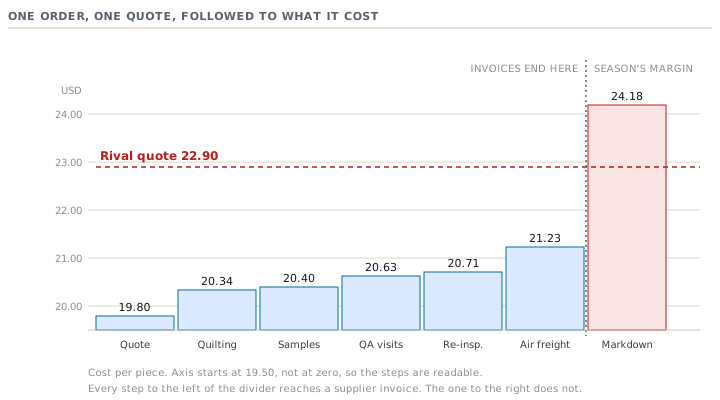
| Girga | Tarkhan | |
|---|---|---|
| FOB as quoted | USD 364,320 | USD 421,360 |
| Quilting subcontract added | USD 9,936 | — |
| Extra sample rounds, courier and time | USD 1,044 | — |
| Two extra quality visits | USD 4,360 | — |
| Re-inspection fee | USD 1,450 | — |
| Buyer's share of air freight | USD 9,456 | — |
| Everything an invoice carries | USD 390,566 | USD 421,360 |
| Per piece | USD 21.23 | USD 22.90 |
| Markdown on 3,400 late units | USD 54,366 | — |
| What the season actually cost | USD 444,932 | USD 421,360 |
| Per piece | USD 24.18 | USD 22.90 |
Read the middle of that table before the bottom. On every invoice Duinhoven's finance system holds, Girga was USD 30,794 cheaper, or USD 1.67 a piece. The supplier ledger, the landed cost report and the intake margin file all say the decision was right.
The last two rows are where the money went. The range planner's post-season reconciliation put 3,400 units of DH-7420 through the first markdown, on units the plan had at full price, because four of the nine full-price selling weeks were gone. At USD 79.95 retail and a first markdown of 20%, that is USD 15.99 a unit and USD 54,366 of margin.
So Girga cost Duinhoven USD 23,572 more than Tarkhan would have, or USD 1.28 a piece. The decision taken to protect a USD 25,760 overrun against the plan produced an overrun of USD 49,332.
Why the accounting hid it
The USD 54,366 does not sit in a supplier ledger. It sits in a markdown line owned by the range planner, in a different system, joined to a style and a store and a week. It is joined to no supplier at all.
That is why this decision repeats. Nothing in a normal buying office's reporting joins a markdown back to the factory that caused it. If your systems will not do it, do it by hand, once a season, for the five largest markdowns in your category, and write the cause beside each one. It takes an afternoon, and it changes next season's allocation more than any negotiation will.
Check yourselfGirga's efficiency shortfall never appeared on a Duinhoven invoice. Why did it still cost Duinhoven money?Show the answer
Because a factory absorbs lost efficiency in its own margin, but it pays for that in time, and the time is the buyer's. The FOB stayed at USD 20.34 while the order went 16 days late. That forced part of it into the air at a shared cost, and pushed the rest past four selling weeks. Efficiency is a supplier's problem. The delivery date it produces is a buyer's.
Prompt · Take this quote all the way to what it will actually cost
Before you place an order with a factory that is cheaper than the alternative but has not made this category.
Act as a sourcing director who has been burned by a cheap quote and has no interest in being polite about it. Compare two quotations on one order all the way to a delivered cost, including the costs that never reach an invoice. The order: style [STYLE], [QUANTITY] pieces in [NUMBER] colours split as [SPLIT], target FOB [PRICE], retail [PRICE], first markdown [PERCENT], ex-factory [DATE], in store [DATE], full-price selling weeks [NUMBER]. Supplier A: [NAME, QUOTE, PIECES OF THIS CATEGORY MADE IN 24 MONTHS, SET-UP COST PER COLOUR IF QUOTED, QUOTED LEAD TIME, EFFICIENCY THEY COSTED AT, EFFICIENCY ON THEIR LAST NEW CATEGORY, OPERATIONS IN THIS STYLE THAT ARE NEW TO THEM, SAMPLE ROUNDS THEY BUDGET]. Supplier B: [SAME FIELDS]. My own costs: quality visit [AMOUNT] each, sample courier [AMOUNT] each, my loaded hourly rate [AMOUNT], sea freight per piece [AMOUNT], air freight per piece [AMOUNT], re-inspection fee [AMOUNT]. Do the following. First, restate each quote as a price for THIS order shape, and show what each supplier's price would be at half the quantity and at double the number of colours, using their set-up cost. Second, build a delivered cost for each in two clearly separated blocks: everything that will appear on an invoice, and everything that will appear only in the season's margin. Third, estimate the calendar effect of any new-category work. Include extra sample rounds, subcontractor approval, and the days lost to a learning curve computed from the two efficiencies I gave you. Then turn the resulting lateness into pieces that miss the full-price window, and the markdown that follows. Fourth, give me the total for each supplier and the difference per piece, and state which one is cheaper on invoices and which is cheaper in the profit and loss account, because they may not be the same. Fifth, list the four questions I should ask the cheaper supplier before I place, with what a bad answer looks like. Label every estimate as an estimate, and give me the assumption behind it in a list at the end.
AI can make mistakes — check anything you act on.
The four questions that would have predicted all of it
Ask them before the price, and write the answers in the file.
- How many pieces of this category have you made in the last 24 months, and for whom? Girga: none.
- Which operations in this style are new to your lines, and where will each one be done? Girga: quilting, outside, in a workshop not yet declared.
- What efficiency did you cost this at, and what did you actually run on your last new category? Girga: costed at 55%, last new category ran 34% for three weeks.
- How many sample rounds do you budget for a first style in a new category, and who pays for the extra ones? Girga budgeted two and needed five.
None of those is a hard question. All four were available on 5 February, free, by email.
What to take away
- A quote is a price for one order shape. Ask for the set-up cost per colour and per style, and you can rebuild the curve yourself.
- Compliance status is a veto, not a criterion. Screen it against the last day of production, never against today.
- A factory's learning curve is paid in your calendar. If your order is its first in a category, you are buying the miles for whoever books it next.
- Build the delivered cost in two parts: what an invoice carries, and what the season carries. The second part is where the decision actually lives.
- Join at least your largest markdowns back to a supplier by hand each season. No system will do it for you, and the answer changes where you place work.