Lessons · Lesson 2 of 3
A date your own calendar can keep
Work an ex-factory date backwards from the shop shelf, run it against your own approval diary, and find the days you have already lost before you issue.
Lesson 2 of 3 · 40 min
Five dates, and only one of them is the order
A delivery date is not chosen. It is worked out backwards from the day the clothes have to be in the shops. You subtract the shipping, the packing, the sewing and the dyeing until you reach the day the factory must start. That much is ordinary practice. What almost nobody does is run the same arithmetic over their own office, where the decisions have to be made.
WN-7305 carries five dates. In most buying offices four of them are used interchangeably in conversation.
| Date | WN-7305 | What it actually is |
|---|---|---|
| Ex-factory | 10 July | the supplier's contractual obligation — the only date they can be judged against |
| On board | 16 July | the carrier's, not the factory's; it moves when a vessel moves |
| Arrival at the distribution centre | 17 August | a forecast, owned by nobody in this conversation |
| Intake window | 17 to 21 August | your own warehouse's promise to itself |
| In store | 31 August | what marketing has already told the customer |
The most expensive word on a purchase order is delivery, because each of these five people means a different one of those rows by it. When a factory says we will deliver on the tenth and a buying director hears the goods are with us on the tenth, thirty-eight days of ocean, port and inland haulage have been agreed away in a sentence. Write the field name, never the word: ex-factory 10 July. And write the date so it cannot be misread. The fact card below this lesson is about the one field on an order that can be wrong without anybody being wrong.
Only the first row is a contractual date on this order. The other four are consequences of it, and every one of them is somebody's plan.
Backwards from the shop shelf
The date on a purchase order is not chosen. It is worked out, and it is worked out from the end.
| Step | Date | Interval |
|---|---|---|
| In store | 31 August | — |
| Distribution centre intake | 17 August | fourteen days of goods-in, ticketing and allocation |
| On board at Chittagong | 16 July | thirty-two days of ocean and inland haulage |
| Ex-factory | 10 July | six days to the port cut-off |
| Last output off the finishing line | 2 July | eight days of final inspection, pressing and packing |
| First knitting day | 8 June | twenty-one available working days for twenty days of output at 930 pieces a day |
| Dyed yarn at the knitting floor | 25 May | fourteen days of winding and a knit trial |
| Bulk shade approval | 9 May | sixteen days of yarn dyeing |
That last row is the one that matters, and it is the only row on the whole table that Nabaganga cannot do anything about. Everything above it is manufacturing, and manufacturing can be pushed, split, subcontracted or run at overtime. 9 May is not a manufacturing date. It is a date in a buying office in Harrogate, and it is the date the factory quoted back to you on 12 February.
The other calendar, the one nobody draws
Here is Wrenfold's own diary for AW26. All of it existed on 9 February, when the order was raised.
| Wrenfold's calendar | When | Fixed by |
|---|---|---|
| AW26 range review — palette signed | 20 March | the range calendar, published in October |
| Colour standards issued by the colour studio | ten working days after sign-off | the studio's service level |
| Colour approvals signed | Tuesday afternoons only, under a light cabinet | the design director's standing sitting |
| Design director at the Paris fabric fair, then on leave | 20 April to 8 May | booked in November |
| Delegated authority for colour approval | none | never decided |
Now run the two calendars against each other. This is twenty minutes of arithmetic, and nobody in the building had ever done it.
- 20 March, the range review signs the palette. The order was raised six weeks before this meeting, because the lead time demanded it. So the ex-factory date on WN-7305 depended, from the day it was issued, on a meeting that had not happened.
- 3 April, ten working days later, the colour studio issues the four physical standards.
- 8 April, they arrive at Shitalakhya Yarn Dyeing in Narayanganj. Wrenfold has hit the first of the supplier's two conditions exactly, and everybody feels fine.
- 20 April, the dyer submits lab dips for all four shades. A lab dip is a small swatch dyed to your standard, sent for you to approve before bulk dyeing starts. The next colour sitting is the following afternoon, Tuesday 21 April.
- The design director is in Paris, and then on leave until 8 May. Nobody else signs colour, because nobody was ever appointed to.
- 12 May, the first Tuesday sitting after the return. Oatmeal and Bramble pass. Deep Fern and Damson are rejected — correctly; they are genuinely off.
- 22 May, round two is submitted. 26 May, the next sitting, both approved.
Bulk shade approval: 26 May. The date the supply calendar needed: 9 May. Seventeen days.
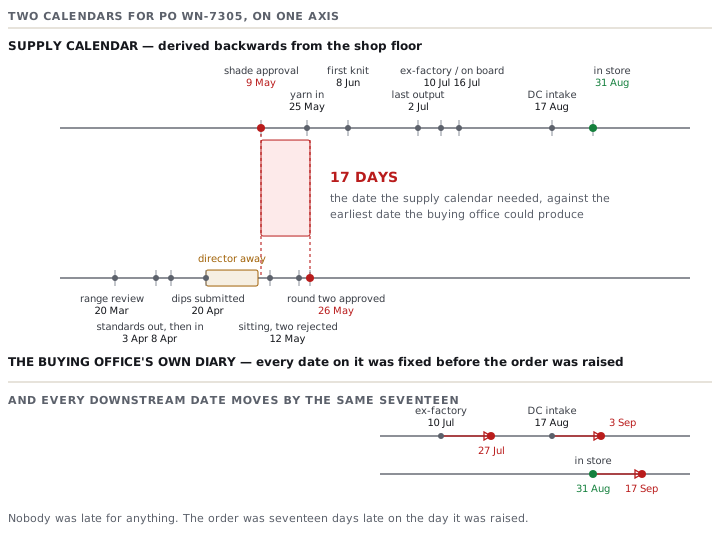
The mistake nobody made
Lay the seventeen days out and look for the person who was careless.
The merchandiser worked the ex-factory date back correctly from the in-store date, using the right transit time and the right production rate. The supplier accepted it and named its two conditions, in writing, on 12 February. The colour studio issued the standards inside its own service level. The standards arrived on the day the supplier asked for. The design director rejected two shades that deserved rejecting, at the first sitting they could possibly have been seen at. The Paris fair had been in the calendar since November, and going to it was the right thing to do.
Nobody was late for anything. Every individual commitment in the chain was met. The order was seventeen days late on 9 February, the day it was raised. The only thing that would have revealed it was somebody laying the two calendars side by side, and reading the last row of one against the first row of the other.
That is why this is a purchase-order lesson rather than an approvals lesson. How an approval is given, what it transfers and what a slow one costs is course 27.4's subject. What belongs here is narrower and earlier: the date you write on an order is a claim about your own calendar, and it is the only claim on the page nobody checks.
Seventeen days, priced on 12 May
Seventeen days moves everything: ex-factory 27 July, on board 2 August, into the distribution centre 3 September, in store 17 September. Three weeks of an eleven-week autumn knitwear window, gone.
Four options, priced the afternoon the arithmetic is finally done.
| Option | Extra cost USD | What it buys | What it does not fix |
|---|---|---|---|
| Take the delay | 0 | nothing | the launch moves to 17 September |
| Air the whole order | 44,640 | far more time than is needed | you cannot buy days in halves |
| Air Oatmeal and Deep Fern, sea the rest | 28,800 | the 31 August launch | Damson and Bramble land two weeks in |
| Cut Bramble from the buy | saves 2,700 pieces of stock | nothing | the constraint is an approval, not capacity |
Here is the arithmetic behind row three. A jumper is 0.50 kg chargeable once it is bagged and its share of the carton is counted. So the two lead colours — 12,000 pieces — are 6,000 kg. At the quoted USD 5.25 a kilo all-in from Dhaka, that is USD 31,200, less the USD 2,700 of sea freight those pieces are no longer using. Net USD 28,800, or USD 2.40 on every aired piece, which is 16.4% of the FOB price. Why air freight is priced by weight, and how a divisor works, belong to course 8.4. What belongs here is that the cheque is written by the buyer, on a delay the buyer caused. It is roughly the whole packing and trims cost of the order.
The fourth row is the one worth sitting with. Cutting Bramble feels like the responsible response to a late order: reduce the buy, reduce the exposure, shorten the run. It saves zero days. Oatmeal is the largest lot and dyes first, and the thing standing in the way is a signature rather than a machine. When the constraint is an approval, capacity decisions buy nothing.
The fix, and what it is worth
Four things, none of which is software.
- Put your own milestones on your own order. The six rows from lesson 1 become fields on the purchase order, with a date and a named owner each, and they are issued to the supplier with the order. A date the buyer owes that lives only in a merchandiser's head is not a date.
- Run the two calendars before you issue, not after. Take the earliest date your own diary can produce for each of your milestones — actual sitting days, actual leave, actual service levels — and compare it with the date the supply calendar needs. Twenty minutes, once per order, at the only moment the date is still movable.
- When they do not meet, choose in February rather than in May. There are three honest answers and no fourth: move the in-store date, buy the approval time back, or accept the freight bill now instead of discovering it later. The one thing you may not do is issue the date anyway and hope.
- Buy the approval time where it is cheap. A named deputy with authority to sign colour in the director's absence costs nothing, and would have been worth USD 28,800 on this order alone. Carrying over a shade already approved last season costs nothing either, and removes a whole round.
Prompt · Run my own calendar against the supplier's before I issue
The twenty minutes before an order goes out, while the date is still movable. Also any time a launch date arrives from someone who has never seen a lead time.
Act as a critical-path planner in a brand's buying office. I am about to issue a purchase order and I want to know whether the ex-factory date on it is a date my own company can actually support. Order facts: style [STYLE], quantity [QTY], colours [LIST], fabric or yarn [DESCRIPTION AND WHETHER IT IS DYED, PRINTED OR YARN-DYED], supplier [SUPPLIER], factory country [COUNTRY]. Fixed end point: in store [DATE]. Intervals I have or can estimate: warehouse goods-in and allocation [DAYS], transit from port to distribution centre [DAYS], port cut-off to on board [DAYS], ex-factory to port cut-off [DAYS], finishing and packing [DAYS], production rate [PIECES PER DAY] and working days per week [NUMBER], material into the factory before first cut or first knitting [DAYS], material lead time from approval [DAYS]. My own approval calendar: range or design sign-off [DATE], how colour standards are issued and how long that takes [DESCRIBE], when colour or fit approvals are actually signed [DESCRIBE THE MEETING OR CADENCE], any leave, trade fair, shutdown or travel in the window [LIST WITH DATES], whether anybody else is authorised to sign in the approver's absence [YES OR NO], and the lead time on anything a third party owes me — artwork, barcodes, nominated supplier prices [LIST]. Do the following. First, derive the ex-factory date backwards from the in-store date, showing every interval as its own row so I can argue with any of them. Second, build my own calendar FORWARDS and give me the earliest date each of my milestones can realistically be met, using my actual meeting cadence and absences rather than an average. Third, compare the two and tell me, in days, whether they meet — and if they do not, say exactly which of my milestones is the binding one. Fourth, give me three priced or dated options: move the in-store date, buy approval time back inside my own building, or issue the later date deliberately and decide the freight question now. Fifth, list the milestones I owe as dated lines with a named owner, in a form I can put on the order itself and send to the supplier. Do not smooth over a gap by shortening a manufacturing interval; if the calendars do not meet, say so plainly.
AI can make mistakes — check anything you act on.
Check yourselfYour supply calendar needs bulk shade approval on 9 May. Your own diary cannot produce one before 26 May. The order has not been issued yet. What are your options?Show the answer
Three, and they are all available today and none of them is available in May. Move the in-store date, which costs a conversation with the people who own the launch. Buy the seventeen days back inside your own building — a delegated signature, a carried-over shade, a range review brought forward, a standard issued before final sign-off. Or issue the later ex-factory date deliberately, tell the launch owners now, and put the freight decision in front of them while it is still a choice rather than a rescue. What is not an option is writing 10 July because 10 July is what the launch needs. The supplier will accept it, because your date is not the one they are measured on until it is.
What you should be able to do now
For any order you are about to issue, do three things. Work the ex-factory date backwards from the in-store date, with every interval named. List your own milestones with the earliest date your own calendar can actually produce. And say, before you press send, whether the two meet. If they do not, say by how many days, and put the three options in front of the person who owns the launch date while all three still exist.