Lessons · Lesson 1 of 3
The order is a promise you make
Read your own purchase order for what it commits you to, including the clause your company wrote that is your supplier's best defence.
Lesson 1 of 3 · 35 min
Monday 9 February 2026
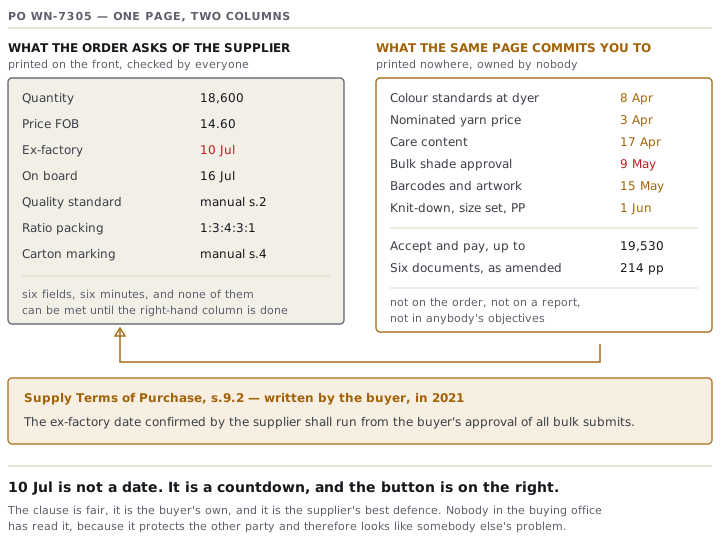
An order form for clothing reads like a set of instructions to a factory. Make this. This many. By then. Turn the same page round and it is a list of things the buying company has promised to do. Most of them are not printed on it. They are deadlines of its own, and rulebooks it agreed to without reading. This lesson goes through one such form from the buyer's side, including the sentence buried in the paperwork behind it.
You are a garment merchandiser in the Harrogate buying office of Wrenfold, a UK womenswear and knitwear brand with 190 stores. On your screen is a purchase order you are about to issue to Nabaganga Knitwear in Gazipur, Bangladesh. Filling it in took four minutes.
A word about the job title first, because it decides what this course is about. On the supply side a merchandiser runs the order. They sit inside the factory and get it made. In UK and European retail the same word means the numbers role: open-to-buy, phasing and allocation. There it is the buyer who selects the product. This course serves neither of those exactly. It serves the person at a brand or buying office whose job is to get what the buyer chose actually made, on time, in somebody else's factory. Call the role whatever your company calls it. What matters is the thing nobody says out loud on the day you are trained to use the system: when you issue a purchase order, you are not asking. You are promising.
- PO WN-7305, season AW26
- Style WF-3104, women's fine-gauge crew-neck jumper, 12gg, 55% merino / 45% acrylic
- Quantity 18,600 pieces — Oatmeal 7,200, Deep Fern 4,800, Damson 3,900, Bramble 2,700
- Sizes 8 to 18 at a ratio of 1:3:4:3:1
- Price USD 14.60 FOB Chittagong, Incoterms 2020
- Payment 60 days from the bill of lading date
- Ex-factory 10 July 2026 · on board 16 July · distribution centre intake 17 to 21 August
- In store 31 August 2026
Two terms on that list carry the rest of the course, so pin them down now. FOB means free on board: the price covers the goods loaded onto the ship at the named port, and every cost after that point is yours. Ex-factory is the day the finished goods leave the factory gate. It is not the day they reach you.
Order value USD 271,560. The Incoterms rule and the payment term are named on this order and taught elsewhere. What an Incoterms rule does and does not settle belongs to track 12, Trade and Customs. How an order actually gets paid belongs to track 13, Trade Finance. This course is about everything else on the page.
What you commit by pressing send
Six things, and only two of them are numbers most people check.
- To take the goods and pay for them. Not the goods you hoped for. The goods that comply with this order, in the quantity this order permits, which is not 18,600.
- To pay the stated price on the stated terms, counting from whatever event the order says starts the clock.
- To do, by fixed dates, the things only you can do. Colour standards, shade approvals, fit and knit-down sign-off, artwork, barcodes, and the price you agreed with a supplier you nominated. A knit-down is a small sample panel, knitted to prove the yarn and the stitch before bulk starts. None of this is on the front of the order. Every one of them is a condition of the date that is.
- To the Incoterms rule you selected, including the costs and risks it puts on your side of the line.
- To every document the order incorporates, including the versions of them that have not been written yet.
- To the variation regime — how this order may be changed, by whom, and in what form. That one cuts both ways, and lesson 3 is where it cuts towards you.
The documents behind your own signature
At the foot of the page, in the same size type as the delivery address:
This order is placed on the Wrenfold Supply Terms of Purchase and the Wrenfold Supplier Manual, as published on the supplier portal and as amended from time to time.
Six documents, 214 pages, and you have read two of them. That is not a confession. It is the normal state of a buying office, and the same sentence sits on the orders of almost every brand. But notice what is different about reading it from the issuing side.
You cannot vary these documents. Section 1.4 of the Supply Terms says no variation binds Wrenfold unless it is issued as a revised purchase order signed by an authorised signatory. So the sensible thing you agree with Nabaganga on a call — a later trim date, a split shipment, a relaxed carton count — is, on your own company's paper, nothing at all. Either your email is a variation you had no authority to give, or it is worthless. Which of the two it is depends on a clause you did not write.
They change without you. On 14 January the Wrenfold compliance team published a revised Packaging Annex. It requires a recycled-content polybag carrying a specific marking. No notice, no amendment, no price conversation. Nabaganga's polybag stock — 19,600 bags at USD 0.021, USD 411.60 — stopped being compliant, because the manual requires the version current at the date of shipment. You changed a supplier's costs without knowing you had, and without paying for it. It will come back to you next season as a price increase nobody can trace to a cause.
And one of them is your supplier's best defence, written by your own company. Section 9.2 of the Supply Terms:
The ex-factory date confirmed by the supplier shall run from the buyer's approval of all bulk submits.
A sourcing director put that there in 2021, tired of suppliers confirming dates they had never had. It is a fair clause and a defensible one. It also means the date on the front of your order is not a date. It is a countdown, and the start button is in your building. Lesson 2 is what happens when nobody notices that.
The tolerance field nobody changes
Field 12 on the Wrenfold template reads quantity tolerance plus or minus 5%. The clause behind it says the buyer shall accept and pay for any quantity delivered within tolerance.
Read that as a buyer and it stops being insurance. Plus 5% of 18,600 is 930 pieces you have agreed to buy and have not planned. That is USD 13,578 at cost, arriving in whichever sizes the knitting floor happened to produce, on a style you costed to sell at full price for eleven weeks. Nobody chose that number. It is on the template because it was on the template.
Now open your own goods-receipt settings. Wrenfold's receipt tolerance is plus 2%, which is 18,972 pieces. So a delivery of 19,120 pieces is contractually perfect and systemically impossible: 148 pieces more than the warehouse system will book in. It does not part-receive. It blocks the receipt, which blocks the three-way match between order, receipt and invoice, which blocks the whole invoice — not the excess, the whole USD 279,152 of it — while a supplier who did exactly what your contract permits waits to be paid.
Two numbers, set by two people, four years apart, neither of whom knew the other existed. Reconciling them takes three minutes. Decide the tolerance per order — zero on a fashion colour, plus 5% on a carry-over basic where the overage will sell — and make the receipt tolerance the same number. Do it before you issue, because after you issue, the number is a term of a contract.
Prompt · Read my own purchase order back to me
Before you issue an order on a template nobody in the building has questioned. Or the first time you run an order under a set of supply terms you did not write.
Act as a sourcing contracts manager on the BUYER's side, briefing a merchandiser who is about to issue a purchase order. I want to know what issuing it commits my company to, not what it asks of my supplier. Order facts: buyer [MY COMPANY], supplier [SUPPLIER], purchase order [NUMBER], style [STYLE], quantity [QTY] by colour [BREAKDOWN], size ratio [RATIO], price [PRICE] on [INCOTERMS RULE AND NAMED PLACE], payment [TERMS], ex-factory [DATE], on board [DATE], warehouse intake window [DATES], in store [DATE]. Quantity tolerance field says [VALUE]. Our goods-receipt tolerance in the ERP is [VALUE]. The order incorporates these documents by reference: [LIST THEM, WITH REVISION NUMBERS AND DATES IF YOU HAVE THEM]. Paste of the supplier's confirmation: [PASTE IT VERBATIM]. Do the following. First, list every obligation the ORDER places on ME, separately from the obligations it places on the supplier, and say which of mine has a date and which does not. Second, take the tolerance clause and tell me the maximum quantity I have agreed to accept and pay for, in pieces and in money, and whether my receipt configuration can actually book that quantity — if the two numbers differ, tell me what happens to the invoice. Third, go through the incorporated documents and name, for each, the clause most likely to cost ME money or make MY supplier's date conditional; flag any clause that limits my remedies or that lets my own colleagues change the supplier's obligations without an amendment. Fourth, read the confirmation and tell me whether it is an acceptance or a counter-offer, and list every condition in it that is mine to meet, as dated lines with an owner. Fifth, give me the five questions I should be able to answer from the paper before I press send. Do not tell me what is customary; tell me what this order says. Where a document is missing, ask me for it rather than assuming its contents.
AI can make mistakes — check anything you act on.
A confirmation is not a tick box
Nabaganga reply on 12 February. The reply is not the word confirmed.
Ex-factory 10 July accepted, subject to colour standards in Shitalakhya Yarn Dyeing's hands by 8 April and bulk shade approval by 9 May. Yarn dyeing is sixteen days and cannot start before approval.
That is a counter-offer, and an unusually honest one. It accepts your date and names the two things that have to be true for the date to exist. Both of them are yours. It even gives you the arithmetic.
Your order-management system recorded it as confirmed. A checkbox. A yes-or-no field cannot hold a condition, so the two dates in that email were stored nowhere, appeared on no report, and were owned by no one. Everything that goes wrong in lesson 2 lives inside those two dates, and your supplier handed them to you eleven days after you raised the order.
The fix is not a system change, though a system change would help. It is a habit: a confirmation is read, not ticked. Anything conditional in it is copied onto the order as a dated line with a named owner before the confirmation is accepted. If your system has nowhere to put it, put it in the order's notes and in your own calendar. A condition nobody can see is a condition nobody will meet.
What you owe, with dates on it
This is the list that does not appear on a purchase order anywhere, and it is the half of the contract you can actually control.
| What Wrenfold owes | By | What stops if it is late |
|---|---|---|
| Colour standards physically at the yarn dyer | 8 April | yarn dyeing cannot begin |
| Bulk shade approval, all four colours | 9 May | yarn dyeing cannot begin, day for day |
| Nominated yarn price agreed with the spinner | 3 April | greige yarn is not ordered |
| Care content and the second care-symbol set | 17 April | trims are not ordered |
| Knit-down, size set and pre-production approval | 1 June | bulk knitting cannot begin |
| Barcodes and swing-ticket artwork | 15 May | finishing and packing stop |
Greige in that table means undyed yarn, straight off the spinning frame.
Six rows. Two of them are approvals a single person signs. One is a price negotiation with a third party. One is a set of numbers only your own company can issue, because your own company owns the licence for them. None of them costs money. All of them cost days, and days on this order are worth what lesson 2 says they are worth.
Check yourselfYour supplier confirms the ex-factory date and adds two conditions, both of which are things you owe. Has the order been confirmed?Show the answer
The date has been accepted and the order has not. What came back is a counter-offer: the supplier will hold 10 July if two events happen by 8 April and 9 May, and both events are inside your building. Treating that as a confirmation records an unconditional promise the supplier never made, and it is the buyer who is misled by it. The supplier knows exactly what they said. Copy both conditions onto the order as dated lines with a named owner, then accept.
What you should be able to do now
Take the last order you issued and answer five questions from the paper, not from memory.
- What quantity have I agreed to accept and pay for, and does my warehouse system agree with that number?
- Which documents does this order incorporate, which version, and when did I last look at them?
- Which clause in my own terms makes my supplier's date conditional, and on what?
- What did the confirmation actually say, as against what my system recorded?
- What do I owe, by when, and who signs it?
If the fifth answer is a shrug, the order is not yet an order. It is a request with a date attached, and lesson 2 is what that costs.