Lessons · Lesson 1 of 3
One calendar, many suppliers
Build one dated calendar across a whole book of orders, and find the one number that lets you compare a parka in Turkey with a tee shirt in Bangladesh.
Lesson 1 of 3 · 45 min
The desk
To keep one order on track you need to know its own chain of dates. Keeping a whole season on track is a different problem. The orders are not alike. Some are a few days' drive away. Some are a month's sailing. Comparing their delivery dates will not tell you which one is in the most trouble. So this lesson fixes the calendar to a different day: the day the goods must reach the warehouse.
Wednesday 3 June 2026, a buying office in Leeds. Bryony Calder looks after outerwear and jersey at Hollowell, a mid-market British clothing brand. Her autumn/winter 2026 book is:
- 41 live orders, placed between the middle of March and the first week of April
- 9 factories in five countries: Turkey, Portugal, Egypt, India and Bangladesh
- 553,800 units, FOB value USD 3,824,880
- all of it landing in one distribution centre at Wakefield, in a receiving window that opens on 28 September and closes on 20 November
FOB is short for free on board. It is the price of the goods loaded on the ship at the export port, before freight and duty.
A word first, because one job title means several different things and this course is about one of them. On the supply side a merchandiser runs the order. She sits inside the factory and gets the goods made. In UK and European retail a merchandiser is the numbers role: the buying budget, the allocation to stores, the weekly sales and stock. There the buyer chooses the product. Bryony is neither of those. She is the third kind, and it is the kind this track serves: the person at a brand or a buying office whose job is to get what was bought actually made, on time, by nine factories she does not manage. Some companies call her a production merchandiser. Some call her a sourcing merchandiser. Some call her a critical path manager. The work is the same.
She has one screen, forty-one orders, and about four and a half hours a week to look at them.
What does not scale
Course 7.1 builds one order's critical path from the factory's chair. A critical path is the chain of steps that decides the finish date: hold up any link in it and the whole order moves. That course works backwards from the vessel, through the port cut-off dates, the sewing arithmetic and the fabric lead time, to a latest start date and two days of float. That is the right way to build one calendar, and you should not build one any other way. Go and read it if you have not.
It does not scale to forty-one. Not because the method is wrong, but because you do not own the inputs. You do not know Gemlik's line balance. You do not know Rupganj's holiday plan. You will never know either well enough to rebuild their calendars from the outside. Each of the nine factories will send you a Time and Action calendar, which is that factory's own dated plan for the order. Nine formats, between 22 and 61 milestones each, three different ways of writing a date. Try to hold all of that and you will hold none of it.
So a portfolio calendar is a different thing. It takes each supplier's chain length as a given: one number, the days from today until the goods leave the factory on the longest chain. That moment is called ex-factory, the day the finished goods leave the factory gate. The calendar then spends its effort on the two things a factory cannot do for you:
- Making forty-one unlike orders comparable, so you can sort them.
- Deciding which claims you believe, because every one of those numbers arrived by email from somebody who would rather you did not worry.
The anchor is the door, not the ship
Here is the first thing that breaks when you go from one order to many.
Course 7.1 fixes its calendar to the vessel: 14 October, on board at Alexandria. That is the right anchor for a factory, because the factory's obligation ends at the ship's rail. Yours does not. Hollowell has to have stock in Wakefield in time to pick it, send it to the stores and get it on the shop floor for a promotion. So the fixed point of a portfolio calendar is the DC date, the day the goods must be at your distribution centre. Every order's ex-factory date is that date minus its own transit time.
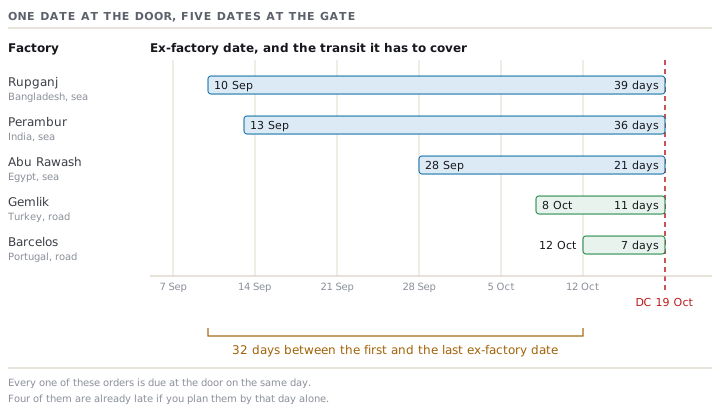
Take the orders in this book that all have to be in the DC on Monday 19 October.
| Factory | Country | Mode | Ex-factory to DC | Latest ex-factory |
|---|---|---|---|---|
| Rupganj Fashions | Bangladesh | Sea | 39 days | Thu 10 Sep |
| Perambur Knits | India | Sea | 36 days | Sun 13 Sep |
| Abu Rawash Apparel | Egypt | Sea | 21 days | Mon 28 Sep |
| Gemlik Konfeksiyon | Turkey | Road | 11 days | Thu 8 Oct |
| Barcelos Malhas | Portugal | Road | 7 days | Mon 12 Oct |
One date at the door, five ex-factory dates spread across 32 days. Rupganj must finish sewing a month before Barcelos starts thinking about it, and both are equally on time.
This is not a small point. It is the commonest reason a buyer's calendar is quietly wrong. Somebody writes "week 42" against every order in a delivery, and the far factories read that as their own finishing week. Four of the nine are a month late before anyone has done anything wrong. Write the DC date and the ex-factory date on every line, always. Never let one of them travel alone.
The one number that makes unlike orders comparable
Forty-one orders, eleven product types, chains from 46 days to 129. You cannot sort them by ship date: a September ship date on a tee shirt is comfortable, and a November one on a parka is not. You cannot sort them by percent of milestones complete either. The milestone lists are different lengths, so a supplier who has done four cheap things looks better than one who has done a single expensive one.
There is exactly one number that works, and it is a subtraction:
float = days from today to the DC date − days of work still left on the critical chain
Both halves are in days. Both halves are known. And the difference means the same thing on every order in the book, in every category, at every supplier: the number of days this order can lose before it is late. That number is the float. A negative float is not a risk. It is a fact: the order is already late and nobody has said so yet.
| Order | Factory | Product | Units | FOB value | DC date | Days to DC | Chain left | Float |
|---|---|---|---|---|---|---|---|---|
| HL-8817 | Gemlik | Padded parka | 6,400 | USD 138,240 | 19 Oct | 138 | 127 | 11 |
| HL-8802 | Rupganj | Long-sleeve tee | 31,000 | USD 127,100 | 12 Oct | 131 | 118 | 13 |
| HL-8823 | Perambur | Interlock dress | 7,200 | USD 67,680 | 26 Oct | 145 | 122 | 23 |
| HL-8829 | Abu Rawash | Brushed sweat | 9,800 | USD 87,220 | 2 Nov | 152 | 129 | 23 |
| HL-8836 | Perambur | Rib polo | 8,600 | USD 67,940 | 19 Oct | 138 | 115 | 23 |
| HL-8808 | Gemlik | Quilted gilet | 5,100 | USD 88,740 | 9 Nov | 159 | 127 | 32 |
| HL-8845 | Rupganj | Jersey tee | 27,500 | USD 104,500 | 16 Nov | 166 | 118 | 48 |
| HL-8791 | Barcelos | Repeat jersey | 4,500 | USD 27,900 | 5 Oct | 124 | 46 | 78 |
Read the two ends of it. HL-8791 has the earliest DC date on the board and the most room of any order in the book. Its fabric is a carry-over already sitting in Barcelos's store, so the chain is only 46 days long. HL-8817 has eleven days of room. A padded parka needs a shell fabric, a wadding, a lining, a two-way zip, a moulded puller and a label. Every one of them has to arrive before the first panel is cut.
If you asked both factories on 3 June whether they were on track, both would say yes. Both would be telling the truth. Only one of them is worth twenty minutes of your Thursday.
Check yourselfTwo orders both report 40% of milestones complete. Why does that tell you nothing about which is at risk?Show the answer
Because a share of milestones is a share of a list somebody else wrote, and the lists are different lengths and unequally weighted. On a jersey order with fourteen milestones that share is four lab dips (dyed swatches sent to you for colour approval) and a trim approval, which are days of work. On a parka with thirty-one milestones the same share can be reported while the shell fabric, which is 52 days of the chain, has not been ordered. Float is a subtraction in days and does not care how the list was written.
Green is a claim until a document says otherwise
Nine factories report to Bryony every week. All nine report in colours. On 3 June, thirty-eight of the forty-one orders are green.
A colour from a supplier is not evidence. It is the absence of a complaint, and a supplier has good reasons not to complain. A problem raised in June is a problem they own for four months. A problem raised in September is a problem you share. That is not dishonesty. It is where the incentive points. Plan for it.
The test that costs nothing and changes everything is this: is there a document, with a date on it, produced by somebody who was not selling me the answer?
| Claim | What backs it | Worth |
|---|---|---|
| Fabric inspected and passed | A four-point report with roll numbers and a date | Evidence |
| Lab dip approved | Your own team's stamped decision, in your register | Evidence |
| Space booked | The forwarder's booking confirmation, naming a vessel | Evidence |
| Yarn secured | The mill's order acknowledgement to the factory | Good, if you see it |
| Fabric in-house | A roll count that matches the invoice | Weak: in-house is not inspected |
| Cutting started | A date typed into a report | Weak |
| On track | Nothing | Nothing |
Be hardest about fabric in-house. It is the milestone most likely to be true and useless at the same time. Rolls in a store are not metres you can cut. Between the two sits a four-point inspection: an inspector walks each roll, scores every fault by its size, and the roll passes or fails on the points it has picked up. If that report does not exist, the milestone is unproven, however many rolls are stacked against the wall. In the third lesson you will meet an order that stayed green for fourteen weeks on exactly that gap.
Check yourselfA supplier's weekly report shows every milestone green and their ex-factory date has not moved for eleven weeks. Reassuring?Show the answer
No, and it is the least reassuring pattern on the board. A real factory's dates move: fabric slips two days, a holiday lands badly, a machine goes down, an approval comes back late. Eleven weeks of perfect stillness means the report is being generated rather than observed. Ask one question with a document behind it, such as send me the four-point report for the shell fabric, and see how long the answer takes.
What you own at the end of this lesson
One board, forty-one rows, sorted by float, with a DC date and an ex-factory date on every line and a source column that says what backs each claim. It takes about two hours to build the first time and twenty minutes a week to keep.
Prompt · Turn nine supplier calendars into one float board
The week your season's orders are all placed and you are holding a different Time and Action calendar, in a different format, from every factory in your base.
Act as a buyer-side production merchandiser who runs a portfolio of orders across several factories. Build me one comparable float board. Portfolio facts: brand [BRAND], season [SEASON], number of live orders [NUMBER], factories and countries [LIST THEM], receiving window at my distribution centre [DATES], today's date [DATE]. For each order I will give you: order reference, factory, product, units, FOB price, required date at the distribution centre, and whatever the factory has sent me about its own plan. Here they are: [PASTE ONE BLOCK PER ORDER]. My door-to-door transit figures, if I have them, are: [FACTORY, MODE, DAYS]. Do the following. First, for every factory tell me the door-to-door transit you are using and say whether I gave it to you or you assumed it, and list what a door-to-door figure has to include that a port-to-port quotation does not. Second, convert every order's distribution-centre date into a latest ex-factory date and show both on the same row. Third, estimate the remaining critical chain in days for each order from what the factory has told me, and say plainly which orders you had to guess at and what the guess turns on. Fourth, compute float as days to the distribution-centre date minus the chain remaining, and give me the board sorted by float ascending, with order, factory, product, units, FOB value, distribution-centre date, latest ex-factory date, chain remaining and float. Fifth, list every order with negative or single-figure float and, for each, name the one milestone that is holding the chain. Sixth, tell me which of my inputs is a claim rather than evidence, and for each one name the dated document that would settle it. Do not report an order as on track anywhere. Report float in days or report that you could not compute it and why.
AI can make mistakes — check anything you act on.
It will also tell you something you will not enjoy. Sort the book by float and count the orders with fewer than fifteen days: on 3 June there are seven of them, and four are at the same two factories. That is not forty-one problems. It is two conversations, and you now know which two.
The next lesson is about the constraint you have not put on the board yet, because it is not at any of the nine factories. It is your own desk.