Lessons · Lesson 2 of 3
The buyer is on the critical path
Count the approval decisions a portfolio owes you, find the queue they sit in, and see what a week of correct decisions in the wrong order costs one order.
Lesson 2 of 3 · 45 min
The step that is not at a factory
Everyone in a buying office thinks of delay as something that happens at factories. A good deal of the waiting happens in the office itself. Samples, colours and artwork all have to be looked at and signed off by somebody. While they sit in a queue, nothing at the factory can move. This lesson counts that waiting properly. It also separates how fast a queue is worked from the order it is worked in.
Every chain in the last lesson runs through the same desk at least eight times. Lab dips come to you. Strike-offs, which are trial prints of the artwork on the real fabric, come to you. Fit comments, size sets, the pre-production sample, trim and label artwork, care and packing instructions, the test report, the release to inspect: all of them stop at Leeds, wait, and go back.
Count them properly, because nobody ever has. Across Bryony's forty-one orders:
- 14 basic jersey orders at 10 decisions each
- 18 mid-complexity orders at 13 each
- 9 outerwear orders at 16 each
518 decisions, spread over the 23 weeks from the middle of April to the end of September. An average of 22.5 a week.
That average is the most misleading number in this course, and the rest of the lesson is about why.
Three queues wearing one badge
The 518 are not one population. They are three, and they behave completely differently.
| Kind of decision | How many | Who has to touch it | Mean turnaround |
|---|---|---|---|
| Bryony decides alone: lab dips against a standard, test reports, care labels, packing, trim colour, release to inspect | 350 | One desk | 1.1 days |
| Needs the fit session: proto, first fit, size set, pre-production sample | 97 | Garment technologist, Thursdays, six slots | 7.8 days |
| Needs design sign-off: prints, embroidery artwork, badge and label graphics | 71 | Design, one afternoon a week | 9.4 days |
Turnaround here means the whole wait: from the day the item lands to the day the answer goes back.
Hollowell's supplier manual promises a decision within three working days. Bryony's dashboard reports her average turnaround for this season as 2.4 days, and she is inside the standard on 97% of what it counts.
Both statements are true. The dashboard counts the 350. When a sample goes to the fit session, or artwork goes to design, the item is logged as with technical or with design and the clock stops. The measure leaves out exactly the two thirds of the wait that a factory actually experiences.
Do the subtraction the dashboard does not do. Door to door, all 518 decisions:
(350 x 1.1 + 97 x 7.8 + 71 x 9.4) / 518 = 3.5 days
Three and a half days against a promise of three. Nobody has ever seen that number, because no report is built to produce it. It is the first thing to go and build.
Why the wave, not the average, sets the wait
Look at the design queue on its own. Seventy-one decisions over 23 weeks, against a capacity of about 6.3 an afternoon, is 49% utilisation. Utilisation is simply how much of the desk's capacity the work uses up. On that number there is no problem at all.
But artwork does not arrive evenly. It arrives after fabric quality is settled and before bulk cutting, which for this book means a nine-week window from the middle of June. Seventy-one decisions in nine weeks is 7.9 a week against a capacity of 6.3. So during the wave the desk runs at 125%, the queue grows by about 1.6 items a week, and by the end of the wave it is roughly fourteen deep. An item joining the back of that queue waits more than a fortnight, on a desk whose season-long utilisation is under half.
The fit session does the same thing more sharply. Ninety-seven samples against 138 slots is 70% for the season. But 62 of them land in eight weeks, which is 7.75 a week against six slots. The queue peaks about fourteen deep, or sixteen days of waiting to be looked at.
This is not a Hollowell problem or a Bryony problem. It is what queues do. Waiting time does not rise gently as a desk fills up. It accelerates, and it is driven by the load in the weeks the work actually arrives rather than by the season's average. Bunched arrivals make it worse again, and a season of orders placed inside a three-week window guarantees bunched arrivals. The fact card on this lesson names the result that describes it.
The practical consequence is a planning rule, not a slogan: capacity planning on the average is planning for the weeks that were never going to hurt you. Plot the arrivals, find the wave, and size the desk for the wave, or move some of the wave.
The week that cost USD 13,152
Now the thing that actually happened, and the reason this lesson exists.
Monday 13 July 2026. Into Bryony's inbox that week come 35 items. She clears 24. Nothing in what follows is a failure of effort, judgement or care.
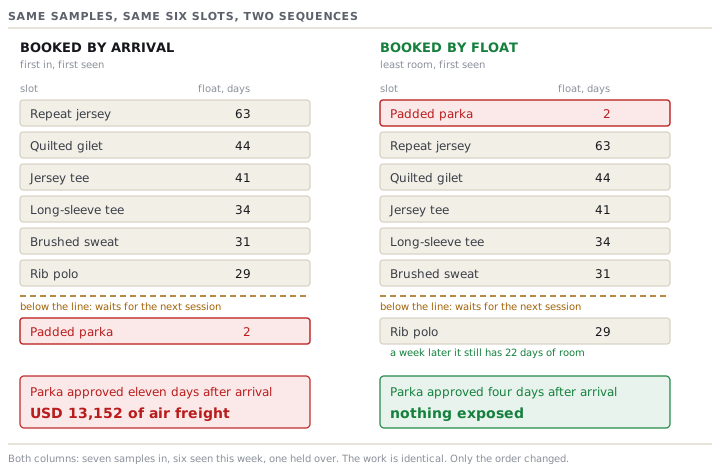
Six garments arrive on the Thursday and Friday before, 9 and 10 July. On Friday afternoon they are booked into the six slots of the fit session on Thursday 16 July, in the order they arrived. That rule is written down, it is fair, and every supplier knows it.
On Monday 13 July the pre-production sample for HL-8817, the Gemlik padded parka, clears customs and lands on the desk. The session is full. It goes to the next one, Thursday 23 July. The technologist measures it, the comments are written up, and the approval goes back to Bursa on Friday 24 July.
Eleven days. Every single one of them correct under the rule she was following.
Here is what was in the six slots it lost, and what each of those orders had to lose.
| Sample | Order | Arrived | Float that day |
|---|---|---|---|
| Repeat jersey | HL-8791 | Thu 9 Jul | 63 days |
| Quilted gilet | HL-8808 | Thu 9 Jul | 44 days |
| Jersey tee | HL-8845 | Thu 9 Jul | 41 days |
| Long-sleeve tee | HL-8802 | Fri 10 Jul | 34 days |
| Brushed sweat | HL-8829 | Fri 10 Jul | 31 days |
| Rib polo | HL-8836 | Fri 10 Jul | 29 days |
| Padded parka | HL-8817 | Mon 13 Jul | 2 days |
The parka had eleven days of float on 3 June. By the middle of July it had two: the shell fabric dip went to a second resubmit and the chain absorbed the difference quietly, which is what float does, and which course 7.1 covers on a single order.
So the eleven days went straight through the floor. Gemlik could not cut without an approved pre-production sample. Their plan cut on Monday 27 July. The approval landed on the 24th, by which time the cutting room had been given to another buyer, and the next free slot was Wednesday 5 August. Nine days lost at the cut, of which sewing overtime recovered two. Ex-factory moved from Thursday 8 October to Thursday 15 October.
Eleven days on a desk in Leeds became seven days at a factory gate in Bursa. On road transit of eleven days, 6,400 parkas would reach Wakefield on Monday 26 October: seven days after the DC date, and three days after the outerwear promotion opened on Friday 23 October.
Pricing the eleven days, and pricing the fix
Three ways out, priced on the Monday morning it became clear.
| Option | What it costs | Extra over plan |
|---|---|---|
| Everything by road as planned, three days after the launch | USD 3,904 | Nothing, and the launch is missed |
| Everything by air | USD 38,976 | USD 35,072 |
| The store launch quantity by air, the rest by road | USD 17,056 | USD 13,152 |
Air is priced on a chargeable weight of 1.4 kg a parka at USD 4.35 a kilo. Road is USD 0.61 a unit. The third option flies the 2,400 units the stores need for the launch and lets the other 4,000 follow by road as replenishment. It costs USD 13,152, which is 9.5% of the order's FOB value, or USD 2.06 on every parka in the order. Whether the alternative, accepting a late launch and a shorter selling season, is worth more or less than that is a range decision. It belongs to the buyer, not to you. Put it in front of them with the number attached.
Now price the fix.
Suppose the fit session had been booked by float rather than by arrival. The parka takes a slot on 16 July. The comments go back on the 17th. Gemlik cuts on plan on 27 July, the order ships on 8 October and lands in the DC on 19 October. One of the six original samples is pushed to the 23 July session, a delay of seven days. The tightest of those six was the rib polo at 29 days of float, which becomes 22.
The same 35 items arrived. The same 24 were cleared. The same technologist did the same work in the same six slots. Only the sequence changed, and the sequence was worth USD 13,152 against a cost of nothing.
That is the whole lesson. A queue's throughput is set by capacity, which is expensive to change. A queue's exposure is set by its ordering, which is free to change. Almost every buying office in the trade sorts its inbox by arrival, because arrival is the order it is presented in.
Check yourselfWhy is sorting the approval queue by float better than working harder, or hiring?Show the answer
Because it does not change the amount of work, so it costs nothing and needs nobody's permission. Extra capacity raises throughput and lowers everyone's wait a little; re-ordering moves the wait off the items that cannot absorb it and onto the items that can. In the week above, capacity would have had to rise by a fifth to clear the parka on time. Re-ordering cleared it with the capacity already there. Do the free thing first, then argue for the desk.
The rule, and its one exception
Sort every approval queue you control by the float of the order behind the item, recompute the float weekly, and break ties by arrival.
Prompt · Re-sequence this week's approval queue by float
The Friday afternoon you book next week's fit session, or any morning the inbox holds more decisions than the day holds hours.
Act as a buyer-side production merchandiser who has to clear an approval queue and cannot clear all of it. Here is what is waiting: [PASTE EVERY ITEM — WHAT IT IS, WHICH ORDER, WHICH FACTORY, THE DATE IT ARRIVED, AND WHO HAS TO TOUCH IT BESIDES ME]. Here is the float on each of those orders this week: [ORDER, FLOAT IN DAYS]. My capacity: I can decide [NUMBER] items myself this week; the fit session has [NUMBER] slots on [DAY]; design gives me [HOURS] on [DAY]. Do the following. First, split the queue into the ones I decide alone, the ones that need a physical session, and the ones that need another department, and count each group. Second, tell me the structural minimum turnaround for each group given how often the session and the department actually run, and say whether my published service standard is achievable for each group or arithmetically impossible. Third, produce next week's sequence sorted by the float of the order behind each item, with ties broken by arrival date. Fourth, list separately any item whose own deadline is not the order's ship date — a laboratory booking, a yarn option that lapses, a printer holding a slot — and put those first regardless of float, naming the deadline. Fifth, name every item that will NOT be cleared this week, the order it belongs to, and the float that order will have when it finally is. Sixth, for the tightest item in the queue, tell me what a delay of one more week does to the order's ex-factory date and what the recovery would cost, in money, at both air and sea. Do not tell me to work faster and do not propose extra headcount before you have exhausted the sequence.
AI can make mistakes — check anything you act on.
The exception is worth naming, because a rule with no exception gets applied stupidly. Some decisions have a deadline of their own that is not the order's ship date: a chemical test whose laboratory booking expires, a supplier's yarn option that lapses on Friday, an artwork approval a nominated printer holds a slot for. Those come first regardless of float, because their float is not the order's float. Everything else goes in float order.
What makes a good approval decision, what you are actually transferring when you sign, and what a rushed approval costs you later, is course 27.4's subject. It is a different question from this one. This lesson has been about the line the decision stood in.
The next lesson is about the forty-one orders you are not looking at.