Lessons · Lesson 2 of 3
The cost of the clock
Count the days your own office takes, learn why the same delay is free at one point and ruinous at another, and stop buying speed you do not need with certainty you do.
Lesson 2 of 3 · 36 min
The line no buyer's calendar has
Every company that buys clothes keeps a list of the dates its factories owe it. Almost none keeps the other list. That is the list of dates it owes the factories: samples waiting to be looked at, colours waiting to be signed. This lesson counts one order's worth of that waiting. Then it makes an awkward point. A day of silence has no fixed price.
On 17 February 2027, Brindlemere's order tracker showed BRD-2274 green. Every factory milestone was on its planned date or ahead of it. Cara Bellwood had not missed a thing, and neither had anybody else in Nottingham.
The tracker was accurate. It was also blind in exactly one direction, and it is the direction every buying office's tracker is blind in: it tracks the dates the factory owes you and has no row for the dates you owe the factory. Approval turnaround is the one activity on a critical path that a buyer performs and only a supplier measures.
So measure it. Here is the whole of it on this order.
| Submission | Received in Nottingham | Answered | Days taken | Days allowed | On the critical path |
|---|---|---|---|---|---|
| Lab dips, three shades | 12 Nov | 17 Nov | 5 | 3 | yes |
| Fabric quality | 19 Nov | 24 Nov | 5 | 3 | yes |
| Fit round 1 | 24 Nov | 2 Dec | 8 | 5 | yes |
| Embroidery sew-out, first | 1 Dec | 4 Dec | 3 | 3 | no |
| Embroidery sew-out, second | 8 Dec | 8 Dec | 0 | 3 | no |
| Trims, six items | 9 Dec | 21 Dec | 12 | 4 | no |
| Fit round 2 | 15 Dec | 24 Dec | 9 | 5 | yes |
| Bulk shade band | 4 Jan | 8 Jan | 4 | 3 | yes |
| Fit round 3 | 6 Jan | 11 Jan | 5 | 5 | yes |
| Size set | 18 Jan | 27 Jan | 9 | 5 | yes |
| Pre-production sample | 2 Feb | 12 Feb | 10 | 5 | yes |
| Carton and label artwork | 15 Feb | 17 Feb | 2 | 3 | no |
Seventy-two days taken against forty-seven allowed. That headline is the wrong number, and it is the one most buying offices quote at themselves. A day spent on something with slack behind it is not a day of anything.
Take only the rows on the critical path: fifty-five days taken against thirty-four allowed, twenty-one days over. The order carried nine days of float at PO stage. Float is the spare time in a plan: the days you can lose before the ship date moves. So twelve days had to come from somewhere, and they did not come from Brindlemere.
Where the twelve days came from
They came out of Kadamba, in two pieces, and Brindlemere paid for neither.
Kadamba ran a second sewing line for eleven days to compress the programme. That is an operations cost inside their FOB price. And the cutting room released the cut four days before the size-set approval landed, carrying the risk that the grade would come back with a correction. The priced, written-down version of that decision is in 7.7 lesson 3, and the factory's own way of thinking about it is 7.2 lesson 3. Neither appeared anywhere Brindlemere could see.
This is not an argument for guilt. It is an argument for arithmetic. A supplier who silently absorbs twelve days is a supplier who has just discovered what your account really costs. And it comes back. It comes back as a price, as a slower quotation next season, or as the day they run out of ways to absorb it and the order is simply late. 27.6 is about that day. What matters here is that the decision was taken by a factory and never appeared in a buyer's file.
Why the same delay costs nothing and then costs everything
Here is the part that is genuinely counter-intuitive, and it is why "answer approvals quickly" is advice rather than a method.
The cost of a day is not a property of the day. It is a property of what is booked behind it.
There are three regimes, and every approval you hold sits in one of them.
Nothing is committed yet. Money has not moved, no capacity is reserved, and the order still has float. A day here costs nothing at all, and you can spend it on being right.
Something is booked, and the booking is a slot. Supply chains are not smooth. They are queues with openings at fixed points. A dye house runs a ground colour on a cycle. An embroidery subcontractor lets its capacity in blocks. A vessel sails on a day. In this regime a day of delay does not cost a day. It costs the whole gap to the next opening, and that gap has nothing to do with how late you were.
The float is gone. Now a day is a day of the ship date, and it turns into money at whatever the fastest available recovery costs.
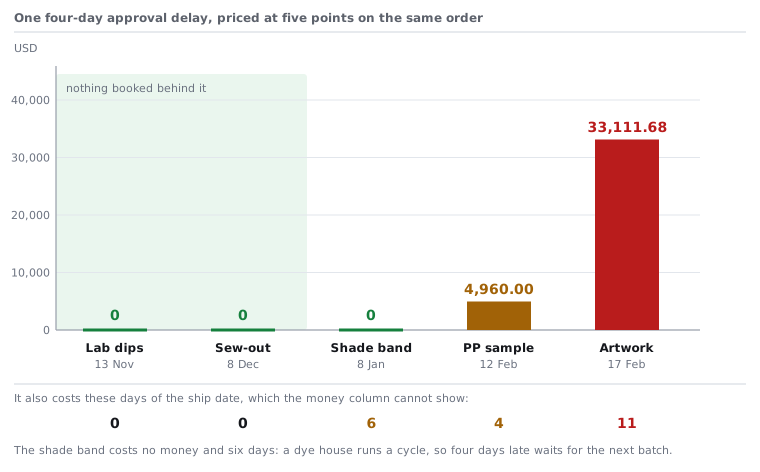
| Where the four days fall | Days it costs | Money it costs | Why |
|---|---|---|---|
| Lab dips, 13 November | 0 | 0 | Nothing is committed. The order still has nine days of float and absorbs it |
| Embroidery sew-out, 8 December | 0 | 0 | The physical sew-out was in Nottingham on 14 December, the day before the booking deadline |
| Bulk shade band, 8 January | 6 | 0 | The dye house runs this ground on a ten-day cycle. Four days late waits for the next batch |
| Pre-production sample, 12 February | 4 | 4,960.00 | Line loading moves. Kadamba holds two lines idle at USD 620 a line-day |
| Carton artwork, 17 February | 11 | 33,111.68 | Past the vessel cut-off. The next sailing lands outside the DC window, so the order flies: 8,512 kg at a differential of USD 3.89 a kilo |
Two things in that table are worth more than the rest of the lesson.
The first is that the cheapest day and the most expensive day are separated by nine weeks and nothing else. The same four days, the same office, the same person answering the same kind of question.
The second is that the second row is a zero and everybody believed it was a twelve. That is what the rest of this lesson is about.
How to find out what a day costs, before you spend it
You cannot price a delay from Nottingham. The information is entirely inside the factory. It takes one email and three questions, which any competent supplier answers in an hour, because the answers are already on their planning board.
- What is booked behind this approval, and when does that booking lapse?
- If it lapses, when is the next opening?
- What does the gap between those two dates cost, in days and in money, and who carries it?
Ask those three on every submission that matters. Most of the time you will find that the answer to the first is nothing is booked behind it. Then take the time and be right. And when something is booked, you will have the one number that lets you decide honestly between speed and certainty. That is the decision you are actually making every time you answer an email quickly.
The mistake nobody made
Tuesday 8 December 2026, 11:20 in Noida. Meharban Embroidery is the subcontractor that will run BM-3140's yoke. It finishes the second sew-out, EMB-2. Kadamba couriers the physical sample to Nottingham and, in the same hour, emails four photographs of it on the frame.
Cara knows the pressure. Kadamba must confirm Meharban's February capacity block by 15 December or lose it. Meharban will not hold a booking against an unapproved design, and the next block they can offer is twelve days later. That would land the embroidery after Kadamba's cut and unpick the whole programme.
Tuesday 8 December, 16:05 in Nottingham. Ruth Almeida approves from the photographs. The placement is right, the thread colours are right against the standard, the design is right. Zero days taken, against three allowed. It was noticed and it was praised, and in a buying office where the average is nine days it deserved to be.
The physical sew-out reached Nottingham goods-in on Monday 14 December, the day before the booking deadline. It was signed for and shelved, because the item was closed.
What the photographs could not carry
The sew-out was made on 118 g/m² viscose crepe with a 40 g/m² tearaway backing at 4.2 stitches a millimetre. Backing is the sheet held behind the cloth while the machine embroiders, so the ground does not move. A tearaway backing is torn off afterwards. A cutaway backing is trimmed and stays in the garment.
Photographed on the frame it is perfect, because on the frame the ground is under tension and cannot move. Off the frame and pressed, a light crepe with that much thread in it draws. The ground gathers slightly around the design and will not press flat. That gathering is called pucker.
A photograph of an embroidery on its frame is a photograph of the one condition in which the defect cannot exist.
The remedy, on the day it was free
On 8 December the correction was small and it was known: a 50 g/m² cutaway backing instead of the tearaway, and the density dropped from 4.2 to 3.4 stitches a millimetre. Meharban's quotation for that change, that week: the cutaway is USD 0.006 a piece dearer, which is USD 134.40 across the order, and the lower density gives back 0.9 minutes of machine time a piece. It was cheaper to make and better.
It would have cost six days of Ruth's time and no days of anybody's calendar, because the physical sample was in the building on 14 December and the deadline was 15 December.
The two ways an approval costs money, and they are not the same money
Lesson 1 ended with a wrong approval that cost nothing because a factory was generous. This lesson has a slow half and a fast half, and it is worth being precise about how differently they hurt.
A slow approval costs days. Those days turn into money at a rate set by whoever is standing idle, and the bill usually lands on the supplier first. You will not see it. You will see it later, in a price.
A fast wrong approval costs the remedy. It does not spend days. It spends your ability to fix the thing at all. On 8 December the fix was a backing and a density, and it was cheaper than the original. On 12 February, when the pucker appeared on a pre-production sample, 22,400 fronts had not yet been embroidered, so the fix was still possible and was partly made. By 6 April the goods existed, and no amount of money buys back a decision.
Both cost. They land on different people at different times. That is why an office that only improves one of them will keep being surprised by the other.
Check yourselfYour technologist has a fit sample she is not sure about, and the factory says the cut is booked for Monday. Fast or right?Show the answer
Neither, until you have asked what is actually booked. "The cut is booked" is a sentence about a plan, not about a commitment. Ask what lapses if it moves, when the next opening is, and what the gap costs. If the fabric is in the store and the line has other work, Monday is a preference and you have the week. If the line is loaded, the fabric is issued and the next window is a fortnight away, you now know the price of certainty and can decide honestly. Approve narrowly on what you are sure of, refuse the part you are not, and say which is which. The answer you must never give is a confident yes to a question you have not priced.
Check yourselfA supplier sends you a photograph and asks you to approve from it because the courier will take five days. When is that reasonable?Show the answer
When the property you are judging is one a photograph can carry, and the way it could fail is not physical: artwork, a placement, a layout, a printed label's text, a carton marking. It is not reasonable for anything whose defect only exists off the frame, out of the box, on a body or after pressing. That means hand, drape, pucker, shade, fit and weight. The useful habit is to answer the question in the other direction: name the way this could be wrong, and ask whether a photograph would show it. If the answer is no, approving from the photograph is not a fast decision. It is a decision about something else.
Prompt · Find out what a day of your silence costs, before you spend it
Whenever you are deciding between answering fast and answering properly, and somebody has told you the factory is waiting.
Act as a factory planning manager who has no interest in flattering me. I am a buyer deciding how long I can take over an approval, and I want the real price of a day rather than a feeling. Order facts: PO [NUMBER], style [STYLE], quantity [QTY] by colour [BREAKDOWN], FOB [PRICE], PO confirmed [DATE], on board [DATE], float at PO stage [DAYS]. The approval in question is [ARTEFACT], submitted [DATE], and I am considering taking [N] days over it. What I know about what sits behind it: [FABRIC OR TRIM BOOKINGS, DYE OR EMBROIDERY OR PRINT SLOTS, LINE LOADING DATES, VESSEL CUT-OFF, ANY SUBCONTRACTOR]. Do the following. First, tell me which regime this approval is in: nothing committed behind it, a booked slot, or float exhausted. Say what evidence would settle it if I do not know. Second, if it is a slot, tell me when the booking lapses and when the next opening is, and turn my [N] days into the real number of days lost, which is usually not [N]. Third, price those days in money, naming who pays each line: idle line time, a lost slot fee, a re-booking premium, expedited freight, and anything I have not thought of. Fourth, tell me what the same delay would cost at two other points on this calendar, one earlier and one later, so I can see the shape. Fifth, write the three questions I should be emailing my supplier right now, in the form they can answer in an hour from their own planning board. Sixth, if the honest answer is that the delay costs nothing, say that first and in one line, because that is the answer I most need and least expect.
AI can make mistakes — check anything you act on.
What you own at the end of this lesson
You can count what your own office costs the critical path, and you know the count that matters is the one filtered to the critical path rather than the flattering total. You know that a day of delay is priced by what is booked behind it, not by how late it feels, and you have three questions that get you that price in an hour. And you know the two currencies: a slow approval spends days, a fast wrong one spends the remedy, and the second is the one you cannot buy back.
Lesson 3 collects the bill for 8 December. It is the most dangerous document in the file: an approval with a condition on it.