Lessons · Lesson 1 of 3
What you are actually signing
Say what each approval you give actually transfers, tell a decision from a deferral wearing a decision's clothes, and get your own comment into the document that governs bulk.
Lesson 1 of 3 · 37 min
Tuesday 3 November 2026, Nottingham
Saying yes to a sample looks like paperwork. You reply to an email. You type one word at the end of a busy afternoon. It is not paperwork. It is the moment a risk stops belonging to the factory and starts belonging to you. It is also the permission a factory needs before it starts spending money. This lesson sets out what each kind of yes hands over, and what it leaves unsettled.
A purchase order confirms this morning. From today the calendar belongs to two people who have never met.
- PO BRD-2274 from Brindlemere, a British womenswear retailer, to Kadamba Apparel, Noida
- Style BM-3140, a women's midi shirt-dress, viscose crepe, 118 g/m², yoke embroidery, one chest patch pocket, self-fabric belt
- Sizes 8 to 18
- Quantity 22,400 pieces — Chalk 9,600, Juniper 7,200, Sorrel 5,600
- Price USD 12.40 FOB, order value USD 277,760
- On board 12 April 2027, which is 160 days away
FOB means free on board: the price with the goods loaded on the ship at the port of export. Everything after that point is the buyer's cost.
Between today and 12 April, Brindlemere will say the word approved to Kadamba about twenty times. Each time, a question the factory was asking turns into an answer the factory is entitled to build on.
This course is about giving those answers. It is deliberately the other half of a course that already exists. 7.7 Approval Governance teaches the approval as it ARRIVES at a factory: the six things it has to carry, the register that holds it, what to do when it never comes. Read it if you have not. Nothing here repeats it. 7.2 Sampling Management owns the sample queue, what a round costs to make, and the pre-production gate from the factory's side. 27.3 owns the approval queue as a portfolio problem: forty orders, one inbox. This lesson owns the single decision, and what it moves.
An approval is a transfer, and it transfers exactly what it names
When you write approved, one thing happens that is worth more than the goodwill. From that moment, if the goods match the thing you approved, the risk of the goods being wrong is yours and not the factory's.
That is not a technicality to resent. It is the mechanism that lets a factory spend your money with confidence. A buyer who will not give a clean approval is a buyer whose orders are made cautiously, late and dear. The skill is not withholding. It is knowing, at the moment you type the word, which risk you have just accepted and which you have not.
An approval transfers only over the thing it names. A fit sample settles fit. It does not settle colour. It does not settle the grade, which is the set of measurements that steps the pattern up and down through the size range. And it certainly does not settle whether the bulk method can make what the sample room made.
| Submission | The question it settles | What it does not settle | What it releases at Kadamba |
|---|---|---|---|
| Lab dip | Whether this shade is achievable in this fibre | Whether bulk hits it, or how it behaves under store light | Bulk dyeing |
| Fabric quality | Whether this cloth is the cloth you bought | Its shade, and how it behaves once cut | The mill's weaving booking |
| Fit sample | Fit in the sample size, on your block | The grade, the bulk cloth, or the method | Grading |
| Size set | The grade across the range | The bulk method | Bulk cutting |
| Embroidery sew-out | Design, placement and thread colours | How the ground behaves under a bulk machine | The embroidery subcontractor's booking |
| Shade band | The limits either side of the standard | Any individual roll | Fabric acceptance |
| Pre-production sample | Whether the production method makes the approved garment | Only what you let it settle | Line loading |
| Carton and label artwork | The pack | Anything about the garment | Vessel booking |
A lab dip is a small swatch dyed to your colour. A sew-out is a test run of the embroidery on the real ground fabric. A shade band is a set of physical swatches marking the lightest and darkest shades you will accept.
Read the third column before the second. That third column, what it does not settle, is what you are paid to know. Every gap in it is a risk somebody is carrying, and it is usually not the person who thinks they are.
The trap in that table is the fit sample. Kadamba's sample room can make one garment beautifully by hand that its line cannot reproduce. The fusing, the sleeve ease, the pressing: one person with judgement does those things, and a machine with a setting does them in bulk. That failure is real, and it is worked all the way through, from the factory's side, in 7.2 lesson 3. Your side of it is one sentence on your approval: approved as a fit; the method is not approved until the pre-production sample.
Three words, and only two of them are decisions
Almost every approval a buying office sends is one of three. They look like variants of a yes. They are not.
"Approved." A decision. Risk moves over the thing named. Work is released.
"Approved with comments." This is the one to watch. It releases the work AND it attaches a list of changes. The changes arrive with no owner, no date, no verification point, and, above all, no route into any document. It is a deferral wearing a decision's clothes. It feels like doing two things at once, and it reliably does one.
"Approved subject to." A decision when the condition is verifiable and blocks something specific. A deferral when it is neither. Lesson 3 is about nothing else.
The test that sorts them is short. For every comment you attach to an approval, name the document it changes. If a comment changes no document, it is a preference, and it will reach bulk only by luck.
The mistake nobody made
Here is BRD-2274's fit thread, dated, with nobody doing anything wrong at any point.
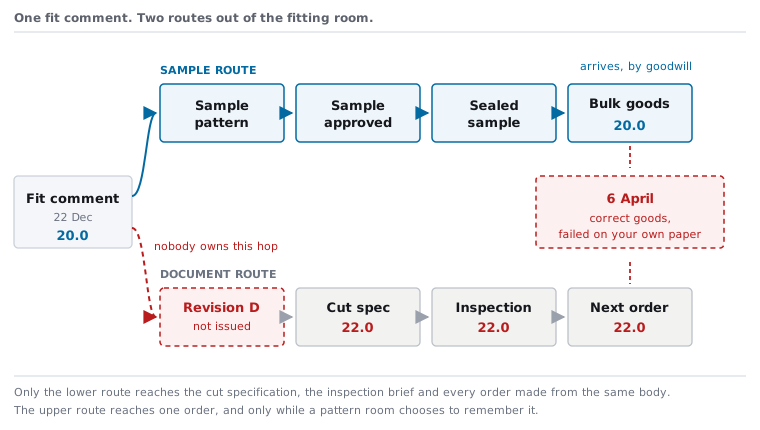
Tuesday 22 December 2026. Fit session in Nottingham on FIT-2, size 12, on the fit model. Ruth Almeida, Brindlemere's garment technologist, writes five comments on the fit report. Item 7 of that report reads: raise the chest patch pocket 2.0 cm; at the specified 22.0 cm from the high point of shoulder it sits on the bust apex from size 14 upward. She is right. It is a good, specific, executable comment.
Thursday 24 December. Ruth replies to Kadamba: "Approved with comments." The five comments are attached.
Wednesday 6 January 2027. FIT-3 arrives with all five actioned. The pocket top edge measures 20.0 cm.
Monday 11 January. Ruth replies: "Approved." A clean, unambiguous, well-formed approval. It is exactly what 7.7 asks a factory to hope for.
Friday 12 February. The pre-production sample is approved and sealed. Its pocket is at 20.0 cm, because Kadamba's pattern room worked from the last approved sample, as pattern rooms do.
16 to 23 February. Cutting. 6 April. Final inspection.
And the tech pack, revision C, released on 30 October, still says 22.0 cm. Nobody re-issued it. Brindlemere's own process raises a revision from the fit report and holds it for the technologist's signature. The signature never happened, because the pocket had already been fixed on the garment and everybody could see that it had.
Tuesday 6 April 2027: the inspection stops the lot
Brindlemere's appointed inspection agency inspects at Noida against the documents Brindlemere sent it. That is exactly what an inspection agency is for. The measurement brief is built from the released specification, revision C.
Measurement point 14, pocket top edge from the high point of shoulder: specified 22.0 cm, tolerance 0.6 cm. Tolerance is the amount a garment may vary from the specified figure and still pass. Five garments measured: 20.1, 19.9, 20.0, 20.2, 20.0. Five out of five outside tolerance. Under Brindlemere's own inspection manual that stops the lot.
The garments are correct. The sealed sample is correct. The document is wrong. It is Brindlemere's document, held by Brindlemere's agency, failing Brindlemere's goods six days before the vessel.
The six days, priced
| Option | Days | Money | What it actually does |
|---|---|---|---|
| Issue the revision and re-inspect | 11 | 340.00 | The agency needs three working days' notice; the next Noida slot is four days out, and the goods then miss the sailing by a day. Next vessel is eleven days later, outside the DC window |
| Fly the order | 0 | 33,111.68 | 8,512 kg at USD 4.15 a kilo against a sea equivalent of USD 0.26, so a differential of USD 3.89 a kilo |
| Written deviation, signed by the buying manager | 0 | 0 | Records that the goods conform to the approved and sealed sample, and that the specification is out of date. Same day |
The DC is the distribution centre, the warehouse that receives the goods and feeds the shops. It books its intake in windows, and a shipment that lands outside its window waits.
Douglas Frayne, Brindlemere's buying manager, signed the deviation at 19:40 that evening after two phone calls. The dresses sailed on 12 April.
So the episode cost nothing. That is the honest answer, and it is the uncomfortable one. It cost nothing because Kadamba had chosen to follow the approved sample rather than the released specification. The purchase order says the specification prevails. Kadamba could have built 22,400 dresses at 22.0 cm and been entirely right.
What that would have cost
Kadamba quoted the correction on 7 April, for the file.
| Line | Basis | USD |
|---|---|---|
| Unpick, re-set the pocket, re-press, re-bag | 22,400 at 7.5 minutes, USD 3.05 an hour | 8,540.00 |
| Garments downgraded for a visible needle line | 6.5% of 22,400, which is 1,456, at FOB USD 12.40 | 18,054.40 |
| Total | 26,594.40 |
That is 9.6% of the order. The needle-line rate is not an estimate. Kadamba pressed 200 reworked pieces and 13 still showed the original stitch line, because 118 g/m² viscose crepe does not forgive a removed row of topstitch.
It could not have been done anyway. 22,400 garments at 7.5 minutes is 2,800 hours. A rework cell of sixteen people at eight hours a day gives 21.9 days against a six-day window. The goods would have shipped with the pocket on the bust apex, and Brindlemere would have had no claim, because Brindlemere would have got what Brindlemere specified.
The exposure nobody was looking at
The bigger number was never on BRD-2274 at all. On 2 March, Brindlemere placed the autumn repeat of the same body, style BM-3216, with a different factory. That factory has never seen the sealed sample and works from the released specification. Until 8 April it was going to build the pocket at 22.0 cm and be right. Revision D closed that six days before its cutting date, by accident, because somebody was tidying up the deviation file.
A comment that reaches only the sample reaches only that order. A comment that reaches the specification reaches every order made from it, which is what you were actually trying to do when you wrote it.
What your own comment cost to produce
Round three existed to carry five comments, and the round is not free on your side either. Here is Brindlemere's cost, ignoring Kadamba's entirely. 7.2 lesson 2 prices the factory's side, and it is the larger half.
- Technologist and fit session, 3.5 hours loaded at USD 62.00 an hour: USD 217.00
- Courier, Noida to Nottingham and the counter-sample back: USD 148.00
- The sample itself, charged by Kadamba: USD 96.00
- Total USD 461.00, and eighteen days of the critical path
USD 461.00 and eighteen days bought a pocket 2.0 cm higher. Whether that pocket reached a customer was decided by a document nobody updated.
Check yourselfYou are about to send 'approved with comments' on a size set. What do you write instead?Show the answer
Split it into the two decisions it contains, because it is two. First the decision: what is approved, in what scope, and what it releases. "Size set SS-1 approved for grade across sizes 8 to 18; bulk cutting released." Then the comments as their own instrument, each with the document it changes, an owner and a date. "Comment 1 changes the measurement chart, revision D, issued today. Comment 2 is a pressing instruction and changes the finishing sheet." A comment with a document behind it is an instruction. A comment without one is a wish, and the factory will grant it or not depending on how helpful they are feeling.
Check yourselfYour fit technologist approves a sample and adds: 'looks great, just soften the collar a touch.' What is wrong with it as an approval?Show the answer
It transfers over a garment while asking for a garment that does not exist yet, and it does so in a unit nobody can measure. "A touch" cannot be cut, sewn, inspected or argued about. Either it is a change, in which case it belongs in the specification with a number in it and it is worth another sample. Or it is not important enough to say, in which case do not say it. The factory will act on it, cannot prove it acted correctly, and will be judged in April by somebody holding a sealed sample that is softer or firmer than what they made.
Prompt · Turn a draft approval into one that says what it transfers
The moment before you send any message containing the word approved, and especially the ones you were about to send with comments attached.
Act as a senior garment technologist in a buying office who has been on the receiving end of a supplier claim. I am about to send an approval and I want it checked before it leaves. Order facts: buyer [BUYER], supplier [FACTORY], PO [NUMBER], style [STYLE], quantity [QTY], FOB [PRICE], ship date [DATE]. The submission I am answering is [ARTEFACT AND VERSION CODE], received on [DATE], made from [BULK OR SAMPLE-ROOM MATERIALS] by [THE PRODUCTION LINE OR THE SAMPLE ROOM]. Here is my draft reply, word for word: [PASTE IT]. Any comments I intend to attach: [LIST THEM]. Do the following. First, tell me exactly what my draft transfers: which risk moves to me, over which object, and from what date. Second, tell me what it does NOT settle that a reader might reasonably assume it does, and give me the one sentence that closes each gap. Third, name what my supplier is entitled to start the moment they read it, and say whether that is what I intended. Fourth, take every comment I listed and, for each, name the DOCUMENT it changes, who has to issue that document, and by when it must be issued for the change to reach bulk rather than reaching only the next sample. If a comment changes no document, say so plainly and tell me it will not survive. Fifth, tell me whether my message is an approval, an approval with comments, or a conditional approval. If it is the second, split it into the two instruments it actually contains. Sixth, rewrite it. Do not soften anything to be polite, and do not add a condition I did not ask for.
AI can make mistakes — check anything you act on.
What you own at the end of this lesson
You can look at any approval you are about to send and say what it transfers, what it does not settle, and what it releases at the factory tomorrow morning. You can tell the two decisions from the deferral, and you know the deferral is the one that feels most helpful. And you have one rule that costs twenty minutes: name the document every comment changes, and issue it before you send the approval.
Lesson 2 is about the other half of the price. This one cost nothing because a factory was generous. The next one is what a day of your silence costs when nobody is being generous at all.