Lessons · Lesson 2 of 3
A scorecard that measures the supplier and not yourself
Weight a vendor scorecard so it says something, take the buyer's own delays out of the delivery number, and compare six factories on work that was never the same work.
Lesson 2 of 3 · 40 min
The card that was about to move two million dollars
A ranked list of suppliers is a short document with long consequences. It settles who gets next season's work and who is quietly wound down. The arithmetic on such a page is usually correct, and that is what makes it dangerous. Correct is not the same as measuring the right thing. This lesson asks whether the factories being ranked were ever asked to do the same kind of work.
Undercliffe's AW27 placement meeting was on 14 September. In front of it was one page: six suppliers, one delivery number each, ranked.
| Supplier | POs | On time and in full | OTIF |
|---|---|---|---|
| Ghazala Garments, Egypt | 9 | 8 | 88.9% |
| Torongo Fashions, Bangladesh | 14 | 12 | 85.7% |
| Barzan Textiles, Jordan | 7 | 6 | 85.7% |
| Nedra Apparels, Bangladesh | 12 | 8 | 66.7% |
| Kastelli Malhas, Portugal | 8 | 5 | 62.5% |
| Selmani Konfeksiyon, Turkey | 11 | 2 | 18.2% |
The base ran at 67.2%. Undercliffe's placement rule said that no supplier below 70% receives new development. On the page in front of the meeting, that rule removed Selmani and Kastelli.
Selmani held USD 1.94m of an AW26 placement worth USD 9.42m, a fifth of the season. It is also the only factory in the base that can make a taped-seam technical shell.
Everything on that page is correctly computed. Nobody has made a mistake. The page is still wrong, in two separate ways, and this lesson is both of them.
What a weight is for
Before the delivery number, look at the card itself. Undercliffe's AW26 scorecard weighted five things.
| Dimension | Weight | The problem |
|---|---|---|
| On time in full | 40 | One number doing two jobs — see lesson 3 |
| Quality, first-presentation inspection pass | 25 | Sound |
| Price and cost movement | 15 | Sound |
| Responsiveness, sample and approval turnaround | 10 | Sound |
| Compliance standing | 10 | Should not be here at all |
The last row is the one to fix first. A supplier with a zero-tolerance social or safety finding loses ten points and can still finish at 90, comfortably inside the band that keeps its volume. A gate written as points is not a gate. Compliance standing belongs outside the weighted total, as a condition of being on the card at all. Course 6.6 sets out how a compliance programme is banded and escalated, and what an exit costs. None of that arithmetic survives being turned into ten points of a hundred.
Undercliffe's revised card: delivery 40, quality 30, cost 20, responsiveness 10, and compliance a gate. Which raises the harder question. What is a weight for?
A weight is a trade you have agreed to make in advance. If you cannot say what one point buys, the weights are decoration. So Undercliffe priced one.
Across AW26 its nineteen late POs cost, on average, USD 3,410 each in expedited freight, re-slotted inbound bookings and administration. On an eleven-PO supplier, ten percentage points of the delivery number is about 1.1 POs, so it is worth roughly USD 3,751. On Selmani's USD 1.94m of placement, that is 0.19%.
Whose days were they
Now the delivery number. Nineteen of the sixty-one AW26 POs were late. Undercliffe went back through every one of them and asked a question the card had never asked: what actually caused this?
| Root cause | POs | Days lost | Owner |
|---|---|---|---|
| Approval overran the vendor manual's service level | 6 | 58 | Buyer |
| Amendment issued after the fabric was committed | 4 | 47 | Buyer |
| Nominated trim supplier delivered late | 4 | 31 | Buyer |
| Fabric mill late, supplier's own sourcing | 3 | 34 | Supplier |
| Factory capacity or line overload | 2 | 23 | Supplier |
| Total | 19 | 193 |
A nominated supplier is one the buyer chose and the factory must use.
Fourteen of the nineteen late POs and 136 of the 193 days belong to the buyer. That is 73.7% of the failures and 70.5% of the days, booked in full against the factories.
None of the three buyer-owned causes is misconduct. An approval that takes eleven days instead of three is a busy design room. An amendment after the fabric is committed is a range that improved. A nomination is a decision the buyer made and the factory was not allowed to make. All three are normal, all three are the buyer's, and all three arrive at the factory as a date it cannot hit.
The same six suppliers, clock-stopped
Stop the clock on the days the buyer owns, and re-score.
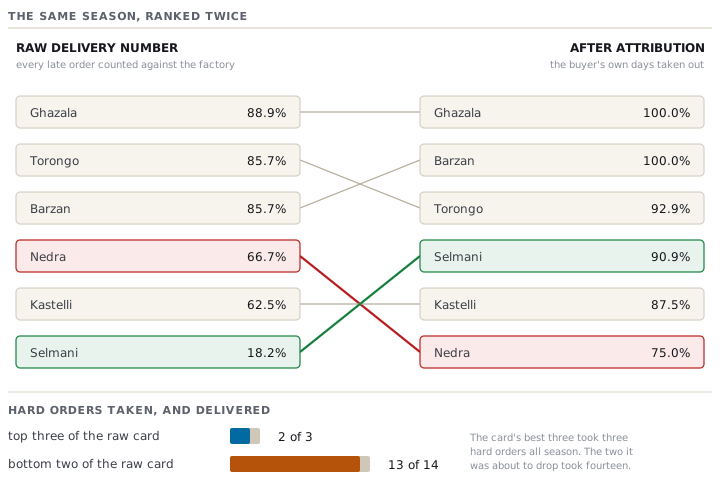
| Supplier | Late | Of which the buyer's | Raw OTIF | Adjusted OTIF |
|---|---|---|---|---|
| Ghazala Garments | 1 | 1 | 88.9% | 100.0% |
| Torongo Fashions | 2 | 1 | 85.7% | 92.9% |
| Barzan Textiles | 1 | 1 | 85.7% | 100.0% |
| Nedra Apparels | 3 | 1 | 66.7% | 75.0% |
| Kastelli Malhas | 3 | 2 | 62.5% | 87.5% |
| Selmani Konfeksiyon | 9 | 8 | 18.2% | 90.9% |
| Base | 19 | 14 | 67.2% | 90.2% |
Selmani moves 72.7 points. Eight of its nine failures were Undercliffe's, and the placement rule was about to remove it for them.
Two other things happen on that table, and both matter.
The adjustment demotes as well as rescues. Nedra was fourth on the raw card at 66.7% and is last on the adjusted one at 75.0%, because only one of its four failures belonged to the buyer. The raw card had Nedra sitting comfortably above two suppliers whose problems were not their own. An attribution that only ever moves people up is not an attribution. It is an excuse engine.
And the base moves from 67.2% to 90.2%. That is the most useful number on the page, and it is about Undercliffe. Twenty-three points of the base's delivery failure was generated inside the buying organisation, by its own approval times, its own amendments and its own nominations. No amount of supplier management would have touched it.
The mistake nobody made
Even adjusted, Selmani is fourth of six. So take the second question, which is harder than the first: were these six suppliers doing the same work?
| Supplier | POs | Median days, PO to ex-factory | New styles | Amendments received | Mean colourways per PO |
|---|---|---|---|---|---|
| Torongo Fashions | 14 | 168 | 1 | 3 | 1.4 |
| Barzan Textiles | 7 | 161 | 1 | 2 | 1.6 |
| Ghazala Garments | 9 | 154 | 2 | 5 | 2.0 |
| Nedra Apparels | 12 | 147 | 5 | 9 | 2.5 |
| Selmani Konfeksiyon | 11 | 118 | 9 | 13 | 3.6 |
| Kastelli Malhas | 8 | 128 | 5 | 6 | 3.1 |
Selmani received 13 of the season's 38 amendments. Nine of its eleven POs were styles it had never made. It was given a median of 118 days where Torongo was given 168. That is not an accident and it is not unfairness. It is the direct consequence of Selmani being good. It is the factory Undercliffe gives the technical outerwear to. It is the factory it goes to when a style is signed off late, and the factory it trusts with a range that is still changing.
The best factory takes the hardest orders, and a delivery number that does not know this ranks it last.
Put more sharply: an unadjusted delivery score is largely a measure of how hard the orders were. A buyer gives its hardest orders to the suppliers it trusts most, so an unadjusted card partly inverts the thing it is supposed to measure. That is not a statistical claim about your data. It is a consequence of how the orders were allocated, and it applies wherever allocation is not random.
Segment, do not adjust
The tempting fix is a difficulty coefficient: divide by lead time, multiply by amendments. Do not. A coefficient invented to correct a ranking will be tuned until the ranking looks right, and then it is not evidence. It is an opinion with a decimal point.
Compare like with like instead. Undercliffe split the sixty-one POs in two. A PO is compressed if it meets at least two of three tests: fewer than 140 days from PO to ex-factory, a style that factory has never made, or more than two colourways. Everything else is planned. That gave 22 compressed and 39 planned.
| Supplier | Compressed POs | On time | Planned POs | On time |
|---|---|---|---|---|
| Kastelli Malhas | 5 | 100.0% | 3 | 66.7% |
| Ghazala Garments | 2 | 100.0% | 7 | 100.0% |
| Selmani Konfeksiyon | 9 | 88.9% | 2 | 100.0% |
| Nedra Apparels | 5 | 80.0% | 7 | 85.7% |
| Torongo Fashions | 1 | 0.0% | 13 | 100.0% |
| Barzan Textiles | 0 | not measured | 7 | 100.0% |
Read the two columns of counts before the percentages.
The three suppliers at the top of the original card took three compressed orders between them all season, and delivered two of them. The two suppliers the placement rule was about to remove took fourteen, and delivered thirteen.
And Barzan's cell is the honest one. Barzan Textiles is at 100.0% adjusted, on seven planned repeat POs with a 161-day median and two amendments in the season. It has never once been asked to do a hard order. Its 100.0% is not evidence that Barzan can perform under pressure. It is evidence that Barzan has never been tested. That is a different sentence, and it leads to a different decision. Give it one compressed order and find out, rather than reading its score as an answer it never gave.
What it costs to know
None of this is free, and the reason most buyers do not do it is that the attribution has to be built while the season runs, not afterwards.
| Item | Working | Cost |
|---|---|---|
| Ongoing: raise every amendment as a numbered revision, stamp every approval against the service level, record every nomination date — 25 minutes a PO | 61 POs, two seasons, at USD 31 an hour | USD 1,576 a year |
| One-off: rebuild AW26's attribution by hand from email | 19 late POs at 90 minutes | USD 884 |
| Year one | USD 2,460 |
USD 2,460 to put evidence under a placement decision worth USD 1.94m on one supplier alone. It is 0.13% of that supplier's placement, and the number it corrects was wrong by 72.7 points.
The ongoing half is the part that decides whether this works, and it is not a system purchase. It is a discipline. An amendment is only an amendment if it arrives as a numbered PO revision with a date. Course 7.6 shows the same season from the factory's side, where four changes to one order arrived as two emails, a portal notification and a line inside a longer message about lab dips. Nothing you cannot date can ever be attributed, and every buyer who wants a clean delivery number has to pay for the dating first.
Check yourselfYour best supplier is bottom of your scorecard. What are the two things to check, in order?Show the answer
First, attribution: how many of its failures were caused by your approvals, your amendments and your nominations? That is usually most of the gap, and it is cheap to establish if your dates exist. Second, comparability: was it given the same kind of work? Split the orders into the hard ones and the planned ones, and compare within each. Do both before you touch the ranking, and do neither by inventing a coefficient. Segment the orders, do not weight them.
Prompt · Find out how much of your supplier's delay was yours
When a supplier is at the bottom of your scorecard and you have never separated out the days your own approvals, amendments and nominations cost it.
Act as a sourcing director rebuilding a delay attribution from raw records. You have no interest in flattering either party. I will give you a season of orders. For each late purchase order: PO number, supplier, style, quantity, PO date, original ex-factory date, actual ex-factory date, days late, and everything that happened in between with a date — approvals I submitted and returned, amendments I issued, nominated suppliers and when they delivered, fabric and trim arrival dates, and anything the factory told me at the time. My vendor manual's service levels are [PASTE THEM]. Do the following. First, assign each late PO a single root cause and an owner — buyer, supplier, or a third party neither of us controls — and where a PO has more than one cause, split the days between them and show how. Second, give me a table of causes with the count of POs and the days lost against each, and the buyer's share of both. Third, re-score every supplier with the buyer-owned days stopped, and show raw against adjusted side by side. Include any supplier whose position gets WORSE: that is the test of whether the attribution is honest. Fourth, tell me which of my delays were structural — an approval step that is always late, a nomination that is always late — rather than one-off, because those are mine to fix rather than to excuse. Fifth, estimate what it would cost me in minutes per PO to keep this attribution live next season instead of rebuilding it afterwards, and what the discipline requires: what has to be dated, by whom, at what moment. Sixth, name every case where the records do not let you attribute the delay at all, and say what document would have settled it. Do not attribute a day to a party without naming the record that shows it.
AI can make mistakes — check anything you act on.