Lessons · Lesson 1 of 3
On time against which date, in full against which number
Score one real shipment under six defensible OTIF definitions, get six different answers, and agree the definitions before the argument instead of during it.
Lesson 1 of 3 · 40 min
One shipment, and nobody can say whether it was late
Was the delivery on time? It sounds like a question with one answer. It is not.
The answer depends on which date on the order you treat as the promise. It depends on whether you measure the goods leaving the factory or arriving at your warehouse. "In full" is just as slippery. So this course takes one shipment and scores it every defensible way at once.
Two words first. OTIF means on time in full: the order arrived on the agreed date, with the whole quantity. Ex-factory is the day the goods leave the factory.
Undercliffe is a British outdoor and travel-clothing brand. It buys direct, with no agent and no buying office, through a sourcing team of five, from a base of fourteen factories. The autumn/winter 26 intake was 61 purchase orders.
This lesson is about one of them.
PO UC-7318. Selmani Konfeksiyon, Turkey. Style UD-4120, a men's insulated parka, 6,400 pieces in four colourways. The price is FOB USD 28.60. FOB means the supplier's price covers the goods loaded on the ship at the port of export, and no further. Order value USD 183,040.
| Event | Date |
|---|---|
| PO issued | 12 January |
| Ex-factory date on the PO | 8 June |
| Supplier's order acknowledgement, confirming that date | 19 January |
| Buyer changes the shell colour on one colourway | 3 March |
| Supplier asks for nine days and says so in writing | 4 March |
| Replacement lab dip submitted | 11 April |
| Replacement lab dip approved by Undercliffe | 22 April |
| Supplier's weekly report gives a revised ex-factory date | 17 June |
| Actual ex-factory | 19 June |
| On board | 24 June |
| Required at Undercliffe's distribution centre | 8 July |
| Received at the distribution centre | 11 July |
A lab dip is a small piece of fabric dyed to the shade you asked for, sent to you to approve before bulk dyeing starts.
Three people looked at this shipment in the same week. They gave three different answers. The planner said it was eleven days late. The supplier's merchandiser said it was two days late. The sourcing manager had gone back through the emails, and he said it was six days early.
None of them was wrong. They were using three different definitions, and nobody had ever written one down.
On time against which date
An on-time percentage is arithmetic sitting on top of a pile of definitions. Every argument you will ever have about a supplier's delivery number is an argument about the pile, not about the arithmetic.
Start with the date. UC-7318 has at least five candidates. Each one is somebody's honest answer to "when was this due".
- The original PO date, 8 June. It is the date in the system. It is the date the merchandising plan was built on. It is the only date anybody signed. Against it the shipment is 11 days late.
- The date the supplier last confirmed in writing, 17 June. The supplier's weekly report has carried it since March. Against it the shipment is 2 days late.
- The original date plus the extension the supplier asked for on 4 March, 17 June. The same day as (2), reached from the other side.
- The original date adjusted for everything the buyer did, 25 June. Nine days for the amendment, plus the eight days by which Undercliffe's own lab-dip approval overran the three working days its vendor manual promises. Against it the shipment is 6 days early.
- The booking date. Some buyers do not measure ex-factory at all. They measure whether the supplier met the cargo cut-off, which is the deadline for handing goods over for a booked sailing. UC-7318 met it.
Definitions (2) and (3) land on the same date. That is comfortable, and it is comfortable by accident. The supplier's revised date came from an extension request the buyer never answered. Had the merchandiser replied "no, hold the original date", the supplier's report would still have said 17 June and the two would have parted company. A revised date that only one party maintains is not a commitment. It is a forecast — and a great many buyers score their suppliers against a forecast the supplier wrote.
Measured at whose door
The second definition is the place. Undercliffe's PO is on FOB terms, so the supplier's delivery duty ends when the goods are on board at the named port. Everything after that is Undercliffe's forwarder, Undercliffe's carrier, Undercliffe's customs broker and Undercliffe's own inbound booking slot.
Measure at the factory gate and UC-7318 is 11 days late. Measure at the distribution centre and it is 3 days late. The calendar allowed thirty days from ex-factory to receipt, and the actual door-to-door ran twenty-two, because the forwarder caught a direct sailing. Eight of the eleven days were absorbed by spare time the factory did not create and could not have relied on.
That cuts both ways. Across a season it cuts harder in the other direction. Undercliffe's AW26 base was on time on 42 of 61 POs measured ex-factory, which is 68.9%. Measured at the distribution centre it was on time on 35 of 61, which is 57.4%. Seven shipments left their factories on the confirmed date and still arrived late: four vessel rolls, two customs holds, and one inbound slot the distribution centre itself refused because the yard was full.
What a window does
Third definition: the tolerance around the date. A shipment is on time if it lands inside a window, and the window is a choice.
| Window around the confirmed date | Verdict |
|---|---|
| Exactly on the day | Late |
| On or before the day | Late |
| Plus three days | On time |
| Minus five, plus three days | On time |
The last row is the one worth arguing about, because it says early is also late. A distribution centre with booked inbound slots and no floor space cannot receive a container three weeks early, any more than it can receive one three weeks late. And a factory that ships early has usually done it by taking capacity from somebody else's order. Undercliffe's window at the distribution centre is minus five, plus three. Its ex-factory window is plus three with no lower bound, because an early ex-factory only moves the goods into the forwarder's warehouse, where the cost is small and visible.
In full against which number
Now the quantity. It has fewer candidates and worse arguments.
UC-7318 shipped 6,268 pieces against 6,400 ordered, which is 97.94%. The PO carries a quantity tolerance of 3% at order level, which is 192 pieces. So the shipment is inside tolerance and, on that reading, in full.
Read it by colourway and it is not.
| Colourway | Ordered | Shipped | Short |
|---|---|---|---|
| Basalt | 2,400 | 2,400 | none |
| Slate | 1,600 | 1,468 | 132 |
| Moss | 1,400 | 1,400 | none |
| Ember | 1,000 | 1,000 | none |
The whole shortfall sits in one colourway, where it is 8.25%. That is nearly three times the tolerance the PO grants at order level. Three of the four lines are complete, so a line-level fill rate is 75.0%.
So "in full" has to answer three questions before it produces a number.
- Against the ordered quantity or the confirmed one? If the supplier acknowledged 6,400 and shipped 6,268, both denominators agree. If the supplier acknowledged 6,200 in January and the buyer never chased it, they do not — and scoring against the acknowledgement lets a supplier set its own denominator.
- At what level? Order, line, colourway, size. A tolerance granted at order level and measured at order level will pass a shipment that is unsellable at size level. The missing pieces are never spread evenly. They are the size the fabric ran out on.
- Does the tolerance belong in the measure at all? A tolerance clause is a commercial term about what you must pay for. It is not a statement that a short delivery did not happen. Undercliffe's answer, in the end, was to keep the tolerance in the invoice and take it out of the scorecard. The card records fill rate as a number, and the contract decides who pays.
The same shipment, six ways
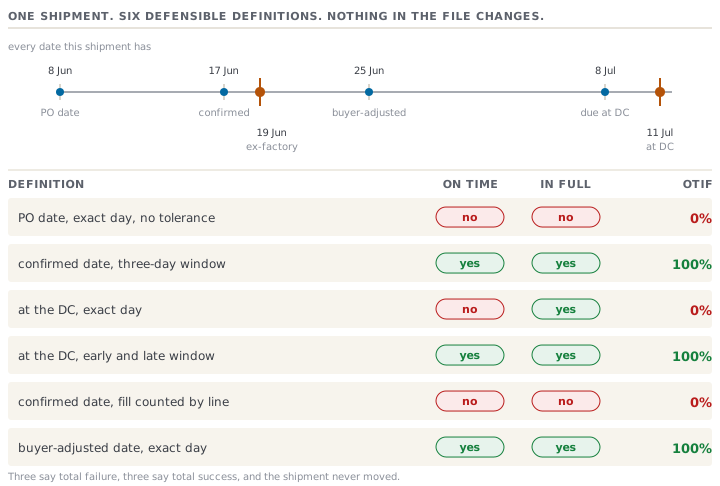
| Definition | On time | In full | OTIF |
|---|---|---|---|
| Ex-factory against the original PO date, exact day; units against ordered, no tolerance | No | No | 0% |
| Ex-factory against the last written confirmation, plus three days; units within tolerance | Yes | Yes | 100% |
| Receipt at the distribution centre against the required date, exact day; units within tolerance | No | Yes | 0% |
| Receipt at the distribution centre, minus five plus three; units within tolerance | Yes | Yes | 100% |
| Ex-factory against the confirmed date, exact day; fill measured by line | No | No | 0% |
| Ex-factory against the buyer-adjusted date, exact day; units within tolerance | Yes | Yes | 100% |
Six definitions a competent person could defend in a meeting. Three say the supplier failed completely and three say it succeeded completely, and not one figure in the shipment's file changed between them.
This is the sentence to take out of the lesson. A supplier's OTIF is not a fact about the supplier until the definitions are agreed. Until then it is a fact about whoever chose the definitions, and in most vendor reviews that is the person holding the meeting.
The denominator nobody publishes
Undercliffe's third-quarter report had Mirene Knitwear at 100%.
Mirene had three POs that quarter. Two of them had no recorded goods-receipt date, because the receipts went through as a manual adjustment when the pallets were cross-docked — sent straight out again without being booked into stock. The report's formula counted a PO as on time unless a late flag existed, and a PO with no receipt date generates no late flag.
So the honest cell reads: one measured, one on time, two unknown. The 100% is a fact about the data. Compare it with Torongo Fashions, also reported at 100%, on fourteen POs every one of which was measured. Two identical numbers, and only one of them is evidence.
A green cell must be produced by positive evidence: measured orders, measured dates, measured quantities. Absence of a recorded failure is not performance. A supplier who is unmeasured is not a supplier who is doing well. This is worth saying out loud, because every reporting tool ever built defaults the other way. A blank is easier to render as a pass than as a question.
What to agree, and when
Definitions are cheap to agree in January and impossible to agree in November. By November one of the two parties already knows which definition helps them. Undercliffe's vendor manual now settles all of it on one page, before the first PO of the season.
- The measured date is ex-factory, against the date on the current PO revision. Not the supplier's report, and not an email.
- A date only changes by a numbered PO revision. An extension request that the buyer does not answer within five working days is treated as accepted, and the revision is raised automatically. That puts the cost of silence on the buyer, where it belongs.
- The window is plus three days at ex-factory, and minus five plus three at the distribution centre. Both are reported. Only the first is scored.
- Fill is measured at colourway level against the ordered quantity, as a percentage, with no tolerance applied. The tolerance stays in the contract and governs payment.
- A cell with fewer than six measured orders is reported as not enough evidence.
- A definition changes only between seasons, and the previous season is restated on the new basis and published alongside.
That last one is not housekeeping. Point six is what stops a scorecard being edited until it agrees with whatever somebody has already decided.
Check yourselfYour supplier's report has said 17 June since March. Your system still says 8 June, because nobody raised a revision. Which is the confirmed date?Show the answer
Neither, and that is the problem. A confirmed date is one both parties hold: a numbered PO revision, an acknowledgement, an agreed change. What you have is a buyer's date nobody has maintained and a supplier's date nobody has accepted. Score against your own and you are scoring a date the supplier has told you for three months it will not hit. Score against theirs and the supplier sets its own target. Fix it forward, with a revision rule that has a deadline, rather than arguing backwards about a shipment that has already sailed.
Prompt · Score one shipment every way it can honestly be scored
Before a vendor review, when you are about to put a delivery percentage in front of a supplier and have never written down the definitions behind it.
Act as a supply chain measurement analyst. Your job is to show me how unstable my own delivery metric is. Here is one shipment. Buyer [BUYER], supplier [SUPPLIER], PO [NUMBER], style [STYLE], Incoterm [TERM]. Dates: PO issued [DATE], ex-factory date on the original PO [DATE], supplier's order acknowledgement [DATE] confirming [DATE], every amendment I issued with its date and what it changed [LIST], every approval I owed with the date it was submitted to me, the date I gave it, and the service level my vendor manual promises [LIST], the supplier's last written revised date [DATE], actual ex-factory [DATE], on board [DATE], required at my warehouse [DATE], received at my warehouse [DATE]. Quantities: ordered [QTY], acknowledged [QTY], shipped [QTY], and the split by colourway and size [PASTE]. My PO's quantity tolerance is [PERCENT] at [LEVEL] level. Do the following. First, list every date in this file that somebody could defensibly call the due date, and say who would argue for each. Second, score the shipment for on time and in full under at least six combinations of due date, measurement point, window and fill level. Give me a table with the figure each one produces. Third, tell me which combination my current reporting actually uses, as far as you can tell from what I have given you, and what it is silently including that is not the supplier's. Fourth, compute the date that results from stopping the clock on every day I caused, showing the arithmetic. Fifth, tell me which of the six definitions I should adopt and why, and what it would do to this supplier's number for the season if applied to every order. Sixth, write the one page of definitions I should put in the vendor manual before the next season starts. If a date or a quantity I gave you is ambiguous, say so rather than choosing for me.
AI can make mistakes — check anything you act on.