Lessons · Lesson 2 of 3
Corrective action, and what zero tolerance does to an order
Turn eleven findings into a plan that fixes causes rather than states, and work through a zero-tolerance finding on an order that is already made.
Lesson 2 of 3 · 38 min
The situation
A list of problems found in a factory is answered with a written plan. Most such plans are worthless. They promise to change a state, not the reason the state existed. Unchain a gate and it is chained again by winter, because whatever made somebody chain it has not gone anywhere. This lesson is how to write a plan that outlives the person who made it.
21 September. Tessaro's report has been at Zohry Garments for four days, and the corrective action plan is due back to Thurlbeck in seven. The four critical findings are due closed the same week.
A corrective action plan is not a letter of apology, and it is not a list of promises. It is a working document with seven columns. A line that is missing any of them cannot be closed by anybody.
| Column | What goes in it | Why the line fails without it |
|---|---|---|
| Finding | The auditor's words, unedited | Rewriting it softer is how a finding survives three audits |
| Evidence | What the auditor actually saw | Without it nobody can tell whether the fix addresses it |
| Root cause | Why it was true, not that it was true | This is the only column that does any work |
| Action | The physical or systemic change | "Retrain staff" is not an action |
| Owner | A named person, not a department | A department cannot be asked how it is going |
| Due date | A calendar date | "Ongoing" means never |
| Closing evidence | The document that will prove it | Decided in advance, or you argue about it later |
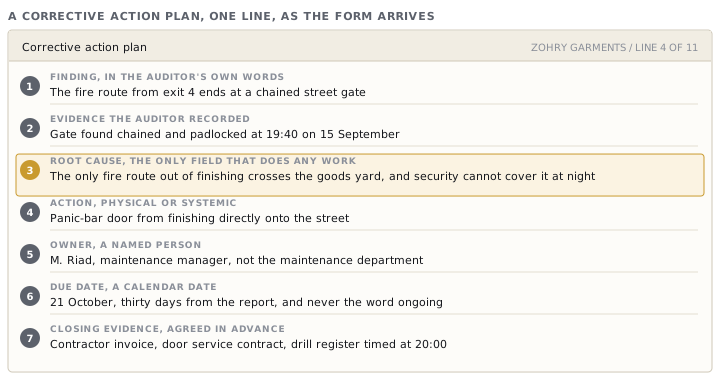
The column people skip is root cause, because it is the only one that requires an admission. It is also the only one that decides whether you will see the same finding next year.
Fixing a finding, and fixing its cause
Take finding 4: the fire route from exit 4 ends at a chained street gate.
Here is the corrective action plan almost every factory writes for it.
Chain and padlock removed. Gate now unlocked at all times. Photograph attached. Closed.
That closes the finding and fixes nothing. The gate is chained after 18:00 because finished goods were stolen from the yard in March, and the site has one night guard covering three gates. Remove the chain and change nothing else, and the gate is chained again by November. Not through bad faith. The reason it was chained is still there, and the person who chained it still has the same problem.
The root cause is not "a padlock". It is this: the only fire route out of the finishing hall passes through a yard that is also the goods yard, and site security cannot cover it at night.
Once that sentence is written, the actions are obvious and they can be priced.
| Action | One-off | Each year | What it depends on |
|---|---|---|---|
| Remove the chain, instruct security | none | none | A person remembering, every night |
| Second night guard on that gate | none | USD 2,520 | A post being filled, every night |
| Panic-bar door from finishing directly onto the street | USD 3,400 | USD 180 | A door, and a service contract |
Zohry chose the door. Owner: the maintenance manager, by name, in the plan. Due in thirty days. Closing evidence agreed in advance: the contractor's invoice, the door's service contract, and — this is the part that matters — a fresh evacuation drill run at 20:00, with the evening headcount written on the register.
The test of a corrective action is simple. If the person who caused the finding left the company tomorrow, would the fix still hold? A chain removed depends on a person. A door does not.
What actually closes a finding
Auditors and buyers grade closing evidence, whether or not they say so.
Weak evidence is a photograph, a newly written policy, a signed management statement, a training slide deck. All of these prove that something existed on one day. That is exactly the property the original finding already had.
Strong evidence proves a system changed and kept running. A purchase invoice with a date. A service contract with a renewal date. Three payroll runs in a row showing the corrected rate. A drill register signed at the right headcount. A training register with the trainer named and every attendee's signature. A third-party certificate with a serial number you can verify.
Evidence that a system changed, not that a state changed on one day. If you learn one sentence from this lesson, learn that one. It also tells you what to build.
The finding that comes back
Zohry's grievance box has been a finding three times: in March 2025, in September 2025, and now. It was moved twice. It is still in view of the HR office window, because the only other wall out of sight is in a stairwell where the box was vandalised.
A finding that appears in three audits in a row is not a finding. It is a decision, and the corrective action plan should say so in the root-cause column: no route to raise a concern exists that is not visible to the people a concern would be about. Then the action stops being "move the box". It becomes an anonymous phone number handled outside the factory, printed on the wage slip, plus an elected worker representative instead of an appointed committee.
What the whole plan costs
| Finding | Action | One-off | Each year |
|---|---|---|---|
| Chained fire route | Panic-bar door and service contract | USD 3,400 | USD 180 |
| Obstructed extinguishers | Wall racking and a marked keep-clear zone | USD 260 | none |
| Solvent store | Extract fan, lockable cabinet, eyewash station | USD 1,180 | none |
| Grievance route | External phone line, two relocated boxes, printed on wage slips | USD 640 | USD 420 |
| Worker committee | Ballot at shift end, minuted, half-yearly | none | none |
| First aid | Restock plus a monthly check schedule | USD 190 | USD 240 |
| Personnel files | Six contracts copied, signed, filed | none | none |
| Drill at peak headcount | Re-run at 20:00, twice a year | none | none |
| Total | USD 5,670 | USD 840 |
That is the entire physical corrective action plan for a factory of 420 people: USD 5,670 once and USD 840 a year. The margin on the one order sitting on the floor while it was written is USD 44,520. So the plan costs 12.7% of a single order's margin, once, and it covers every order after it.
This is worth saying out loud, because the assumption in the room is usually the opposite. The expensive findings are almost never the doors and the fans. They are the ones whose root cause is a commercial decision, and there is exactly one of those on Zohry's list.
Zero tolerance
Thurlbeck's code names four zero-tolerance findings. Most buyer codes name a similar set.
- Forced labour in any form — including retained identity documents, deposits, and recruitment fees that leave a worker in debt to get the job.
- A worker below the legal minimum working age.
- Production at a site the buyer has not approved — undeclared subcontracting.
- Deliberate falsification of records, or obstruction of the audit.
The first two are on the list because of what they do to people. The fourth is on it because if the records are false, nothing else the audit produced means anything. Every other finding, and every absence of a finding, becomes unknown.
The third is on the list because it is where the worst outcomes in this industry have actually happened. An undeclared unit has never been audited, never been walked, never had a worker interviewed in it. It is not that its conditions are known to be bad. It is that nobody has ever looked, and the reason it is undeclared is usually that somebody suspected what would be found.
22 October
Tessaro came back unannounced on 22 October, four weeks after the first audit, to verify the critical closures. The door was in. The drill register showed 20:00 and 398 people.
Then the second auditor spent twenty minutes with the production records and a calculator.
The six sewing lines' output boards, summed for TB-77420 across the whole run, came to 35,880 pieces. The packing list and the finished-goods store showed 42,000 pieces packed and ready.
6,120 pieces existed that the factory had not sewn.
They had been cut at Zohry and sent out as 51 bundles of 120 panels. They were sewn at a workshop in Shubra El-Kheima called Fouad Sewing — twenty-four machines, no fire certificate, no employment records, wages in cash. Then they were trucked back for finishing and packing. Thurlbeck had never heard of it. Nobody had ever walked it.
What zero tolerance does to an order that is already made
| Goods held | All 42,000 pieces, from 22 October |
| Independent investigation, at the supplier's cost | USD 4,800 |
| The 6,120 pieces | Not accepted, written off at USD 37,026 |
| The remaining 35,880 | Released 4 November, shipped seven days late |
| Late-delivery discount on the released quantity | USD 14,083 |
| Direct cost | USD 55,909 |
| Margin the order was carrying | USD 44,520 |
| Result | The order lost USD 11,389 |
And the number that is not in the table: Zohry was suspended from new Thurlbeck orders until it completes a verified remediation programme. Four years of business, stopped by a decision taken in a cutting room.
Note what zero tolerance did not mean. It did not mean the goods were destroyed, and it did not mean the relationship ended that day. Zero tolerance means stop and investigate, not dismiss. That distinction matters most where the finding is about a person rather than a process.
The remediation that has to come first
Before anything commercial was settled, one thing had to happen. The twenty-four people at Fouad Sewing had to be paid for the work they had done. Zohry paid the full contracted USD 3,182 for the 6,120 pieces, and the investigator confirmed with each of the twenty-four workers, one at a time and in private, that they had received their wages for the period.
That is not a gesture. It is the first obligation, and it is the one most often missed, because the moment a zero-tolerance finding lands everybody's attention goes to the shipment.
The same principle runs through the harder cases. Where a worker below the minimum age is found, the remediation is never immediate dismissal. The worker is taken off the work, kept paid, their age verified, schooling arranged, and the family's income protected. Throwing a child out of a factory gate and calling it compliance leaves them worse off than the finding did. Where a whole site is exited, the exit is a decision with a workforce on the other side of it, most of whom had nothing to do with what was found.
Cutting and running is sometimes the right answer. It is never a free one, and a merchandiser who presents it as the clean option has not counted properly.
Prompt · The first days after a zero-tolerance finding
The hour a zero-tolerance finding is confirmed, when the instinct is to work the shipment first and the order of the steps is what everything else depends on.
Act as a senior compliance and sourcing manager. A zero-tolerance finding has been confirmed. What was found: [DESCRIBE PRECISELY — undeclared subcontracting, a young worker, indicators of forced labour, falsified records, obstruction]. Where: [SITE, ADDRESS, HEADCOUNT, WHO OPERATES IT]. Buyer [BUYER], and here is the zero-tolerance clause from their code, word for word: [PASTE]. Order affected: PO [NUMBER], [QTY] pieces, FOB [PRICE], order value [VALUE], production stage [STAGE], ship date [DATE], port cut-off [DATE]. Today is [DATE]. Give me a sequenced plan and be strict about the sequence. Start with the obligations to the PEOPLE involved and finish with the commercial questions, not the other way round: who must be paid what and how that is verified with them rather than with whoever contracted them; who must be removed from work and kept whole while their situation is verified; what must never be done, such as dismissal presented as remediation, or any step that could expose a worker who spoke to an auditor. Then: what I must disclose, to whom, in what form and by when, and how a self-disclosed breach is treated differently from a discovered one. Then: what happens to goods already made at the unapproved site and to goods made properly against the same order, and who has authority to release either. Then: the investigation — who conducts it, who pays, what it must cover to be credible. Then: price the outcomes for me — supervised remediation against exit — including the cost of the exit to the workforce that had nothing to do with the decision. State plainly which facts you would need before recommending an exit, and refuse to recommend one without them.
AI can make mistakes — check anything you act on.
Check yourselfA corrective action plan comes back with every line closed and a photograph attached to each one. Which lines do you actually believe?Show the answer
The ones where the photograph is not the evidence. A photograph shows a state on a day, which is the same thing the finding showed. So for a physical fix, ask for the invoice and the service contract. For a systemic fix, ask for three payroll runs in a row, a signed register, or a certificate with a serial number. Then check the root-cause column. If it restates the finding instead of explaining it, the fix will not survive the reason that caused it. A plan whose root causes all read like the findings is a plan that will produce the same report next year.
Check yourselfYour factory has found undeclared subcontracting inside its own supply chain, on an order that ships in eleven days. What is the first thing you do?Show the answer
Not the shipment. First, make sure the people who did the work are paid what they are owed, and confirm it with them rather than with whoever contracted them. Second, disclose it to the buyer yourself, in writing, before anybody finds it. A breach you disclose and a breach that is discovered are treated very differently, because the fourth zero-tolerance item is about concealment. Only then work the commercial problem, which will now be somebody else's decision to make with you rather than about you. The instinct to ship the goods and disclose afterwards turns one zero-tolerance finding into two.