Lessons · Lesson 3 of 3
Purchasing practices are a compliance input
Cost an order against the working-hours standard the same buyer signed, and price the four honest ways out of a plan that does not fit inside it.
Lesson 3 of 3 · 44 min
The situation
Long hours in a garment factory are usually discussed as something the factory does. More often they are something the order does. A buyer takes extra days over an approval, then adds quantity without moving the ship date. That is an instruction about how long people will work, issued without the word being used. This lesson is the arithmetic anybody can do in a few minutes.
There were 6,120 pieces at Fouad Sewing because of a sum that anybody could have done on 12 September, and nobody did.
This lesson is that sum. It is the most useful thing in this course. It is the only part of social compliance a merchandiser controls directly. You control it not by being more careful, but by putting a number on a plan before you agree to it.
Thurlbeck's supplier code sets the standard the order is measured against. Two lines of it matter here. They are Thurlbeck's own code — not a legal limit, and not a quotation from any audit protocol:
- The working week, including all overtime, does not exceed 60 hours.
- Every worker gets one day off in every seven.
Zohry runs an eight-hour day, six days a week. That is a 48-hour week, which leaves twelve hours of overtime inside the code. The question the plan has to answer is whether twelve hours is enough.
The calendar, and whose decision moved it
| Date | What happened | Effect |
|---|---|---|
| 21 July | PO issued: 38,000 pieces, on board 3 November | Sewing planned 26 August to 20 October — eight six-day weeks, 48 working days |
| 28 July | Fabric ordered, mill to deliver 25 August | |
| 4 August | Buyer reissues the tech pack: chest pocket moved, button changed | The approved sample no longer matches the pack |
| 12 August | First lab dip submitted | |
| 19 August | Lab dip rejected, second submission sent | |
| 1 September | Lab dip approved | Fabric cannot be dyed until this date |
| 9 September | Buyer raises the quantity from 38,000 to 42,000 for a promotion | |
| 11 September | Fabric in house, seventeen days late | |
| 12 September | Sewing starts. Window is now 33 working days | On board date unchanged |
Nothing in that table is unusual, and nothing in it is anybody's misconduct. A pocket moved. A lab dip took two rounds. A promotion needed four thousand more pieces. Every one of those is an ordinary week in this trade.
But add them up. The sewing window went from 48 working days to 33 — fifteen days removed, all of them on the approval chain. Then 4,000 pieces were added to what has to be made inside it. The ship date did not move at all.
Fifteen days out and four thousand pieces in, with the finish line where it was. That is not a scheduling problem. It is an instruction about hours, issued by somebody who never used the word.
What the plan actually required
The order is 42,000 pieces at a standard allowed minute value of 28.5 minutes. That is 1,197,000 standard minutes of sewing. Two lines are assigned, 48 operators each: 96 operators.
Now the two numbers that matter.
The plan on paper. Zohry's planner used the factory's normal efficiency of 60%. To put 1,197,000 standard minutes through 96 operators in 5.5 six-day weeks at 60% takes 63.0 hours a week, per operator.
Stop there for a moment. The planner's own optimistic number, produced in good faith on a spreadsheet the buyer never saw, is already three hours a week above the code that the same buyer wrote and the same factory signed. Nobody noticed, because the plan was checked against the ship date and the machine list. It was never checked against the code.
The plan as the line actually runs. TB-529 is a new style with a moved pocket and a different button, so the line does not start at 60%. It ramps up:
| Week | Efficiency |
|---|---|
| 1 | 38% |
| 2 | 47% |
| 3 | 56% |
| 4 onward | 62% |
| Weighted average over the window | 53.8% |
At that average, 1,197,000 standard minutes through 96 operators in 5.5 weeks needs 70.2 hours a week, per operator. Six days at nearly twelve hours a day, for five and a half weeks.
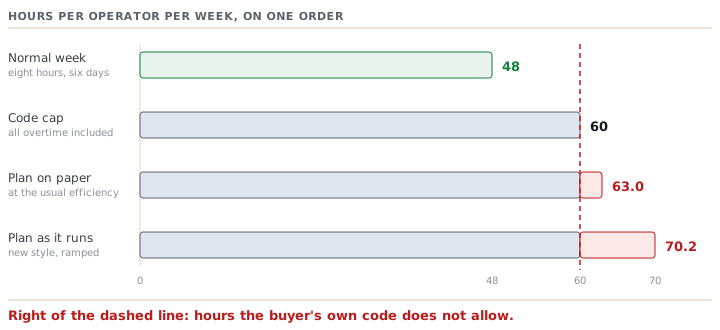
And the capacity that actually exists inside the code: 96 operators, 60 hours a week, 5.5 weeks, at the efficiency ladder above, produces 35,893 pieces. The order is 42,000.
The order was short by 6,107 pieces on the day sewing started. The cutting room sent out 51 bundles of 120 — 6,120 panels, thirteen more than the gap, because bundles do not divide.
The projection was thirteen pieces out over five and a half weeks. The lines finished 35,880. As capacity forecasts go, that is about as accurate as they get. And it means the shortfall was not a surprise that emerged in October. It was calculable in September, in about ten minutes.
The four honest exits, priced
Every one of these was available on 12 September.
| Option | What it costs the factory | Share of the order's margin | What it needs |
|---|---|---|---|
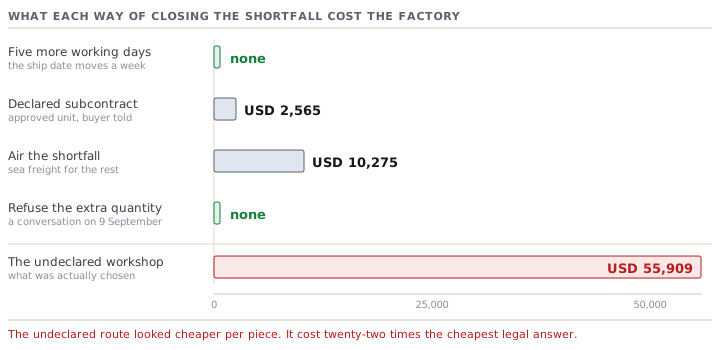
| Five more working days at the factory | none | none | The ship date moves about one week |
| Declared subcontract to an approved unit | USD 2,565 | 5.8% | Written notice, buyer's approval, two days |
| Air the shortfall, sea the rest | USD 10,275 | 23.1% | Nothing from anybody |
| Do not accept the quantity increase | none | none | A conversation on 9 September |
The first is the one nobody asks for. Running at 60 hours a week, the missing 6,107 pieces take five more working days on the sewing floor. Five working days at the factory is about one week later on the water. It costs Zohry nothing it was not already going to spend, because the hours are the same hours, later. It costs Thurlbeck seven days of shelf.
The second is the cheapest thing anybody has to pay for. Nassar Apparel is eighteen kilometres away, on Thurlbeck's approved list, audited in March, with capacity free. Nassar quotes USD 2.32 a piece to sew where Zohry's own cost is USD 1.90 — USD 0.42 a piece more, so USD 2,565 for the shortfall. Add a written notification, and two days for Thurlbeck to approve the transfer.
The third works and it hurts. 6,107 pieces pack into 153 cartons at forty a carton. At 0.46 kg a shirt that is 2,815 kg. The volumetric weight of that carton is lower than its actual weight, so on a shirt you pay for the real kilos. That is not true of a padded jacket, and it is worth checking rather than assuming. At USD 3.65 a kilo, USD 10,275, or 23.1% of everything the order was going to make.
The fourth was free, and it expired on 9 September.
What was chosen
Fouad Sewing quoted USD 1.28 a piece.
Put the three sewing prices in one line, and the whole subject of this course is visible in the gaps between them.
| Where | Per piece | What the price contains |
|---|---|---|
| Fouad Sewing, undeclared | USD 1.28 | Machines, cash wages |
| Zohry Garments, in house | USD 1.90 | Payroll, insurance, the building, the fire door being fitted this month |
| Nassar Apparel, approved | USD 2.32 | All of that, plus somebody else's margin |
Against the legal route, the undeclared one looked like USD 1.04 a piece cheaper — USD 6,365 on the shortfall. And it needed no phone call to a buyer whose report had just landed with four critical findings on it.
It cost USD 55,909 in direct charges, an order that lost USD 11,389 against a margin of USD 44,520, and a suspension. Set against the USD 2,565 that Nassar wanted, the decision was twenty-two times more expensive than the cheapest legal answer. And that is before anything is said about twenty-four people working in a building nobody had ever inspected.
The check to run before you confirm
Five lines. Ten minutes. Run it on the day the order is confirmed, and again on any day the window or the quantity changes.
- Standard minutes required = quantity times SAM.
- Efficiency to use = the measured ramp for a new style, not the factory's steady-state number. This is where most of the error lives, and it always errs the same way.
- Operator-hours required = standard minutes divided by efficiency, divided by sixty.
- Operator-hours available = operators times the code's weekly hours times the weeks in the window, with rest days already removed.
- If line 4 is smaller than line 3, the order is not late. It is already an audit finding. And the only day you can say so cheaply is today.
Then say it, in writing, with the number in it. Not "the delivery is tight" but "this plan requires 70.2 hours a week against your code's 60, and we are 6,107 pieces short. Here are four ways to close it, priced." A buyer can refuse a costed request. A buyer cannot act on a feeling.
A price that cannot carry the wage
The same arithmetic works on price. It is worth doing once, so that you recognise the shape.
TB-529 is FOB USD 7.85 against a factory cost of USD 6.79 — a margin of USD 1.06, or 13.5%. Inside that cost, sewing is USD 1.90 a piece. That is 28.5 standard minutes at 60% efficiency, or 47.5 actual minutes, which prices out at USD 2.40 an operator-hour fully loaded. About USD 0.95 of that hourly rate is the direct wage. The other USD 1.45 is everything else the factory has to pay for that hour.
Now suppose next season's negotiation takes FOB from USD 7.85 to USD 7.20 with no change to the garment. That is 8.3% off the price. Fabric is quoted by a mill, trims are quoted by a supplier, freight is quoted by a forwarder. None of them move because a retailer negotiated. So the whole USD 0.65 lands on the one line that is internal: sewing falls from USD 1.90 to USD 1.25, which is 34.2% off it.
Follow it one step further. USD 1.25 for 47.5 actual minutes is USD 1.58 an operator-hour. Take away the USD 1.45 of overhead that does not move, and there is USD 0.13 an hour left for wages, against USD 0.95 today.
That is impossible, and because it is impossible it does not happen. What happens instead is that the hours get longer, or the piece rate replaces the hourly rate, or the work goes to a workshop that does not carry the USD 1.45. A price cut the cost sheet cannot absorb does not reduce the wage bill. It relocates the work.
This particular build is Zohry's, not a general truth about garment costing. The method is the general truth: find the line in the cost sheet that has no external quotation behind it, and you have found where a price cut actually goes.
If you are the one placing the order
Four things, and none of them costs money.
Move the ship date when you move the approval. A day taken on the buyer's side and not given back at the end is not neutral. It is an instruction to work an hour that the buyer's own code forbids.
Price the quantity increase in days as well as pieces. The four thousand extra pieces on this order needed 3,065 operator-hours — about 31.9 hours for each of the 96 operators, or 3.2 working days — added to a window that had already lost fifteen.
Ask for the hours calculation with the order acceptance. Ask for operators, efficiency, days, and hours per operator per week. A supplier who cannot produce those four numbers is not planning. A supplier who produces them and shows a figure above your code has just told you the truth, and should be treated accordingly.
Never let a compliance conversation and a delivery conversation happen in different meetings. They are the same conversation with different vocabulary. Holding them apart is what allows both to be answered honestly and the answers to contradict each other.
Prompt · Check the order against the code before you confirm it
On the day an order is confirmed, and again on any day the window shrinks or the quantity grows, when the hours the plan requires can still be turned into a costed request.
Act as a senior garment production planner who reports to a compliance manager. Work out whether this order can be made inside the buyer's working-hours standard, and if it cannot, price every honest way out. Order: buyer [BUYER], PO [NUMBER], style [STYLE], [QTY] pieces, FOB [PRICE], factory cost per piece [COST]. The buyer's code says: maximum working week including overtime [HOURS], rest days required [HOW MANY IN HOW MANY DAYS] — quote it back to me so I can check I typed it correctly. Factory: normal shift [HOURS AND DAYS], operators assignable to this order [NUMBER], lines [NUMBER], SAM for this style [MINUTES], steady-state efficiency on repeat styles [PERCENT], measured ramp on a NEW style week by week if we have it [PASTE, OR SAY YOU ARE ASSUMING ONE AND SAY WHAT]. Dates: first sewing day [DATE], last sewing day required [DATE], rest day [DAY], any holidays [DATES], ship date [DATE], port cut-off [DATE]. Now: (1) standard minutes required; (2) operator-hours required at the RAMPED efficiency, and separately at the steady-state figure, so I can see the size of that error; (3) operator-hours available inside the code across the real working days in the window; (4) the resulting hours per operator per week, stated against the code's limit, for both efficiency assumptions; (5) if there is a shortfall, express it in PIECES as well as hours. Then price four options: extending the ship date, declared subcontracting to an approved unit, air freighting the shortfall using chargeable weight, and reducing the quantity — each in dollars, as a percentage of this order's margin, and with the last date the option is still available. Finally, draft the paragraph I should send the buyer today, with the hours figure and the shortfall in it. Do not soften it, and do not recommend absorbing the gap in overtime.
AI can make mistakes — check anything you act on.
Check yourselfA buyer's approval comes back nine days late and the ship date is unchanged. Your line already runs six days a week. What have you actually been asked for?Show the answer
Nine days of production, from a window that no longer has them, which can only come out of hours. Work out how many. The standard minutes still outstanding, divided by your efficiency, divided by the operators you can put on it, gives the hours per operator per week the new window needs. Compare that to the buyer's own code, not to what the floor can physically stand. If it is above the code, you have a costed request rather than a complaint: a later ship date, an approved subcontractor, air freight, or a smaller quantity. Make it in writing on the day the approval arrives. That is the last day all four are still available.
Check yourselfYour factory's efficiency on repeat styles is 62%, and the planner used 62% to schedule a brand new style. Where does that error end up?Show the answer
On the floor, as hours nobody planned. A new style ramps up: the first week can run twenty points below the steady-state number. So a plan built on the steady-state figure understates the work by roughly the area under that ramp. The shortfall does not appear until week three, when the window has already shrunk. By then the free options are gone: a ship-date change is easy in week one and nearly impossible in week five. On this order, the difference between planning at 60% and planning at the real 53.8% average is the difference between 63.0 hours a week and 70.2 — and both of them are above a limit the factory had signed.