Lessons · Lesson 1 of 3
Cotton, and the numbers on the bale
Read the six numbers on a cotton test report, and use them to choose and price the right cotton for an order.
Lesson 1 of 3 · 45 min
The situation
Cotton is not one material. Every bale of cotton comes with a test report. The report is one page of numbers. Those numbers decide three things: how fine a yarn you can spin, how evenly the fabric will take dye, and how much the cotton will cost you. This lesson reads that page with you, number by number. At the end it covers where the cotton was grown — the first thing customs officers ask about today.
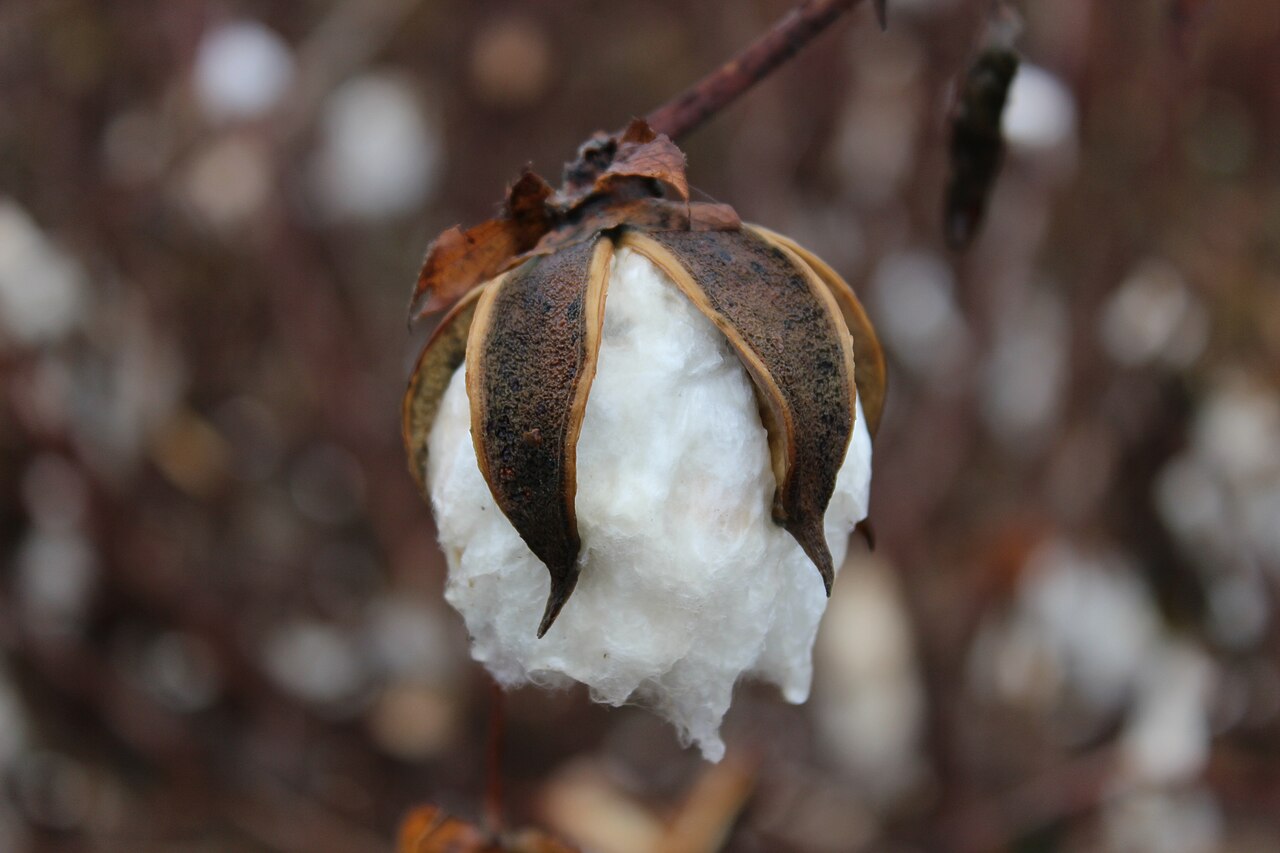
It is 14 February, 11:20, at the yarn desk of a knitting mill in Faisalabad. Style KS-402 is for the German retailer Brenner: 24,000 men's single-jersey T-shirts. Body fabric 180 g/m². Target price FOB USD 3.40. Order value USD 81,600. The yarn must be booked this week. If not, the mill loses its March knitting slot to someone else.
The fabric line on the tech pack says: 100% combed cotton, 30s Ne ring-spun, 180 g/m².
That looks like a full specification. It is not. Every cotton in the world matches that line. Between the cheapest cotton that matches and the most expensive one, the yarn price on this order moves by about USD 3.00 per kilogram. That is about USD 0.79 per shirt, on a shirt priced at USD 3.40. Nothing in the tech pack says which cotton to buy. The bale decides — and every bale arrives with a document.
The document that really specifies cotton
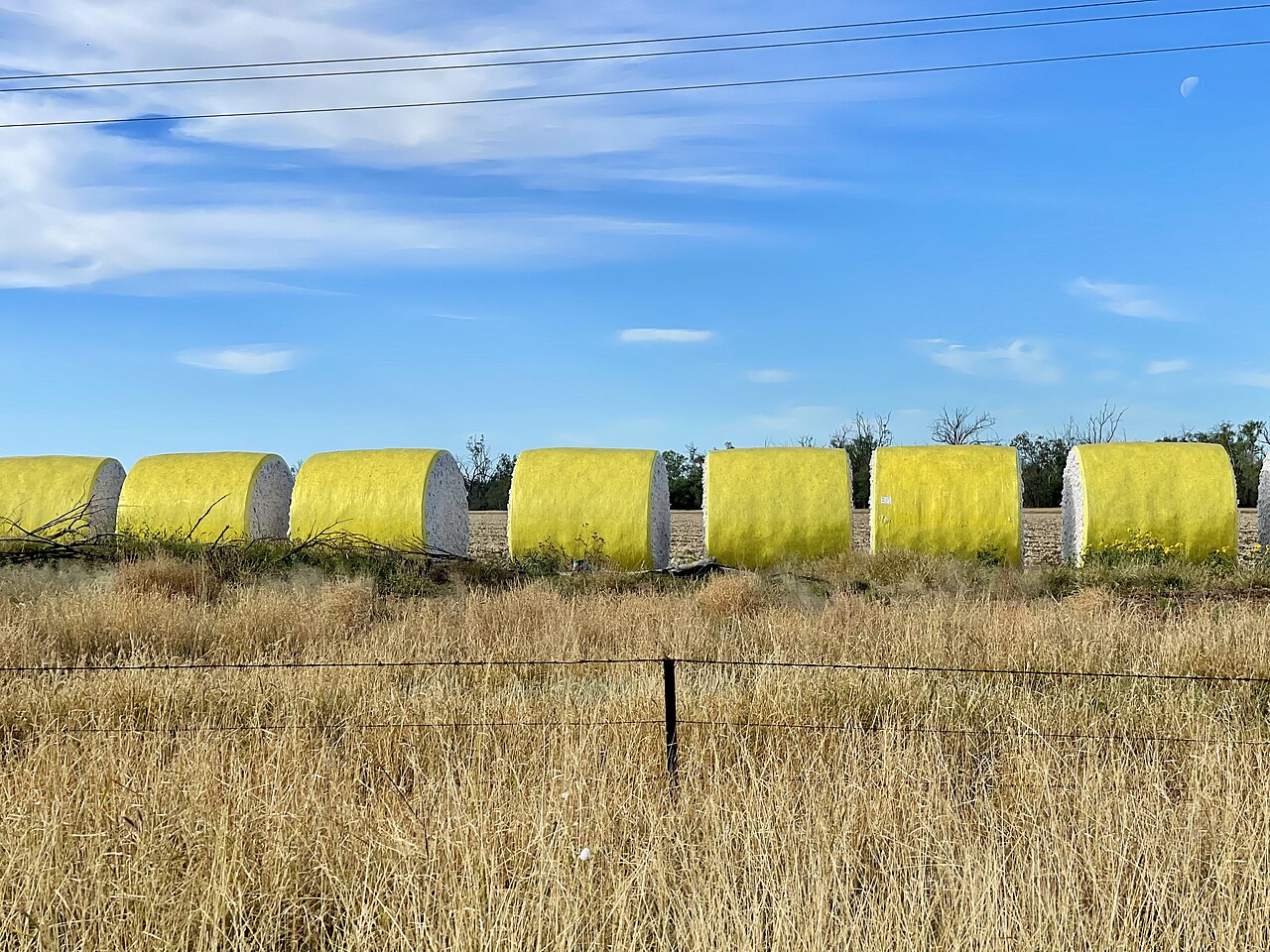
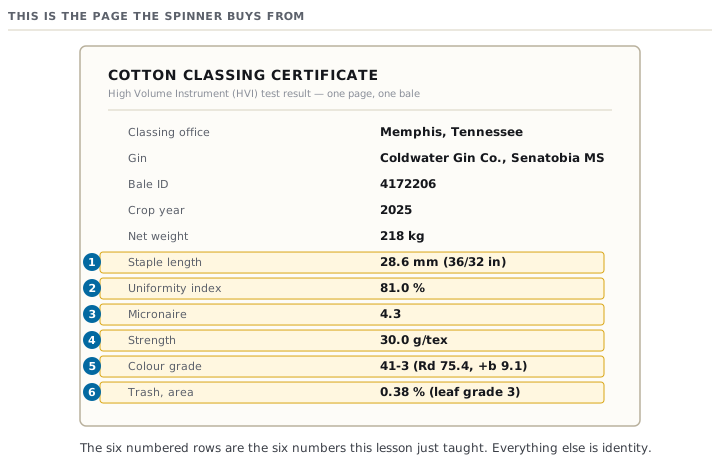
Every commercial bale is tested on an HVI machine (High Volume Instrument). The test certificate is what a spinner buys from. Six numbers on it matter to you:
- Staple length — how long the fibres are, in millimetres.
- Uniformity — how similar the fibre lengths are, as a percentage.
- Micronaire — one number for fibre fineness and maturity together.
- Strength — in grams per tex. The force a standard bundle of fibres takes before it breaks.
- Colour grade — how white or how yellow the cotton is.
- Trash — the percentage of leaf and stalk still in the cotton.
Here is the document itself. The six numbered rows are the six numbers you just read. Its values are the US upland cotton you will meet in the table below.
Here are those numbers for four cottons you could buy for this T-shirt order.
| Cotton | Staple length | Uniformity | Micronaire | Strength | Lint price USD per kg |
|---|---|---|---|---|---|
| Pakistani upland, machine-picked | 27.5 mm | 80% | 4.6 | 28 g/tex | 1.95 |
| US upland, Memphis territory | 28.6 mm | 81% | 4.3 | 30 g/tex | 1.86 |
| Egyptian Giza 86, long staple | 33.0 mm | 85% | 4.1 | 42 g/tex | 4.20 |
| US Supima, extra long staple | 36.5 mm | 85% | 4.0 | 44 g/tex | 3.60 |
The US upland price is not made up. It is the Cotlook A Index at 84.50 US cents per pound, divided by 0.4536 to convert to kilograms. Traders quote in cents per pound. Cost sheets use dollars per kilogram. Getting this conversion wrong is the first mistake people make when they argue about fibre prices.
Staple length decides how fine a yarn you can spin
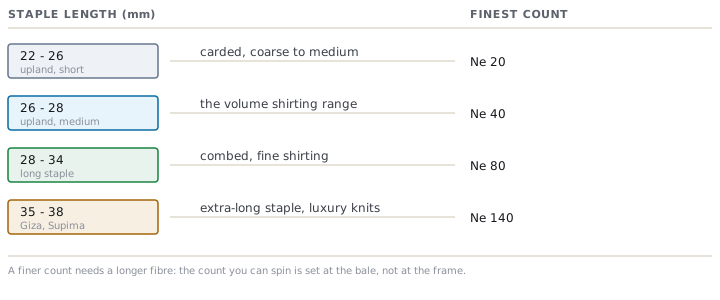
The most useful fact about cotton is this: fibre length sets a limit on how fine the yarn can be. A spinning machine twists fibres together into yarn. Short fibres need more twist to hold together. So short cotton cannot be pulled thin enough for a fine yarn — the yarn keeps breaking.
| Staple length | Class | Practical maximum ring-spun count | Where it ends up |
|---|---|---|---|
| 25 to 27 mm | Short to medium | Ne 24 | Coarse jersey, fleece, denim weft |
| 28 to 30 mm | Medium long, standard upland | Ne 40 | T-shirts, poplin, most of the trade |
| 32 to 34 mm | Long, Giza 86 class | Ne 80 | Fine shirting, 60s jersey |
| 35 to 38 mm | Extra long, Supima and Giza 88 | Ne 140 | 100s to 140s shirting, luxury knits |
Now compare that table with order KS-402. The tech pack asks for Ne 30 yarn. Standard upland cotton at 28.6 mm spins Ne 30 easily — it is nowhere near its limit. Egyptian Giza 86 can spin up to Ne 80, but this order does not need that. Buying Giza 86 for a 30s jersey pays for quality the shirt can never show. That is the whole argument in one line. Use it when a buyer writes an expensive long-staple cotton into a heavy T-shirt because the name sounds like quality.
Micronaire decides how many fibres are inside the yarn
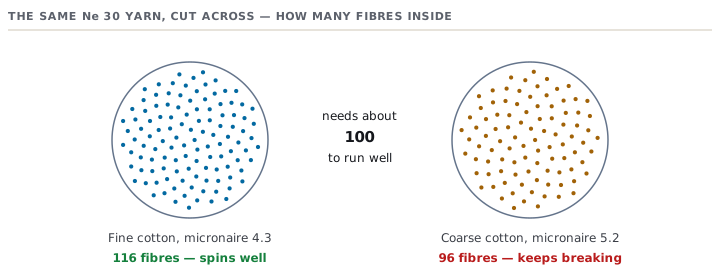
Micronaire is measured with air flow. It stands for two things at once: how fine the fibre is, and how mature it is. The good range is 3.5 to 4.9. Below 3.5, the fibre is immature and thin-walled. It takes dye differently and shows up as streaks (barré) and small knots (neps) in the finished fabric. Above 5.0, the fibre is coarse. Coarse fibre feels harsher — and it means fewer fibres inside the yarn.
You can check that last point with simple arithmetic at your desk:
- A Ne 30 yarn is 590.5 divided by 30, which is 19.7 tex — 19.7 grams per 1,000 metres.
- A cotton of micronaire 4.3 has a fineness of about 1.7 dtex, which is 0.17 tex per fibre.
- Fibres inside the yarn: 19.7 divided by 0.17, which is 116.
Ring spinning needs about 100 fibres inside the yarn to run well. Combed ring spinning struggles below that. Now do the same sum with a coarse bale at micronaire 5.2. Its fineness is about 2.05 dtex, or 0.205 tex per fibre. 19.7 divided by 0.205 is 96 fibres. Same yarn count, same machine, same operator — but now the yarn keeps breaking, and the shift's low output looks like a machine problem. It is not a machine problem. It is the bale.
What the money buys
Now price the choice properly. The price on the bale is not the price in the yarn. Why? Because combed yarn throws fibre away on purpose. The picture shows it:
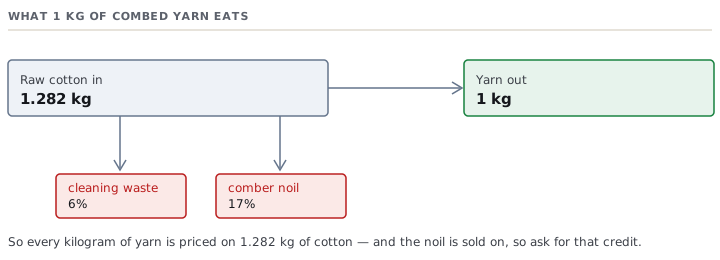
- Waste in opening and carding: 6%.
- Comber noil — the short fibres removed to make the yarn smooth and even: 17%.
- Total yield: 0.94 multiplied by 0.83, which is 0.7802.
- So 1 kilogram of combed yarn uses 1.282 kg of raw cotton.
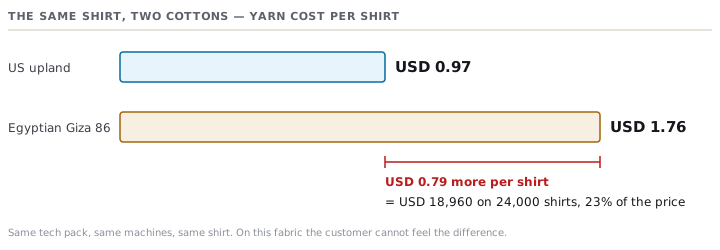
At the US upland price, that is 1.86 multiplied by 1.282, which is USD 2.38 of fibre in every kilogram of yarn. At the Giza 86 price, it is 4.20 multiplied by 1.282, which is USD 5.38. Add a spinning charge of USD 1.30 per kg. The two yarns now cost USD 3.68 and USD 6.68.
Now bring it down to one shirt:
- Fabric in one T-shirt: 0.235 kg.
- Cutting waste is 12%, so yarn per shirt is 0.235 multiplied by 1.12, which is 0.263 kg.
- Upland yarn: 3.68 multiplied by 0.263 is USD 0.97 per shirt.
- Giza 86 yarn: 6.68 multiplied by 0.263 is USD 1.76 per shirt.
The difference is USD 0.79 per shirt. That is USD 18,960 on the whole order, and 23% of a price of USD 3.40. And on this fabric, the customer in Hamburg will not feel any difference.
Where the cotton comes from is a business fact, not only a quality fact
Cotton comes in two families. Upland cotton (Gossypium hirsutum) is about 90 percent of world production. Extra-long-staple cotton (Gossypium barbadense) is the rest: Egyptian Giza 86, 88 and 92, US Pima sold as Supima, Peruvian Pima, Israeli. Each upland region has its own character a spinner knows — US Memphis and West Texas, Brazilian, Australian, West African, Indian Shankar-6, Central Asian, Chinese Xinjiang.
Two origins carry risks that have nothing to do with fibre quality.
The first is traceability. Goods made fully or partly with cotton from Xinjiang cannot enter the United States, unless the importer proves no forced labour was used. So a US buyer will ask for documents from the bale to the garment — the gin ticket, the bale ID, the spinner's mix declaration, sometimes an isotope test. This is a sourcing question. It is settled at the bale, months before anyone cuts fabric.
The second is the name on the label. "Egyptian cotton" and "Supima" are protected trade marks, with licence schemes and DNA or isotope testing behind them. A mill that buys Giza-class fibre from a broker with no certificate has bought long-staple cotton — but not the right to print the name on a label.
Prompt · Turn a cotton line into a specification you can buy
The day a tech pack arrives saying 100% cotton and nothing else, and yarn has to be booked this week.
Act as a senior yarn buyer in a knitting or weaving mill. I have a tech pack whose fabric line says only: [PASTE THE FABRIC LINE EXACTLY AS WRITTEN]. Order facts: buyer [BUYER], style [STYLE], PO [NUMBER], quantity [QTY] pcs, fabric [GSM] g/m2, target FOB USD [PRICE], destination market [MARKET]. Garment fabric consumption is [KG] kg per piece and cutting waste is [PERCENT] percent. Do the following. First, rewrite that fabric line as a fibre specification a spinner can quote against: origin class (upland or extra long staple), staple length in millimetres, micronaire band, uniformity index, strength in grams per tex, and a contamination standard. Second, state the practical maximum ring-spun count for each staple class you name, and tell me plainly whether the count in my tech pack needs anything longer than standard upland. Third, build the yarn price from the lint price up: show the blowroom and card waste, the comber noil if the yarn is combed, the resulting kilograms of lint per kilogram of yarn, the conversion charge, and whether a noil credit is included. Fourth, convert every lint price you quote from US cents per pound to USD per kilogram and show the division. Fifth, give me the cost per garment and as a percentage of my FOB for each fibre option, and say which of them the customer could actually perceive in this fabric at this count. Sixth, list the origin and traceability documents my buyer's market will require. Do not tell me a more expensive fibre is better without naming the property it improves and the count at which that property becomes visible.
AI can make mistakes — check anything you act on.
Check yourselfA buyer asks for Supima cotton for a heavy 210 g/m² hoodie in count 20. What do you say?Show the answer
Say this: count 20 is a thick yarn, and Supima cannot show any difference in it. Ordinary 28 mm cotton spins count 20 easily. Supima can spin all the way to count 140 — and none of that is used here. Supima does add strength and shine, but brushing the fabric removes the shine. If the buyer wants the Supima name on the label for marketing, that is their right. Just price it as a name licence, not as a technical need — and write that down.
Check yourselfYour spinner offers a batch at micronaire 3.3, USD 0.14 per kg under the market. Do you buy it?Show the answer
Not for fabric that will be dyed. Micronaire 3.3 is below the 3.5 floor. That means immature fibre. Immature fibre takes dye differently, so streaks and small knots show up in the fabric. And the saving is small: USD 0.14 on a kilo of cotton is USD 0.18 on a kilo of yarn (one kilo of yarn needs 1.282 kg of cotton) — about USD 0.05 per shirt. One rejected dye lot on a 24,000-piece order costs many times that saving. This cotton has real uses: thick yarns, and colours where streaks don't show. Not a fine combed yarn that must match the approved shade.