Lessons · Lesson 2 of 3
Wool, and what a micron costs
Price a wool order from the raw lot to the finished sweater, and check with simple arithmetic whether the wool a buyer asked for will itch.
Lesson 2 of 3 · 43 min
The situation
Wool is bought by thickness. One number gives the average thickness of the hairs, and that number sets the price. The same lot of wool carries three prices, depending on how much grease and dirt is still in it. And the average cannot tell you whether a sweater will itch. That needs a second number, and few tech packs ask for it. The lesson ends on the care label — a fibre requirement written on a different page.
It is 6 March, 14:00, at a knitwear factory in Tekirdağ. Style KN-77 is for the Norwegian retailer Fjellstad: 6,500 women's crew-neck sweaters, 12 gauge, finished garment weight 310 g, FOB USD 26.50, order value USD 172,250. Yarn is 60 percent of the cost. The yarn has not been booked.
The tech pack says: 100% Merino wool, 19.5 micron, Nm 2/48, two ends.
Unlike the cotton line in the last lesson, this one is nearly a specification. It names the number wool is actually priced by. But what it leaves open is enough to move the yarn cost by USD 6.43 per kilogram. And it says nothing at all about whether the sweater will itch.
Wool is priced by one number, and it is not a grade
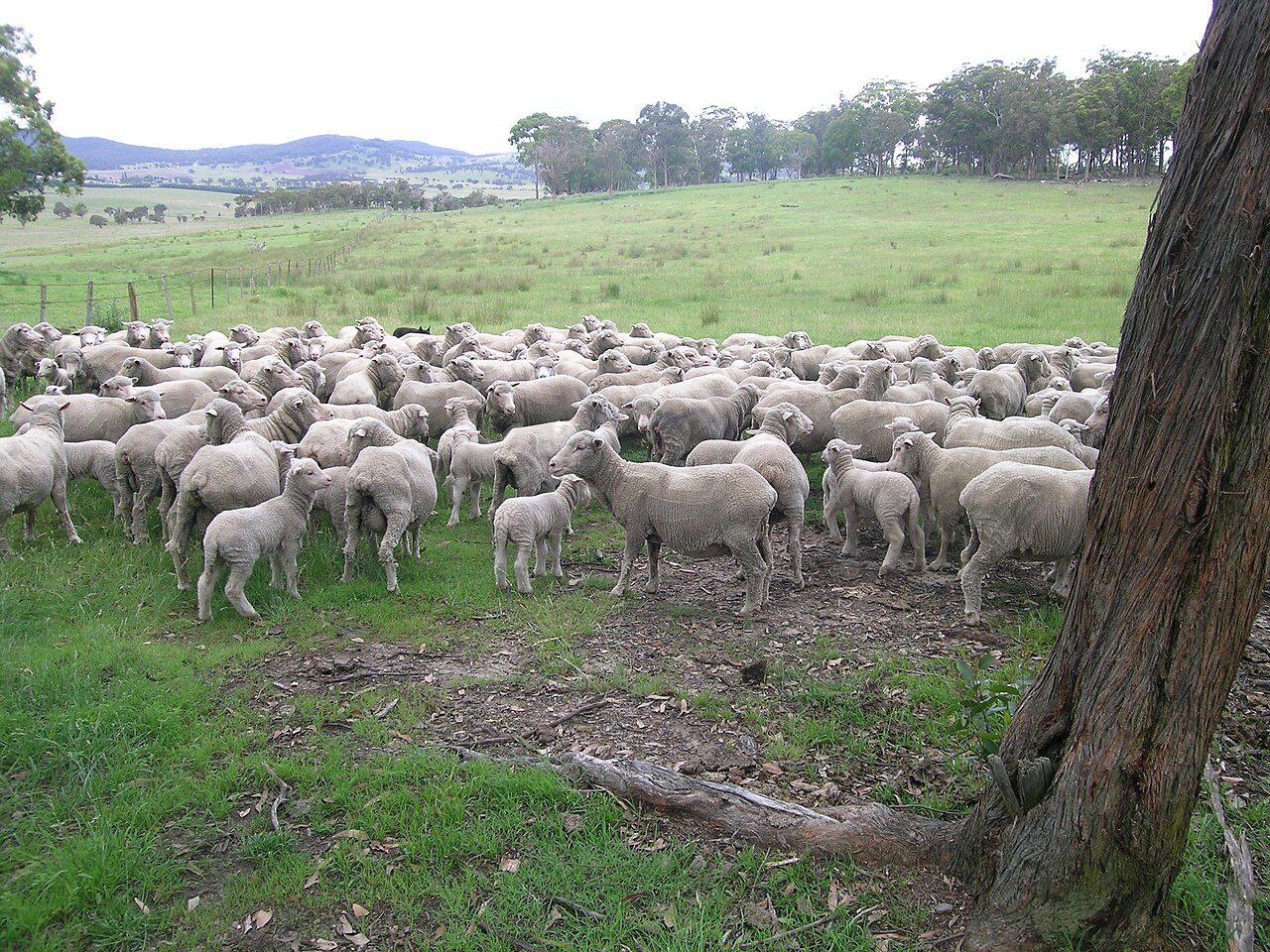
Cotton is classed on six numbers. Wool is priced on one: the mean fibre diameter — the average thickness of the hairs, measured in microns. A micron is a thousandth of a millimetre. Everything else adjusts around that one number. And the price does not climb in a straight line. It is nearly flat at the coarse end, then climbs steeply below about 20 micron. The reason is simple: the sheep that grow fine wool grow less of it.
| Class | Mean fibre diameter | Staple length | What it becomes | Clean price USD per kg |
|---|---|---|---|---|
| Superfine Merino | 16.5 micron | 75 mm | Next-to-skin base layers, Nm 2/60 | 24.80 |
| Fine Merino | 18.5 micron | 80 mm | Fine-gauge knitwear, light suiting | 15.40 |
| Medium Merino | 21.5 micron | 90 mm | 12 gauge sweaters, worsted suiting | 9.60 |
| Fine crossbred | 26.0 micron | 110 mm | Outerwear, heavy knits, blankets | 4.10 |
| Coarse crossbred | 32.0 micron | 130 mm | Carpet, felt, upholstery | 2.05 |
The reference everyone quotes is the AWEX Eastern Market Indicator. It is published in Australian cents per kilogram of clean wool. At 1,285 cents and an exchange rate of 0.66, that is USD 8.48 per kg. It is an average across all micron classes — useful for the direction of the market, useless for pricing one specific lot.
Three prices for the same wool
A wool lot has at least three prices. Mixing them up is how a costing goes wrong by 40 percent.
Greasy is what comes off the sheep: fibre plus lanolin (the wool grease), dried sweat, dirt and bits of plants. Clean is what is left after scouring — the wash that removes all of that. The ratio between the two is the yield, and it is written on every sale document. Merino fleece yields around 68 percent. Crossbred yields around 76 percent.
Say you buy a lot greasy at USD 6.40 per kg, at a yield of 68%. The clean price is 6.40 divided by 0.68, which is USD 9.41 per kg clean. You did not buy wool at USD 6.40. You bought water, grease and dirt at USD 6.40 — and wool at USD 9.41.
Top is the third price. Scoured wool is combed into a long, smooth rope of fibre called a top. Combing pulls out the short fibres as noil, about 7% of the weight. Spinning loses roughly another 3%. So one kilogram of worsted yarn consumes 1 divided by 0.93 multiplied by 0.97, which is 1.11 kg of top.
Now cost KN-77 properly
Build the yarn price per kilogram from the clean price up. Do it for two wools: the 18.5 micron the buyer is drifting towards, and the 21.5 micron that would actually do the job.
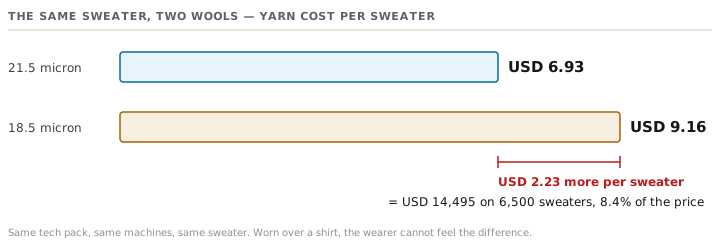
- 18.5 micron: 15.40 multiplied by 1.11 is 17.09. Add topmaking and spinning at USD 6.50, and dyeing at USD 2.80. That gives USD 26.39 per kg.
- 21.5 micron: 9.60 multiplied by 1.11 is 10.66. Add the same 6.50 and 2.80. That gives USD 19.96 per kg.
Then the garment. The finished weight is 310 g. Knitting, linking and mending waste on a fully-fashioned sweater runs about 12%. So yarn per garment is 0.310 multiplied by 1.12, which is 0.347 kg.
- 18.5 micron: 26.39 multiplied by 0.347 is USD 9.16 of yarn per sweater.
- 21.5 micron: 19.96 multiplied by 0.347 is USD 6.93.
The gap is USD 2.23 a sweater. That is USD 14,495 across the order, and 8.4% of an FOB of USD 26.50. It is a real number, and it can be defended in either direction. But it must be decided before the yarn is dyed. Wool yarn is dyed to the buyer's colour card, and a dyed lot cannot be sold to anyone else.
The prickle arithmetic
Now the question the tech pack does not answer. Will it itch?
Prickle is not an allergy, and it does not come from the average. A fibre coarser than about 30 micron is too stiff to bend when it meets the skin. Instead of bending, it presses — and the skin reports that as a prickle. So comfort depends on the share of fibres in the yarn coarser than 30 micron. The trade uses the mirror of that share and calls it the comfort factor: the percentage of fibres finer than 30 micron. Above about 95%, almost nobody complains. Below it, wearer trials start to.
To work it out you need two numbers, not one: the mean diameter, and the coefficient of variation of diameter (CVD) — a percentage that says how spread out the diameters are. It is on the test certificate. Treat the diameters as a normal spread, and the arithmetic is one subtraction and one division.
Take the specified 19.5 micron at a typical CVD of 21%. The standard deviation is 19.5 multiplied by 0.21, which is 4.1 micron. The distance from the mean to the 30 micron line is 30 minus 19.5, which is 10.5. And 10.5 divided by 4.1 is 2.56 standard deviations. That leaves 0.5% of fibres above the line — a comfort factor of 99.5%. Nobody will feel it.
| Mean diameter | CVD | Standard deviation | Fibres coarser than 30 micron | Comfort factor | Verdict |
|---|---|---|---|---|---|
| 19.5 micron | 21% | 4.1 | 0.5% | 99.5% | Next to skin, safe |
| 21.5 micron | 18% | 3.9 | 1.5% | 98.5% | Safe |
| 21.5 micron | 26% | 5.6 | 6.5% | 93.5% | Complaints in wearer trial |
| 23.5 micron | 24% | 5.6 | 12.3% | 87.7% | Prickles, mid-layer only |
Read rows two and three together. They are the lesson. Both tops are 21.5 micron. Both meet a tech pack that says 21.5 micron. One is comfortable. One generates returns. The only thing separating them is a number nobody wrote down.
Wool counts are metric, and plied
KN-77 asks for Nm 2/48. Nm is metres per gram: an Nm 48 single is 48 metres of yarn in one gram. Ply two of them together and the count halves — the result is Nm 24. In tex — grams per 1,000 metres — that is 1,000 divided by 24, or 41.7 tex. Feed two ends into a 12 gauge machine and an effective Nm 12 enters the needle. That is where a 12 gauge sweater at this weight lands.
A British spec may quote worsted count instead. Multiply it by 1.6934 to get Nm: Nm 48 is worsted count 28.3. Do that conversion backwards and you order a yarn twice as fine as the one you meant. You discover it at the knitting trial, and you lose three weeks.
Superwash, and the claim you just agreed to
Wool felts. Each fibre is covered in tiny scales. Under heat, water and movement, the scales lock against each other, and the fabric shrinks — permanently. That is felting shrinkage. It comes on top of the ordinary relaxation shrinkage of 3 to 5 percent that any knit shows on its first wash.
So a machine washable claim on a wool garment means the fibre was treated. Almost always this is the chlorine-Hercosett route: the scales are stripped off and the fibre is coated with a thin polymer. The treatment adds about USD 2.10 per kg to the yarn. On the same 0.347 kg per garment, that is USD 0.73 a sweater. It also changes the feel of the fabric slightly — so the buyer's fit sample should be approved on the treated yarn, not discovered in bulk. Untreated wool is labelled hand wash or dry clean. If the care label and the fibre do not agree, the wash test is where it surfaces.
Mulesing, certification, and blends
Mulesing is a painful surgical practice on sheep farms, and most European and Nordic buyers now refuse it. They ask for non-mulesed wool, verified through the Responsible Wool Standard (RWS), ZQ or SustainaWOOL. The premium runs 8 to 12 percent on the clean price. On the 18.5 micron lot, 12% of USD 15.40 is USD 1.85 per kg clean — roughly USD 0.71 a sweater. Understand what you are paying for: it is a certified paper trail, not a different fibre. The wool is identical. The paperwork is not. The transaction certificates must exist at every stage from grower to garment, or the claim cannot be made.
Two blend facts worth carrying. Nylon at 20% in socks, cuffs and elbows roughly doubles the life of the fabric under rubbing. That is a durability decision, not a cost dodge. And 5% cashmere does nothing you can feel in a garment. It is a label. A buyer who wants cashmere to be felt needs 30 percent or more.
Prompt · Check a wool specification before it prickles
Before wool yarn is dyed, when the tech pack names a micron and nothing else.
Act as a senior worsted spinner. I am about to book wool yarn against this specification: [PASTE THE FIBRE AND YARN LINE FROM THE TECH PACK]. Garment: buyer [BUYER], style [STYLE], [QTY] pcs, machine gauge [GAUGE], finished garment weight [GRAMS] g, care label as drawn [PASTE THE CARE SYMBOLS], FOB USD [PRICE]. The top test certificate says mean fibre diameter [MICRON] micron, coefficient of variation of diameter [CVD] percent, staple length [MM] mm, vegetable matter [PERCENT] percent. Do the following. First, work out the share of fibres coarser than 30 micron and the comfort factor, showing the standard deviation and the number of standard deviations from the mean to the threshold. Second, tell me whether this yarn will be felt as prickly in this garment worn in this position on the body, and say what the comfort factor would have to be for me to stop worrying. Third, tell me what the specification is missing and write the exact line I should add to the tech pack so this cannot recur. Fourth, check the care label against the fibre: if a machine wash symbol is drawn, say whether the yarn must be superwash treated, what that adds per kilogram and per garment, and what it does to the hand. Fifth, state the relaxation and felting shrinkage I should expect if it is not treated. Sixth, tell me which certification the destination market is likely to require on mulesing and what the premium is. Answer with the arithmetic shown, not with a verdict.
AI can make mistakes — check anything you act on.
Prompt · Price a fibre change from raw fibre to FOB
The moment a buyer asks to change a fibre, a micron or a blend ratio and expects the price to hold.
Act as a senior costing merchandiser in a garment export factory. A buyer wants to change the fibre on a live style. Current specification: [PASTE]. Proposed specification: [PASTE]. Order facts: buyer [BUYER], style [STYLE], [QTY] pcs, current FOB USD [PRICE], my current yarn or fabric cost USD [COST] per piece, margin [PERCENT] percent. Fibre prices I have been quoted: [PASTE EVERY QUOTE WITH ITS UNIT AND WHETHER IT IS GREASY, CLEAN, LINT, TOP, RAW OR DEGUMMED]. Garment consumption [KG] kg per piece, process waste [PERCENT] percent. Do the following. First, restate every fibre price on one common basis, USD per kilogram of finished yarn, showing every yield, waste and loss step in between, and name each step. Second, give me the change in cost per garment and across the whole order, and as a percentage of FOB. Third, list the consequences that are not fibre price: machine efficiency, breakage rates, dyeing behaviour, extra finishing, shrinkage, lead time, and minimum order quantity on the new fibre. Fourth, tell me what in the tech pack must change at the same time as the fibre, including any tolerance, care instruction or defect clause that the new fibre makes wrong. Fifth, write the three-sentence reply I should send the buyer, stating the new price, the date the price expires, and what I need from them to hold the delivery date. Do not present a fibre change as a price change only.
AI can make mistakes — check anything you act on.
Check yourselfThe buyer asks to move KN-77 from 19.5 to 17.5 micron. What do you tell them, in one minute?Show the answer
That it costs roughly USD 4 a sweater at the yarn stage, and buys almost nothing here. At 19.5 micron and a CVD of 21%, the comfort factor is already 99.5% — there is no prickle to remove. Finer wool earns its price in a base layer worn directly on the skin at 150 g/m², not in a 310 g crew-neck worn over something else. Finer fibre is also weaker in spinning, so yarn breaks and faults rise, and the mill will want a longer lead time. If the brand wants the number on the swing ticket, that is a marketing decision — and it should be costed as one.
Check yourselfYarn is delivered on spec at 21.5 micron. The wearer trial reports itching. Who is at fault?Show the answer
Neither party. That is why it is a specification problem, not a claim. The mean was met; the CVD was never specified. A 21.5 micron top at CVD 26% puts 6.5% of its fibres over the 30 micron line — a comfort factor of 93.5%, and that is felt. The fix is to write the second number into the tech pack from now on: mean diameter plus a maximum CVD, or better, a minimum comfort factor. That is one number, and it directly describes what the wearer feels. And ask the spinner for the top test certificate before the yarn is dyed. After dyeing you are negotiating, not specifying.