Lessons · Lesson 3 of 3
Linen, the other bast fibres, and silk
Price a linen blend against the fibre it replaces, write the two clauses that stop linen failing inspection, and read a silk specification in denier and momme.
Lesson 3 of 3 · 42 min
The situation
Linen crumples, and it has lumps in it. Both are simply what the fibre is. But both sit on the defect list in most buyers' quality manuals. So a good linen shirt can fail inspection for being linen. This lesson covers the plant fibres that must be rotted apart before spinning, and what that does to their price. It ends with silk, which is priced twice — so a costing built on the first price is short.
It is 22 April, 10:15, at a woven shirt factory in Da Nang. Style LS-19 is for the Australian brand Corrigan: 9,200 men's long-sleeve shirts, fabric 55% linen / 45% cotton, 135 g/m², yarn-dyed, FOB USD 9.80, order value USD 90,160.
Two things about this order will go wrong if nobody deals with them this week. The first is a number: the blend is written as a ratio, and nobody has priced what the other ratio would cost. The second is not a number at all. Linen creases, and linen has slubs — the small thick lumps in the yarn. Unless the tech pack says so in writing, the pre-shipment inspection will count both as defects. The shipment will then fail on a property the fibre cannot help having.
What a bast fibre is, and why retting sets the price
Cotton grows as a hair on a seed. Wool grows from a follicle in the skin. Flax, hemp, jute and ramie are different: they are bast fibres — bundles of cellulose running the length of a plant stem, glued to the stem by natural gums. Nothing can be spun until that glue is broken. Breaking it is called retting: controlled rotting. It happens in the field under dew for 14 to 21 days, in tanks of water, or with enzymes.
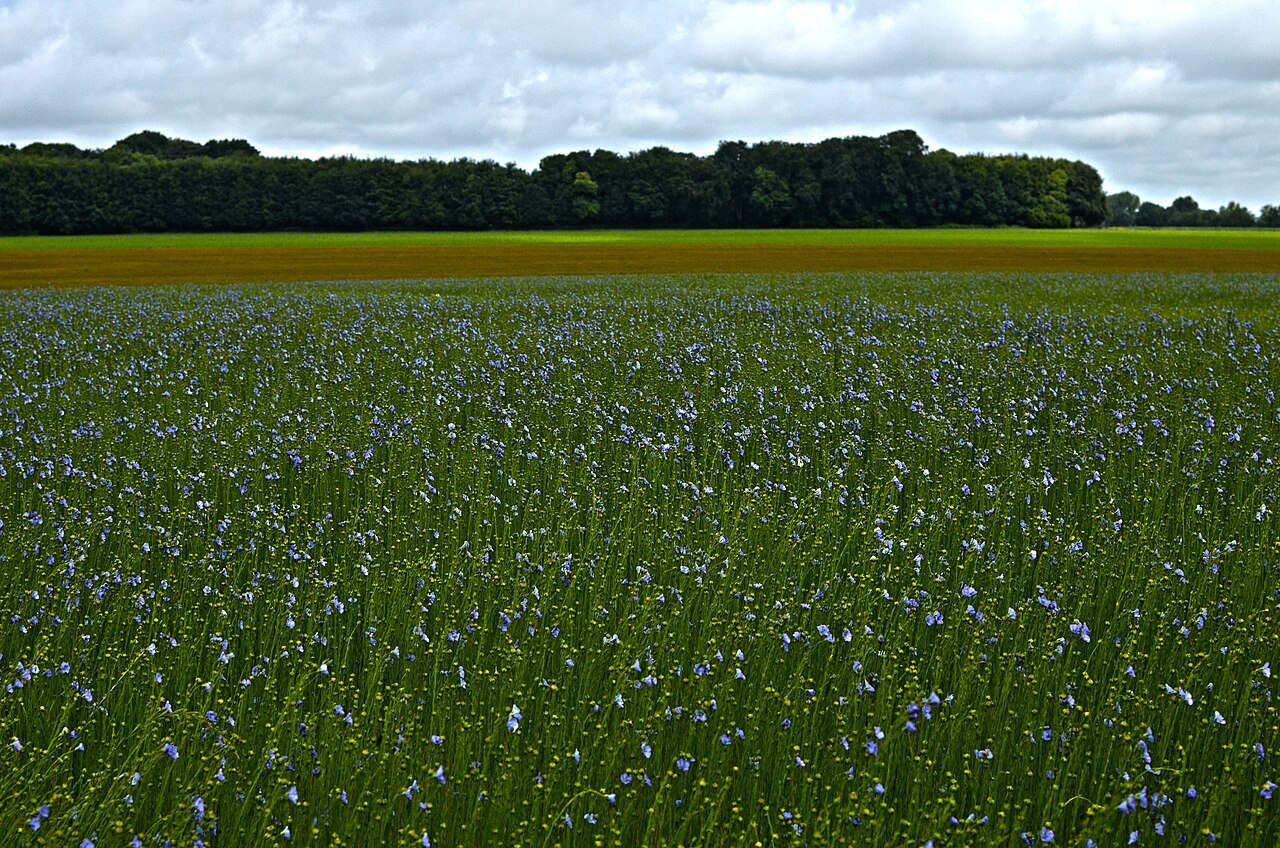
Retting is the whole quality story of linen. Under-retted flax will not separate, and it spins coarse and hairy. Over-retted flax is damaged: the rot has attacked the fibre itself, and it loses strength. Retting is judged by eye and by hand, by people who have done it for decades. That is why flax from Normandy, Flanders and Belgium carries a premium that no number on a certificate can explain.
After retting, the stem is beaten and combed, and the yield splits in two. The long combed fibres are line flax — about 20 percent of the stem — wet-spun into fine, even yarn. The short tangled remainder is tow, dry-spun into coarse, slubby yarn. A linen shirting is line. A rustic upholstery linen is tow. A fabric quoted suspiciously cheap is tow being sold as line.
Linen counts, and the water you are invoiced for
Linen is counted in Nm, metres per gram, like wool. Wet-spun line linen runs Nm 20 to 60. Dry-spun tow runs Nm 6 to 14. Older mills and older buyers still quote the traditional lea count, where one lea is 300 yards of yarn in a pound. Multiply the lea count by 0.605 to get Nm — so a lea 25 is Nm 15.1.
The other number that catches people is moisture regain — the water a fibre naturally holds. Every natural fibre holds some, and yarn is invoiced at a conditioned weight, not a dry one. Linen's commercial regain is 12%. Cotton's is 8.5%. So one tonne of oven-dry linen yarn invoices as 1,120 kg, while the same tonne of cotton invoices as 1,085 kg. When a consignment arrives light and the mill says it dried out in the container, that is a regain argument. It is settled with an oven test and the standard regain figure — not with an opinion.
Costing LS-19, and the ratio nobody costed
Work down from the fabric.
- Fabric consumption: 1.72 m at 145 cm width, which is 2.494 m² per shirt.
- At 135 g/m², that is 0.337 kg of fabric per shirt.
- Weaving and finishing losses of 6% put yarn per shirt at 0.357 kg.
Now the yarn. Wet-spun line linen at Nm 34 is USD 6.40 per kg. Combed cotton at Ne 40 is USD 3.90 per kg. A 55/45 blended yarn costs 0.55 multiplied by 6.40, plus 0.45 multiplied by 3.90. That is 3.52 plus 1.76, or USD 5.28 per kg.
- As specified: 0.357 multiplied by 5.28 is USD 1.89 of yarn per shirt.
- At 100% linen: 0.357 multiplied by 6.40 is USD 2.28.
The difference is USD 0.39 a shirt, USD 3,588 across the order, and 4.0% of FOB. That is what the cotton in the blend is buying.
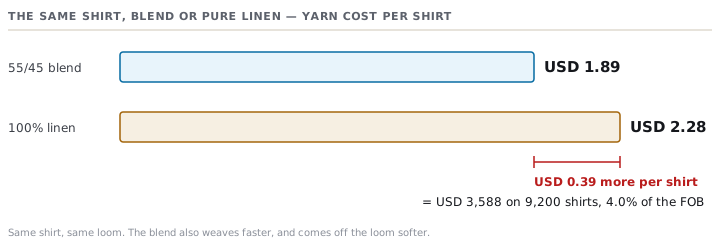
And the cotton buys two other things nobody put on the cost sheet. Linen does not stretch, and it scrapes: a pure linen warp breaks in the loom and slows it down, so a cotton content raises weaving efficiency measurably. And the blend comes off the loom softer. That matters, because the other way to soften linen is an enzyme or stone wash — which costs money and shrinks the garment again.
What the cotton takes away is the reason people buy linen at all: the dry, cool feel, and the way it pulls heat away from the skin. Linen is also 20 percent stronger when wet, so it survives a hard industrial laundry that cotton does not.
The two clauses that keep linen out of the defect list
Linen stretches only 2 to 3% before it breaks. And after being stretched 2 percent, it springs back only about 65% of the way. Cotton springs back about 75%, and wool about 99%. That is the arithmetic of creasing: linen deforms and does not spring back. No finish removes this. A resin finish reduces it — and pays for that with tearing strength, a trade nobody wants on a shirt.
So creases are not a defect. Slubs are not a defect either: the thick places are fibre bundles that did not fully separate in combing, and a mid-count line linen will have several per metre.
But neither of those sentences is true unless the tech pack says it. A third-party inspector works from the buyer's quality manual. And every manual in the world lists "crease" and "uneven yarn" as major defects.
Hemp, jute and ramie in one paragraph each
Hemp is chemically almost a twin of flax, with more woody gum in it. So it starts coarser and stiffer, and it softens with washing rather than with finishing. Cottonised hemp — degummed and cut to cotton length so it can run on cotton machines — costs USD 3.20 to 4.50 per kg, and usually appears at 55/45 with cotton. It grows without irrigation across most of Europe, with far less chemical input than cotton. That is why it turns up in briefs written by the buyer's sustainability team.
Jute is the cheapest textile fibre on earth, at around USD 0.90 per kg. It is rich in lignin, the woody gum — so it yellows and weakens in sunlight, and goes brittle when dry. Jute is sacking, carpet backing and twine. In a garment it is a hangtag, a drawstring or a trim — never a body fabric. But remember: a jute trim still enters the fibre content declaration if it is a component of the garment.
Ramie is the strongest bast fibre, at 55 to 70 cN/tex, with a shine close to silk. It is also stiff, springs back badly, and yellows in the sun. Its gums are 25 to 30 percent of the raw stem, so removing them is chemically harsh and expensive. Ramie almost always appears blended, at 30 to 55 percent with cotton, in summer shirts and jackets.
Silk is a filament, and it is priced twice
Everything above is a staple fibre: short lengths, twisted together. Silk is not. A Bombyx mori cocoon unwinds as one continuous filament of 800 to 1,200 m, and reeling means unwinding several cocoons together into one thread. Wild tussah silk is tan, coarser and uneven, because the moth cuts its way out of the cocoon.
Reeled raw silk is sized in denier — grams per 9,000 metres. The trade's standard article is 20/22 denier, which is 5 to 7 cocoon filaments reeled together. Grades run from 6A down, judged on evenness and cleanness. Grade 3A 20/22 raw silk sits around USD 58 per kg.
That is the first price. The second is the one that matters. Raw silk is 25 to 30 percent sericin — the natural gum holding the filaments together — and degumming washes it out. About 25% of the weight leaves in the bath. So the fibre actually present in the finished fabric costs 58 divided by 0.75, which is USD 77.33 per kg. A costing built on the raw price is a third short before anything is woven.
Silk fabric is then sold not in g/m² but in momme, a weight unit where one momme is 4.34 g/m². An 8 momme habotai is 35 g/m². A 19 momme charmeuse is 82 g/m². So if a buyer's spec says 19 momme and your mill quotes 82 g/m², they are the same cloth.
| Property | Cotton | Flax, linen | Wool | Silk |
|---|---|---|---|---|
| Moisture regain | 8.5% | 12% | 16% | 11% |
| Dry tenacity, cN per tex | 26 to 40 | 45 to 60 | 11 to 14 | 35 to 45 |
| Strength when wet | 10% stronger | 20% stronger | 25% weaker | 18% weaker |
| Elongation at break | 7 to 8% | 2 to 3% | 30 to 40% | 18 to 23% |
| Elastic recovery at 2 percent | 75% | 65% | 99% | 90% |
| Safe ironing temperature | 200°C | 230°C | 150°C | 140°C |
Read the last two rows together, and most garment behaviour falls out of them. Wool springs back — so a sweater returns to shape, and a suit recovers on a hanger overnight. Linen does not spring back — so it creases, and is ironed hot. Silk springs back well but cannot take the heat. It also loses strength when wet, which is why it is dry-cleaned, and why colour fastness to sweat is the test it fails.
Prompt · Write the linen clauses before the inspector applies the manual
While a linen or linen-blend fabric is still being woven, and long before a pre-shipment inspection is booked.
Act as a senior quality manager in a woven garment factory. I am producing [QTY] pcs of style [STYLE] for [BUYER] in [PASTE THE FABRIC COMPOSITION AND WEIGHT]. The buyer inspects to [STANDARD], inspection level [LEVEL], AQL [MAJOR] major and [MINOR] minor. Here is the relevant section of the buyer's quality manual on fabric defects: [PASTE OR SUMMARISE]. Here is the tech pack's fabric and finishing page: [PASTE]. Do the following. First, list every inherent characteristic of this fibre and this fabric construction that a third-party inspector would classify as a defect under that manual: creasing, slubs, colour variation between pieces, natural fibre specks, and anything else you can see coming. Second, for each one, write the exact clause I should get added to the tech pack, worded so an inspector can apply it without judgement, including where a sealed reference swatch is needed and what it should show. Third, tell me which of these clauses a buyer will refuse and what the fallback wording is. Fourth, state the shrinkage I should expect on this fabric washed to the care label, what test to run before cutting, and how to reflect it in the pattern. Fifth, tell me exactly who at the buyer has to approve each clause for it to be binding on the inspector, and by what date relative to the fabric delivery. Be blunt about anything that is already too late to fix on this order and should instead be fixed for the next one.
AI can make mistakes — check anything you act on.
Check yourselfA buyer moves LS-19 from 55/45 linen-cotton to 100% linen but holds the FOB at USD 9.80. What is the conversation?Show the answer
It costs USD 0.39 a shirt in yarn alone — 4.0% of the FOB with nothing else changed. And the yarn is not the whole of it: an all-linen warp lowers loom efficiency and raises warp breaks, so the weaver's price per metre moves too. Bring both numbers, not just the fibre one. Then bring the two non-price consequences, because they are the ones that come back later: creasing and shrinkage both increase. So the crease clause and the shrinkage tolerance in the tech pack have to be re-agreed at the same time. A fibre change is never only a cost change.
Check yourselfA silk supplier quotes a 19 momme charmeuse at a price that works out well under everyone else. What do you check first?Show the answer
Three things: whether you are being offered weighted silk, whether the fibre is Bombyx mori or tussah, and whether the momme was measured before or after degumming. All three produce the same effect on a quotation. Ask for the fabric weight in g/m² as well as in momme. A 19 momme cloth is 82 g/m² — so a certificate saying 19 momme and 68 g/m² has answered the question for you. Ask for an ash content test too. A cheap silk is usually cheap for a reason that appears in the customer's wardrobe two years after the season closed.