Lessons · Lesson 1 of 3
Made, not grown: the regenerated cellulosics
Trace a failed wash test back to the way the fibre was made, and price the four honest ways out of it.
Lesson 1 of 3 · 40 min
The situation
Some fibres are grown. Others are made in a factory. A made fibre behaves the way it does because of settings chosen at a machine — and settings can be changed. This lesson follows the family that starts as wood and ends as soft, cool, flowing fabric. One member of this family loses much of its strength when it gets wet. The lesson ends by pricing the ways out of a dress that has already failed its wash test.
It is 14 March, 11:20, in a mill's development office outside Ahmedabad. On the table is the third wash-test report for PO AR-3391 — the UK retailer Arndale Group: 12,600 women's shirt dresses, style WD-402, FOB USD 6.90, order value USD 86,940. On board 6 June.
The tech pack gives one line for the body cloth: 100% viscose, 30s ring-spun, plain weave, 118 gsm, 145 cm finished width. The wash test was run to ISO 6330 at 40 degrees and measured to ISO 5077. The result: 6.8% shrinkage in the length and 3.1% in the width. The tech pack allows 3% in both directions.
Body length on the size 12 is 96 cm. Take off 6.8% and the dress comes out of the customer's washing machine at 89.5 cm. That is six and a half centimetres shorter. On a shirt dress, that is not a tolerance problem. It is a different size.
Nobody made a mistake. The mill wove what was specified. The finisher finished it. The lab tested it correctly. Viscose does this. The failure was written into the tech pack on the day somebody typed a fibre name and stopped.
Two families, and the line between them
Man-made fibre splits into two families. The split is about where the polymer came from — not about how the fibre was formed. (A polymer is the long chain molecule a fibre is built from.)
- Regenerated cellulosics start from cellulose a plant already made. Wood pulp is dissolved, then pushed back out through a spinneret as fibre. The polymer is cellulose — the same chemistry as cotton. This family holds viscose (also called rayon), modal, lyocell, cupro and acetate.
- Synthetics start from a polymer that did not exist until a chemist made it, usually from oil or gas. This family holds polyester, nylon (polyamide), acrylic, elastane and polypropylene.
Everything on both sides is extruded. A spinneret is a metal plate with holes in it. Melted or dissolved polymer is pumped through, and each hole becomes one thin strand — a filament. The number of holes is the filament count. Leave the filaments running and you have filament yarn. Crimp them and cut them short and you have staple fibre, which is spun on the same machines that spin cotton.
That one fact — extruded, not grown — is why a made fibre has no natural variation. There is no staple length to argue about, no micronaire, no growing season. There is only what the process was set to do. So every property in this lesson is a decision somebody made — and a decision you can ask to change.
Generic fibre names are set by law: ISO 2076 in most of the world, and in the United States the Federal Trade Commission's generic names under the Textile Fiber Products Identification Act. A label carries the generic name. A brand name may sit beside it. TENCEL is a Lenzing brand of lyocell. ECOVERO is a Lenzing brand of viscose. Neither is a fibre. And when a composition is disputed, the referee is ISO 1833 — a chemical dissolving test, run in the buyer's laboratory, not in yours.
What the route does to viscose
Viscose is made in five steps. Every one of them leaves a mark on the finished dress.
- Wood pulp is soaked in caustic soda. This makes alkali cellulose.
- It is aged, then treated with carbon disulphide. This makes cellulose xanthate — an orange crumb.
- The crumb is dissolved in weak caustic soda into a honey-coloured syrup, then ripened and filtered.
- The syrup is pushed through a spinneret into an acid bath of sulphuric acid, sodium sulphate and zinc sulphate. The acid turns it back into cellulose.
- The new filament is stretched, washed, cleaned of sulphur, bleached and cut.
Step 4 is the one that matters. The acid bath works fast, from the outside of the filament inwards. The molecules never get time to line up. So the fibre ends up with its chains in disorder — low orientation, low crystallinity — and that is the whole story:
- Dry strength around 20 to 24 cN/tex, against 26 to 30 for cotton. (cN/tex is the standard measure of fibre strength.)
- Wet strength falls to about half of dry. Cotton gets stronger when it is wet. Viscose gets weaker.
- Moisture regain is 13% — the highest of the common fibres. (Moisture regain is how much water the fibre holds from the air.) That is why viscose feels cool and dries slowly.
- The fibre swells in water and the yarn relaxes. So an untreated woven fabric relaxes 5 to 8% the first time it is washed.
Modal and lyocell: the same cellulose, a different discipline
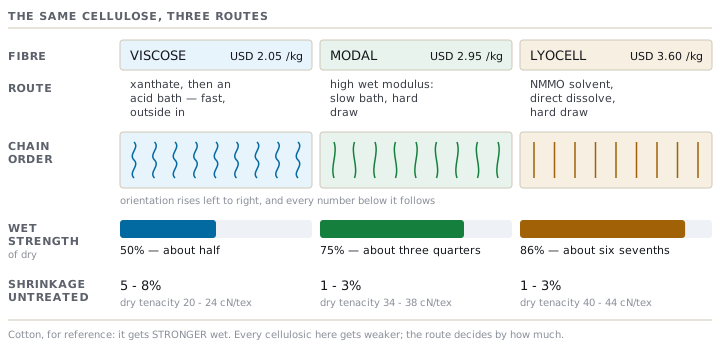
Modal is viscose made with more patience. The regeneration is slowed down, and the filament is stretched much harder while it is still forming. That lines the molecules up. Its proper name is high wet modulus viscose, and the name is the specification: wet strength holds at about 75% of dry instead of falling to half. Shrinkage on a finished modal woven runs 1 to 3%. It can be mercerised (a caustic treatment that deepens the shade), it dyes deeper, and it survives a home wash in a way viscose does not.
Lyocell is a different chemistry altogether. The cellulose is dissolved directly in NMMO, an amine oxide solvent. There is no xanthate step and no carbon disulphide. The solution is extruded into a weak bath, and the solvent is recovered in a closed loop at better than 99%. Direct dissolving plus a hard stretch give the highest orientation of any regenerated cellulosic: dry strength 40 to 44 cN/tex, wet 34 to 38. Lyocell is stronger wet than viscose is dry.
Lyocell has one behaviour you must write the specification around. Rub it while it is wet and the surface splits into tiny hairs — micro-fibrils. This splitting is called fibrillation. Controlled with an enzyme wash, it is the peach-skin feel people buy lyocell for. Uncontrolled, it shows up after three home washes as grey frosting along the seams and the hem edge, and the garment comes back as a fault. The enzyme step is one line on the finishing route. It costs money. If the tech pack does not name it, the mill will not do it.
Acetate is cellulose that has been changed chemically rather than regenerated: its hydroxyl groups are acetylated, and the polymer is dissolved in acetone and dry-spun. It is thermoplastic (it softens with heat), so it holds a pleat, and it has a dry shine nothing else quite matches. It is also weak, poor against rubbing, and weaker still when wet. It softens around 190 degrees, and it dissolves in acetone — nail-varnish remover will put a hole in an acetate lining. It belongs in linings and eveningwear, and nowhere near a hard-working seam.
| Fibre | Route | Dry strength cN/tex | Wet strength, share of dry | Moisture regain | Untreated fabric shrinkage | Fibre USD/kg |
|---|---|---|---|---|---|---|
| Viscose | Xanthate, acid bath | 20 to 24 | about half | 13% | 5 to 8% | 2.05 |
| Modal | High wet modulus viscose | 34 to 38 | about three quarters | 12.5% | 1 to 3% | 2.95 |
| Lyocell | NMMO direct solvent, closed loop | 40 to 44 | about six sevenths | 11.5% | 1 to 3% | 3.60 |
| Acetate | Acetone, dry spun | 11 to 13 | about two thirds | 6.5% | 2 to 4% | 4.50 |
| Cotton | Grown | 26 to 30 | stronger wet than dry | 8.5% | 3 to 6% | 2.05 |
Pricing the four ways out of WD-402
Now do the arithmetic. The meeting needs numbers, not adjectives.
The cloth is 118 gsm at 145 cm finished width. So one metre weighs 0.118 multiplied by 1.45, which is 0.171 kg. Consumption on WD-402 is 2.10 m per dress, including waste. Conversion — weaving, dyeing, finishing — costs USD 1.15 a metre whatever the fibre is. So the only number that moves is the yarn.
| Option | 30s yarn USD/kg | Yarn USD/m | Fabric USD/m | Fabric USD per dress | Extra on 12,600 dresses |
|---|---|---|---|---|---|
| Viscose as specified | 3.10 | 0.53 | 1.68 | 3.53 | — |
| Modal | 4.05 | 0.69 | 1.84 | 3.86 | USD 4,158 |
| Lyocell | 4.85 | 0.83 | 1.98 | 4.16 | USD 7,938 |
| Viscose, relaxed and compacted at the finisher | 3.10 | 0.53 | 1.82 | 3.82 | USD 3,654 |
Margin on this order is 12% of USD 86,940, which is USD 10,433. Modal takes just under 40% of that margin. Lyocell takes 76% of it. So lyocell is not a fix for this order — it is a decision for next season's development. The compacting route — a controlled wet relaxation and mechanical compacting at the finisher, which brings measured shrinkage down to about 3% — takes 35% of the margin and nine days out of the calendar.
There is a fifth option people reach for, and it is a trap: cut the body 6.8% longer, so the dress lands at 96 cm after the customer washes it. It fails because shrinkage on untreated viscose is not one steady number. It moves 1.5 to 2 percentage points between dye lots, and even between the two ends of the same beam. You would ship dresses that finish anywhere from 92 to 100 cm. That is worse than dresses that are all wrong by the same amount, because a uniform fault can be fixed with one pattern change.
Prompt · Read the fibre line before it is costed
At fabric development, when the tech pack says a fibre name and you want to know what the mill will be free to decide for you.
Act as a senior fabric technologist in a garment export house. Here is the fabric line exactly as it appears on my tech pack, copied character for character: [PASTE THE LINE]. Garment: [STYLE AND DESCRIPTION], buyer [BUYER], order quantity [QTY] pcs, FOB [PRICE], ship date [DATE]. The garment will be [WASHED / NOT WASHED] and the buyer's dimensional-stability tolerance is [PERCENT] measured to [TEST METHOD]. Do five things. First, list every property this line leaves undecided that the mill will therefore decide for itself, and say what a mill quoting competitively against three others would choose for each. Second, for the fibre named, tell me its dry and wet tenacity, moisture regain, and the shrinkage I should expect on an untreated fabric of this construction, and say whether the buyer's tolerance is achievable without a finishing step. Third, name the finishing steps that would be needed, in the order they run, and say which of them are optional in the mill's eyes. Fourth, give me the same line rewritten as a real specification, with the fibre, yarn count and spinning system, construction, gsm, finished width, finishing route, and the shrinkage, pilling and fastness tolerances each with a test method. Fifth, tell me which single omission in the original line is most likely to cost money, and roughly how much per garment. Do not soften anything: if the fibre cannot meet the tolerance at any price, say so plainly.
AI can make mistakes — check anything you act on.
Check yourselfA buyer wants the drape and the cool feel of viscose, but will not accept more than 3% shrinkage and will not pay more than about USD 0.20 a metre extra. What do you offer?Show the answer
Offer modal, or viscose put through a controlled relaxation and compacting at the finisher. Both bring shrinkage down to 1 to 3%. Modal costs USD 0.16 a metre more in yarn, and it buys a permanently better fibre — higher wet strength, deeper shade, better pilling. Compacting costs USD 0.14 a metre, but it does nothing for wet strength, so the garment still needs a gentle wash cycle and still slips at the seams. Lyocell is the best fabric of the three, but at USD 0.30 a metre more it is outside the brief. Put it in front of the buyer as a development option for next season, not as an answer to this one. What you never offer is the same viscose with a longer pattern.
Check yourselfA mill offers you lyocell at USD 3.15 a kilo when everybody else quotes USD 3.60. What do you ask before you take it?Show the answer
Ask whether it is lyocell at all. The generic name is protected under ISO 2076 and the FTC rules, but a quotation is not a label. Two things come back at that price: a viscose-lyocell blend described loosely, or a solvent-spun fibre from a producer with no closed loop and no NMMO recovery. Ask for the producer's name and the fibre's own certificate. Then send fabric for an ISO 1833 composition test before the bulk yarn is booked. A 12% saving on a fibre that is 30% of the fabric cost is worth USD 0.05 a dress. A composition claim you cannot back up is worth the whole order, because the label is a legal statement and the brand will place the liability with you.