Lessons · Lesson 2 of 3
Reading the yarn line: denier, filaments and elastane
Read a synthetic yarn line the way a mill reads it, and price what changes when somebody swaps one number in it.
Lesson 2 of 3 · 40 min
The situation
A synthetic yarn arrives on a tech pack as a short string of numbers and letters. Most people read the first number and skip the rest. But every part of that string is a decision: how thick the yarn is, how many strands it holds, whether it was crimped. This lesson teaches you to read that line the way a mill reads it. The second half is about the stretch fibre — a small share of the weight, and a large share of the cost.
It is 2 April, 08:15. A second Arndale order is in development: PO AR-3402, 22,000 pairs of women's leggings, style LG-118, FOB USD 5.60, order value USD 123,200.
The fabric line reads: 82% recycled polyester / 18% elastane, warp-knit tricot, 240 gsm, 150 cm finished. Face yarn 150D/144F semi-dull rPET DTY. Elastane 40D.
At 08:15 the knitter emails. The 144-filament yarn is on a nine-week lead time and costs USD 0.28 a kilo more than what he has on the floor. He can give you the same thing as 150D/48F, four weeks earlier and cheaper. He needs an answer this morning.
It is not the same thing. Everything you need to say back is already in the numbers on the page. This lesson is how to read them.
Denier, dtex, and which way the scale runs
Both are weight per length. So on both scales, a bigger number means a thicker yarn.
- Denier is grams per 9,000 metres.
- Dtex is grams per 10,000 metres.
- So dtex equals denier multiplied by ten and divided by nine. The 150 denier face yarn is 166.7 dtex. The 40 denier elastane is 44.4 dtex.
Cotton count runs the other way. Ne is the number of 840-yard hanks in a pound, so a bigger Ne means a finer yarn — 30s is finer than 20s. Two scales running in opposite directions on one tech pack is exactly how a spec gets read backwards. The bridge between them is worth memorising: denier is roughly 5,315 divided by Ne. So the 30s viscose from the last lesson is about 177 denier, or 197 dtex — a heavier yarn than the 150 denier polyester here. Anyone who can do one division can make that comparison. Almost nobody does.
Elastane is always quoted in denier, and always in the same short list of sizes — 20, 30, 40, 70, 140, 210, 310 — because those are what the producers extrude. A tech pack asking for 55 denier elastane was written by somebody who has never bought any.
Filament count is the number nobody reads
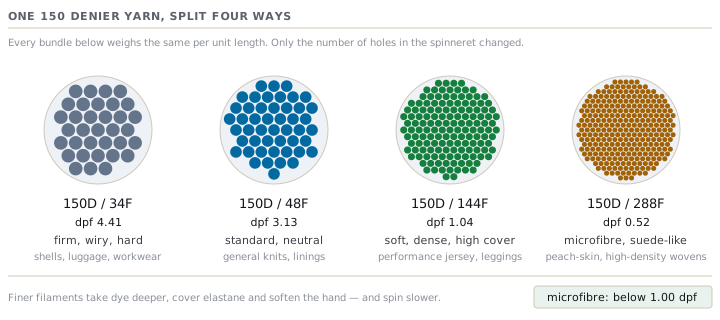
Denier per filament — dpf — is the denier divided by the filament count. It decides how the fabric feels. Two yarns with the same weight and the same fibre can make two completely different cloths.
| Yarn | Denier per filament | Hand | Where it belongs |
|---|---|---|---|
| 150D/34F | 4.41 | firm, wiry, hard | shells, luggage, workwear |
| 150D/48F | 3.13 | standard, neutral | general knits, linings |
| 150D/144F | 1.04 | soft, dense, high cover | performance jersey, leggings |
| 150D/288F | 0.52 | microfibre, suede-like | peach-skin, high-density wovens |
| 75D/72F | 1.04 | soft and light | shirtings, light wovens |
Microfibre in the trade means below 1.0 denier per filament. The ISO convention says below 1.0 dtex per filament, which is 0.9 denier. The two definitions do not agree. A specification that wants microfibre should say which one it means, and at what number.
Finer filaments change five things at once, and only one of them shows on the mill's quotation. Surface area rises, so the yarn takes dye deeper at the same recipe — it needs its own shade recipe, not the one used for the coarse yarn. Cover rises, so the fabric hides the elastane underneath it. The hand gets softer. Wicking improves and air permeability falls. And spinning gets slower, with more filament breaks — which is where the USD 0.28 a kilo comes from.
So price the knitter's swap properly. One pair of leggings carries 0.280 kg of polyester yarn. So USD 0.28 a kilo is USD 0.08 a pair, or USD 1,716 across 22,000 pairs. That is 1.4% of the order value. What it buys back is the one property a customer touches in the first two seconds in a fitting room. The answer to the knitter is no, and the answer takes one line.
Textured or flat, and the lustre nobody writes down
Filament polyester leaves the spinner as POY — partially oriented yarn. From there it goes one of three ways.
- DTY, draw textured yarn: drawn and false-twist textured, so each filament holds a permanent crimp. Bulky, matte, opaque, with a little mechanical stretch and a soft hand. Almost every knitted garment uses this.
- FDY, fully drawn yarn: drawn flat, no crimp. Smooth, shiny, strong, low bulk. Used in linings, shirtings, sheer wovens, and as the base of sewing thread.
- ATY, air textured yarn: the filaments are tangled and looped in an air jet, giving a spun-like, cottony hand.
Put a flat yarn into a construction designed for a textured one and it shows every snag. It glistens under shop lighting in a way the sample never did under an office lamp. It also feels colder and thinner at the same gsm, because the crimp that made the bulk is gone.
Lustre is set at the melt with titanium dioxide, and it is the most common omission on a synthetic spec. Bright carries none or almost none. Semi-dull carries about 0.3%. Full dull carries about 2%. Semi-dull is the default in every mill on earth, so nobody writes it down and nobody notices — until somebody orders bright by accident, and the buyer's word for the sample is "cheap".
The synthetics, one line each that decides something on the floor
| Fibre | Melts at | Moisture regain | Dyeing | Where it wins | Fibre USD/kg |
|---|---|---|---|---|---|
| Polyester (PET) | 255 to 260 degrees | 0.4% | disperse dye, 130 degrees under pressure | strength, UV, shape retention, price | 1.15 |
| Nylon 6 | 215 to 220 degrees | 4.0% | acid dye, 95 to 100 degrees | abrasion, softness, recovery | 3.40 |
| Nylon 6,6 | 255 to 260 degrees | 4.5% | acid dye, 95 to 100 degrees | heat and abrasion, technical use | 5.20 |
| Acrylic | softens near 150 degrees | 1.5% | cationic dye, 100 degrees | wool-like bulk, brilliant colour | 2.40 |
| Elastane | decomposes near 175 degrees | 1.3% | normally undyed, covered or plated | stretch and recovery | 8.40 |
| Polypropylene | 163 degrees | 0.0% | cannot be dyed, solution dyed only | lightness, wicking, price | 1.45 |
Read the melting-point column as a pressing instruction. Polyester takes a hot press. Nylon 6 does not — a finisher who presses a nylon shell at a polyester setting will glaze it. Acrylic will not survive a tumble dryer on high. Polypropylene melts at 163 degrees, which an ordinary iron can reach. And it cannot be dyed after extrusion at all: the colour has to go into the melt. That means a minimum order of 1,000 to 3,000 kg for every shade, and a six-week lead time for a colour that is not in stock. That single fact is why polypropylene is common in socks and base layers, and almost absent from fashion.
Read the moisture-regain column as a comfort and shrinkage instruction. Polyester at 0.4% holds no water. So it dries fast, does not relax in a wash, and feels clammy against skin unless the construction wicks. Nylon at 4.0% absorbs ten times as much. That is why nylon swimwear takes longer to dry than polyester, and why nylon grows in humid weather.
Elastane: 18% of the weight, half the yarn cost
Back to LG-118. One pair uses 0.95 m of 150 cm fabric at 240 gsm. So the fabric in one pair weighs 0.95 multiplied by 1.50 multiplied by 0.240, which is 0.342 kg.
| Line | At 18% elastane | At 12% elastane |
|---|---|---|
| Elastane in a pair | 0.062 kg | 0.041 kg |
| Polyester in a pair | 0.280 kg | 0.301 kg |
| Elastane at USD 8.40/kg | USD 0.52 | USD 0.35 |
| Polyester at USD 1.85/kg | USD 0.52 | USD 0.56 |
| Yarn cost a pair | USD 1.04 | USD 0.91 |
| Saving across 22,000 pairs | — | USD 2,860 |
Look at the third and fourth rows. The elastane is 18% of the weight and half of the yarn cost. That is the arithmetic behind every cost-cutting conversation about a stretch fabric. It is why the elastane percentage is the first thing a costing engineer reaches for.
What the USD 2,860 buys you is recovery. Elastane does not just make a fabric stretch. It makes the fabric come back. Drop the content and the legging still stretches — but it stops returning. The customer meets that as bagging at the knee and the seat after four hours of wear. The measurement for this is called growth: stretch the fabric to a set extension, hold it, release it, and measure again after a recovery period. Arndale's specification is not more than 5% growth after 30 minutes.
Two more things about elastane cost money when they are missed.
- It has to be heat set. Typically 190 degrees for around 45 seconds on the stenter (the finishing machine that holds fabric at width through an oven). Heat setting locks the elastane into the relaxed state it will live in. An under-set fabric measures perfectly on the roll — then grows 9 to 11% in wear, and moves again in the first wash. Heat setting is one line on the finishing route, it is not automatic, and it is the commonest reason a stretch fabric passes the mill's test and fails the buyer's.
- Chlorine destroys it. Ordinary elastane in a swim fabric loses its power in a chlorinated pool within a season. Chlorine-resistant grades exist, at roughly two and a half times the price. A swimwear spec that does not name one is a warranty claim waiting to happen.
Prompt · Check that the elastane is earning its place
When a costing engineer proposes dropping the elastane percentage, or when a stretch fabric passes the mill's test and fails the buyer's.
Act as a senior knitted-fabric technologist. I am costing a stretch fabric and I need the arithmetic and the consequences separated from each other. Fabric: [COMPOSITION], [CONSTRUCTION], [GSM] gsm, [WIDTH] cm finished. Face yarn [DENIER AND FILAMENT COUNT AND TYPE]. Elastane [DENIER], fed at a draft of [DRAFT IF KNOWN]. Garment [STYLE], consumption [METRES] per garment, order [QTY] pcs, FOB [PRICE]. Yarn prices: face yarn [PRICE] per kg, elastane [PRICE] per kg. The buyer's growth specification is [PERCENT] after [MINUTES] minutes recovery, and the finishing route says heat set at [TEMPERATURE] for [SECONDS]. First, compute the weight of fabric in one garment and split it into face yarn and elastane in kilograms, then price each and show me what share of the yarn cost the elastane carries. Second, redo it at [ALTERNATIVE PERCENT] elastane and give me the saving per garment and across the order. Third, tell me in plain terms what the garment loses at the lower percentage, in the specific places a wearer notices it, and after how long. Fourth, list every way this fabric could pass a mill test and fail the buyer's growth test, ranked by how common each is, and tell me the exact record or log I should ask for to rule each one in or out. Fifth, state the label composition tolerance that applies and warn me if the proposal would put the declared composition outside it.
AI can make mistakes — check anything you act on.
Check yourselfA supplier offers 150D/144F at USD 1.85 a kilo, or 150D/48F at USD 1.57. Both are semi-dull rPET DTY. When is the cheaper yarn the right answer?Show the answer
When the fabric is not next to skin and cover does not matter — a shell, a bag lining, a tote, a shoe upper. On any of those, 3.13 denier per filament is the correct choice, and paying for 144 filaments buys nothing. On a legging it is the wrong answer, because dpf is the property doing the work: cover to hide the elastane, softness against skin, and wicking. Note also that the two yarns are not interchangeable in the dyehouse. The finer yarn has far more surface area, takes up more dye at the same recipe, and needs its own shade recipe and its own lab dip. So a mid-order swap is a shade risk on top of a hand risk.
Check yourselfA stretch woven passes the mill's test at 3% growth, then fails the buyer's at 9% on the same roll. Where do you look first?Show the answer
The heat-setting record. Under-setting produces exactly this pattern: the fabric is stable enough on the roll to pass a short test, and only relaxes under the sustained load of real wear. Ask for the stenter log for that batch — the temperature, the time in the oven and the overfeed — against a specification of about 190 degrees for around 45 seconds. Then ask when the test was run. A fabric tested straight off the stenter, still warm and taut, reads tight and passes. The second place to look is the elastane draft on the knitting machine, because an over-drafted fabric grows for the same reason it comes in light on content.