Lessons · Lesson 3 of 3
What it costs, and what recycled polyester actually proves
Cost a fibre choice through to FOB, and audit a recycled-content claim before it reaches a label.
Lesson 3 of 3 · 40 min
The situation
A fibre premium quoted as a percentage sounds enormous. It rarely is, because fibre is a small slice of what a garment costs to make. The first half of this lesson builds that chain, from raw fibre to the factory's selling price. The second half is about a claim no laboratory can test — because recycled polyester and ordinary polyester are the same substance. What stands behind the claim is paperwork, and this lesson reads it.
It is 26 April, 16:40. LG-118 is knitted, dyed and half sewn. Arndale's compliance team asks for the recycled-content file on PO AR-3402. Two things come back wrong.
The knitter's scope certificate expired 11 days before knitting started. And the transaction certificate covering the recycled polyester yarn is for 4,900 kg, against a requirement of 6,900 kg — a shortfall of 2,000 kg, or 29% of the order.
Nobody has cheated. The yarn is recycled. The mill is a real, GRS-certified mill. The fibre in those leggings is exactly what the tech pack asked for. It is the paperwork that has failed — and on a recycled claim, the paperwork is the whole of the evidence. This lesson explains why that sentence is literally true, and what it costs to be careless about it.
Where the money actually sits
Start with the thing everybody argues about backwards. Here is LG-118 broken down to FOB.
| Line | USD a pair | Share of FOB |
|---|---|---|
| Yarn — polyester and elastane | 1.04 | 19% |
| Knitting, dyeing, finishing, process loss | 0.78 | 14% |
| Trims, elastic, labels, packing | 0.73 | 13% |
| Cut and make | 1.85 | 33% |
| Testing, compliance, factory overhead | 0.62 | 11% |
| Factory margin | 0.58 | 10% |
| FOB | 5.60 | 100% |
The yarn is 19% of FOB, and only the polyester part of it is touched by a recycled decision. Recycled DTY at USD 1.85 a kilo, against virgin at USD 1.48, is a 25% premium on the fibre. Across 0.280 kg a pair, that is USD 0.104 — or USD 2,288 on the whole order — which is 1.9% of FOB.
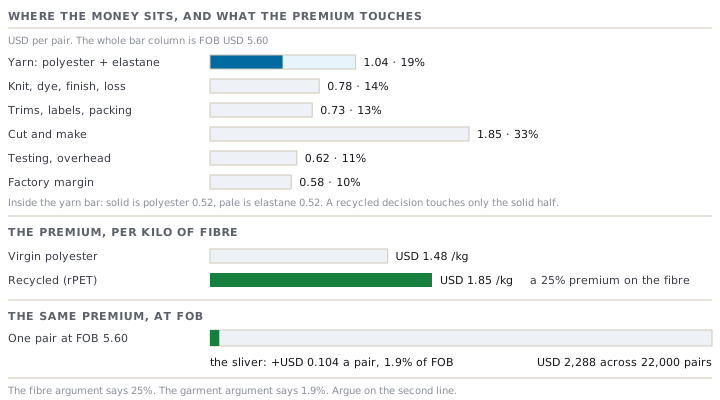
Say the second number out loud in the meeting. The first number is the one that ends the conversation. The second number is the one that is true. A twenty-five percent fibre premium is a two percent garment premium. Almost every argument about whether recycled polyester is affordable is an argument held on the wrong line of the cost sheet.
The chain works in both directions, and it is worth learning for every fibre decision you will ever make.
| Fibre | Fibre USD/kg | 30s yarn USD/kg | Knitted and dyed fabric USD/kg | Fabric in one T-shirt |
|---|---|---|---|---|
| Cotton, combed | 2.05 | 3.30 | 5.60 | USD 1.74 |
| Polyester staple, virgin | 1.15 | 2.10 | 4.10 | USD 1.27 |
| Polyester staple, recycled | 1.52 | 2.55 | 4.55 | USD 1.41 |
| Viscose | 2.05 | 3.10 | 5.40 | USD 1.67 |
| Modal | 2.95 | 4.05 | 6.35 | USD 1.97 |
| Lyocell | 3.60 | 4.85 | 7.15 | USD 2.22 |
| Acrylic | 2.40 | 3.45 | 5.75 | USD 1.78 |
| Polypropylene, solution dyed | 1.45 | 2.60 | 4.30 | USD 1.33 |
Two readings of that table matter more than the numbers. First: the gap from the cheapest fibre to the most expensive is USD 2.45 a kilo, but the gap in the finished cloth is USD 3.05. Conversion cost does not shrink the difference — it carries it through. Second: lyocell costs USD 0.95 more than polyester in the cloth of one T-shirt. That is real money on 50,000 pieces, and almost nothing at a retail price of GBP 22. Which of those two facts wins depends entirely on who is paying. Your job is to make sure the right person is looking at the right one.
Recycled polyester: how it is made and what it will not do
Mechanical recycling is almost the whole of the volume. Used bottles are collected, sorted by polymer and colour, washed, and ground into flake. The flake is either melted straight into fibre, or turned into chip first.
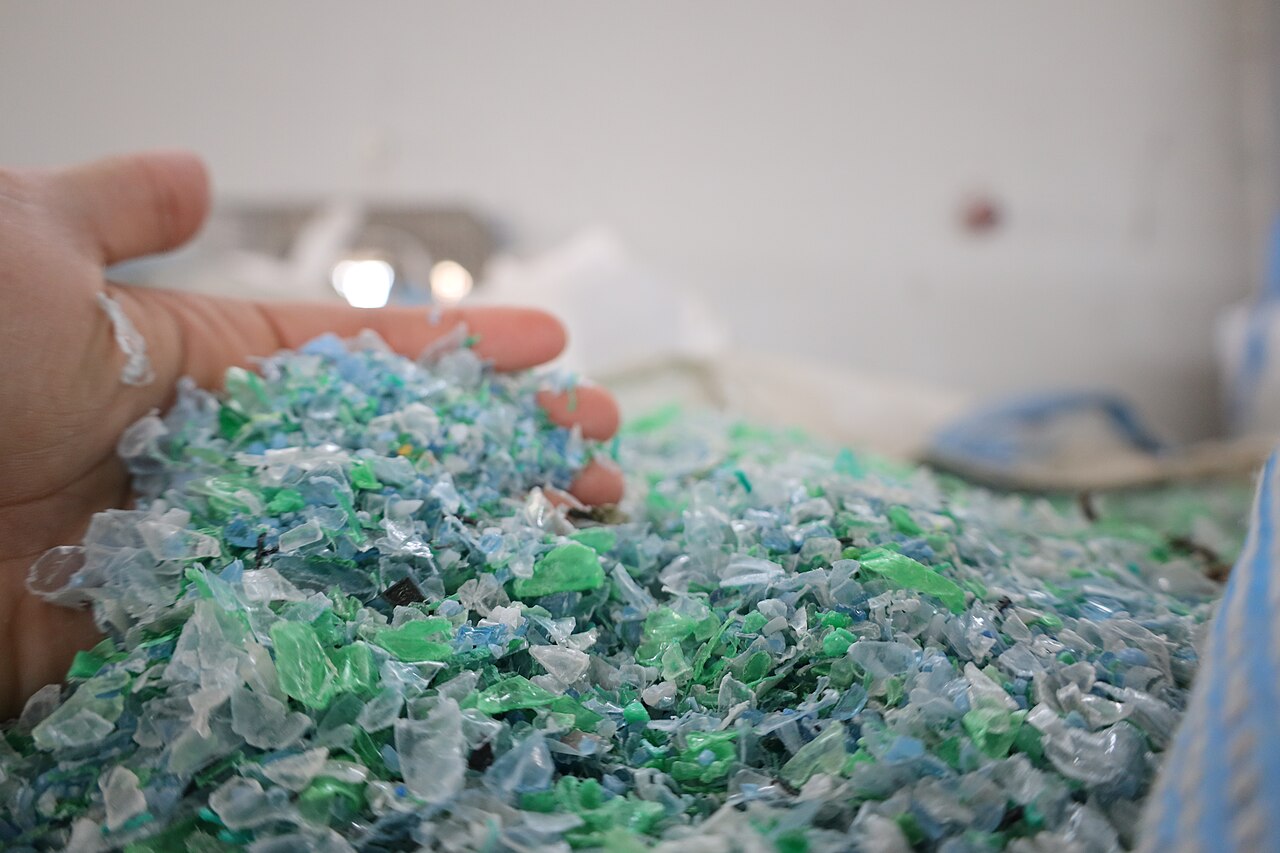
The mechanical route has three consequences you meet on the floor.
- Shade. Flake batches vary, so the base polymer varies, so shade repeat from lot to lot is worse than virgin. Expect a wider shade band and budget for more lab dips. On pastels you can see it. On black you cannot.
- Strength and evenness. Each re-melting shortens the polymer chains. So strength runs slightly below virgin, and there are more breaks in spinning. That is why fine recycled filament is scarcer and dearer than coarse — and why 150D/144F rPET is on a nine-week lead time while 150D/48F sits on the floor.
- Bottles are not garments. Bottle-to-fibre recycling takes packaging out of one waste stream and puts it into another. Textile-to-textile recycled polyester exists, but it is a fraction of a percent of supply and costs several times bottle rPET. If a brand's brief says recycled but means circular, those are two different asks with a large number between them.
The two certificates, and which one is about your order
GRS 4.0, the Global Recycled Standard, is run by Textile Exchange. It covers recycled content plus social, environmental and chemical rules at every processing site. A product needs at least 20% recycled content to be certified, and at least 50% to carry the logo. RCS 2.0, the Recycled Claim Standard, covers content and chain of custody only — no social or chemical rules. RCS Blended starts at 5%. RCS 100 requires 95% and above.
Then comes the distinction that decides your file.
- A scope certificate is issued to a site. It names the processes and materials that site was audited for, and it has a validity window. It says: this dyehouse was certified to dye GRS polyester until this date. It says nothing at all about your order.
- A transaction certificate is issued for a shipment, by the certification body, after the goods move. It names the seller, the buyer, the product, the certified quantity, the invoice numbers, and the scope certificate numbers of both parties. It is the only document that connects a recycled claim to your goods.
Here is the document itself, drawn as it arrives. The numbered fields are the four checks you will meet below.
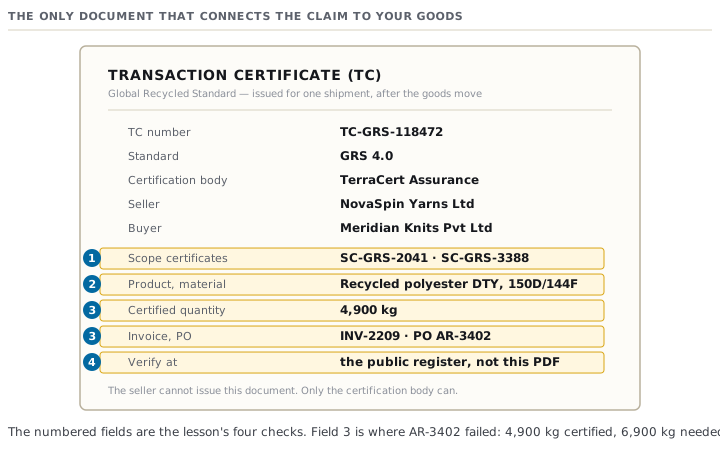
The chain runs: collector, flake processor, chip producer, yarn spinner, knitter, dyer and finisher, garment factory, brand. Every site needs a valid scope certificate on the date it did the work. Every hand-off needs a transaction certificate whose quantity is backed by the transaction certificates that came in. One uncertified link voids everything downstream of it. The fibre can be genuinely, provably recycled and the claim still fails — because what is being certified is not the fibre. It is the custody.
What it proves, and what people believe it proves
It proves one thing: an unbroken, audited chain of custody from a certified recycled input to your shipment, in the quantity written on the transaction certificate. That is the entire claim.
It does not prove a lower carbon footprint — no life-cycle assessment sits anywhere in the standard. It does not prove where the bottles came from. It does not prove the garment can be recycled, which is a different property entirely. It does not prove any performance property. And it does not prove that the specific bale you were shown is recycled, because certification runs on audits and mass balance, not on inspection of the goods.
The four checks, before the yarn is booked
- The scope certificate is in force on the date the work was done — not on the day you happened to open the PDF.
- Its scope list covers the actual process and the actual material. A knitter certified for GRS cotton is not certified for GRS polyester. This is the most common single failure in the file.
- The transaction certificate quantity is at least the quantity on your invoice, and it names your purchase order and invoice numbers.
- Every certificate is verified on the certification body's public register, or Textile Exchange's — not from the document you were emailed. A scope certificate is a PDF, and a PDF is not evidence of anything.
Check them at yarn purchase, not at shipment. Transaction certificates are issued after the goods move. If you wait, the factory has sewn the order and the brand has printed the swing tickets by the time the shortfall appears. That is exactly where AR-3402 stands on 26 April.
The shortfall, priced
| Option | Cost | Ships | What you are betting |
|---|---|---|---|
| Buy 2,000 kg of certified yarn and re-knit | USD 9,400 plus three weeks | Late | That Arndale takes a late delivery on a promoted line |
| Re-label the whole order with no recycled claim | Swing tickets and labels, USD 1,900 | On time | That the buyer accepts losing the claim on all 22,000 pairs |
| Split it: 15,600 pairs carry the claim, 6,400 do not | USD 1,400 in labelling and segregation | On time | That the buyer will take a split declaration |
The third option is the only one that neither misses the vessel nor puts an untraceable claim on a label. The arithmetic is easy to check: 4,900 kg of certified yarn covers 15,600 pairs at 0.314 kg of yarn a pair including process loss. The remaining 6,400 pairs ship as ordinary polyester.
Why do the second and third options exist at all, instead of the obvious fourth — say nothing and ship? Because an environmental claim you cannot back up is a legal matter, not a marketing one. The UK Competition and Markets Authority's Green Claims Code and the EU's Empowering Consumers directive both put the burden of proof on the person making the claim. The person making it is the brand — and the brand's vendor agreement will place the liability with you. A shortfall found in April costs USD 1,400 and an awkward call. The same shortfall found by a regulator costs the account.
Prompt · Audit a recycled claim before the yarn is booked
The day a recycled-content order is placed, because transaction certificates are issued after the goods move and by then the swing tickets are printed.
Act as a compliance manager for a garment exporter, working on a recycled-content order. Buyer [BUYER], PO [NUMBER], style [STYLE], [QTY] pcs, composition [COMPOSITION], claim to be made on the label [EXACT WORDING]. Standard claimed: [GRS / RCS] version [VERSION]. Fabric weight per garment [KG], process loss [PERCENT]. Here are the certificates I have been sent, with their numbers, holders, issue and expiry dates, scope lists and quantities: [PASTE OR SUMMARISE EACH ONE]. The processing chain as I understand it is: [LIST EACH SITE AND WHAT IT DOES, IN ORDER]. Do the following. First, compute the certified quantity of recycled material this order actually needs, showing the loss assumption. Second, map my certificates onto the chain and name every site that has no valid scope certificate, or whose scope does not cover the process or the material it is doing, or whose certificate was not in force on the date the work was done. Third, tell me for each transaction certificate whether it covers my quantity and whether it names my purchase order and invoice. Fourth, state precisely what my claim would and would not be substantiated by if a regulator asked, and name the wording on the label that the evidence supports. Fifth, if there is a shortfall, give me the options with costs and lead times, including splitting the declaration across the order. Be blunt about the gap between what the certificates prove and what the marketing copy says, and remember there is no laboratory test that can settle this after the fact.
AI can make mistakes — check anything you act on.
Prompt · Push a fibre premium through to FOB
When somebody rejects a fibre on the strength of its price per kilo, before anybody has worked out what it does to the garment.
Act as a garment costing engineer. Somebody has rejected a fibre because of its price per kilogram and I want the argument moved onto the right line of the cost sheet. Garment [STYLE], buyer [BUYER], [QTY] pcs, FOB [PRICE], retail [PRICE AND CURRENCY]. Fabric [COMPOSITION], [GSM] gsm, [WIDTH] cm, consumption [METRES OR KG] per garment, process loss [PERCENT]. Current fibre [NAME] at [PRICE] per kg; proposed fibre [NAME] at [PRICE] per kg. My cost build per garment is: yarn [VALUE], fabric conversion [VALUE], trims and packing [VALUE], cut and make [VALUE], overhead and compliance [VALUE], factory margin [VALUE]. First, express every line as a share of FOB so we can all see where the money is. Second, compute the fibre premium per garment and across the order, and express it as a percentage of FOB and as a percentage of retail. Third, tell me what the proposed fibre changes in the finished garment, both the improvements and the new risks, and name the tests that would have to be run to prove each. Fourth, list what else in the cost build would move as a consequence — dye recipes, extra lab dips, a different finishing route, a longer lead time, a higher second-quality rate — and price each. Fifth, give me a three-sentence version of the case I can send to the buyer, with the two numbers that matter in it and no adjectives.
AI can make mistakes — check anything you act on.
Check yourselfA supplier sends you a valid, in-date GRS scope certificate for the spinning mill and says the recycled claim is covered. Is it?Show the answer
No, and it is not close. A scope certificate proves that one site was audited for a process. It says nothing about your goods. What covers your claim is a transaction certificate naming your quantity, your invoice, and both parties' scope certificate numbers. Behind it, you need valid scope certificates for every other site in the chain, on the dates each of them did its work. The spinner being certified does nothing for you if the dyehouse in the middle is not. Ask for the transaction certificate. Check its quantity against your yarn requirement. Then verify the number on the certification body's register, instead of reading the PDF.
Check yourselfA brand rejects recycled polyester because a 25% fibre premium is unaffordable at their retail price. What do you put in front of them?Show the answer
The cost chain. The yarn is 19% of FOB, and only the polyester share of it is affected. So a 25% fibre premium is USD 0.104 a pair — USD 2,288 across 22,000 pairs, and 1.9% of FOB. Then be just as honest about what the 1.9% does and does not buy, because the second half is what earns you the argument. It buys an audited chain of custody, and a claim they can defend to a regulator. It does not buy a measured carbon reduction, a circular garment, or any performance property. And if their brief actually meant textile-to-textile recycling, the premium is a different order of size and needs pricing separately.