Lessons · Lesson 3 of 3
From a yarn fault to a rejected garment
Trace a fabric defect back to the yarn that caused it, price the ways out once four thousand metres are already knitted, and run the claim on the spinner with evidence instead of adjectives.
Lesson 3 of 3 · 37 min
The situation
A fault in a thread can hide for weeks, then appear when the cloth is dyed. By then the cloth is knitted, the money is spent, and blame is a guess. This lesson shows you how to diagnose it properly, from the direction of a mark and the spacing between marks. Then it prices the ways out against the margin the order has left. It ends with the claim against the supplier — which never pays for the recovery.
It is 2 April, 07:30, in the greige store at Zahra Knitting — the store for fabric that is knitted but not yet dyed. On the racks: 4,000 metres of 150 gsm single jersey, knitted between 26 March and 1 April on three machines, each 30 inch, 24 gauge, with 90 feeders. At 1.80 m open width, the fabric weighs 0.270 kg per metre. So this is 1,080 kg of fabric — enough for 5,020 T-shirts of the 22,000 on order HV-3318.
Greige inspection passed it. The 4-point inspection system scored it at 6.2 points per 100 square metres, well inside the buyer's limit of 20. Nobody wrote anything in the remarks column.
Then the first dye batch came out of the jet dyeing machine at 06:20 this morning: 220 kg in pale sand. Laid out on the inspection table under the D65 lamp, the fabric carries horizontal bands running across the width, repeating down the length. They are clearly visible from two metres away. In pale sand, they are unmissable. This is barré, and no finishing process removes it.
The diagnosis is a measurement, not an opinion
Six things cause horizontal banding in a circular knit. Arguing about which one it is, without measuring, is how a week disappears.
- A count difference between yarn lots, or between cones on the creel — the frame that holds the cones feeding the machine.
- A fibre difference in the cotton mixing — micronaire, maturity, or a different origin. This changes how the yarn takes dye, even when every count is identical.
- A hairiness difference between cones, which changes how the surface takes light and shows colour.
- A twist difference between cones.
- A machine cause — a feeder running at a different yarn tension, or a worn cam track.
- A dyeing cause — an uneven temperature rise, or poor circulation of the dye liquid. That gives cloudy patches, not a regular repeating band.
Start with the direction of the fault, because it cuts the list in half at one look. A fault that runs across the fabric arrived with the yarn or with a feeder. A fault that runs along the fabric is a needle, a sinker or a cam. Needle lines run down the fabric, along the vertical stitch columns. This fault runs across, so nothing in the needle bed did it.
Then measure the repeat. The bands recur every 50 mm down the piece. This fabric knits at 18 courses per cm — a course is one knitted row — so 50 mm is 90 courses. And the machine has 90 feeders. One repeat equals one full turn of the machine. That single measurement kills causes 2 and 6, and most of 5. It says the difference is between the cones standing on the creel right now — not between one yarn delivery and another, and not in the dyehouse.
Ten cones are pulled off the creel of machine 2 and taken to the lab. There, 120-yard leas are wound on the measuring reel and weighed. Six cones come back at 30.1 to 30.3 Ne. Four come back at 29.3 to 29.5 Ne.
That is lot A-7741 and lot A-7768, on the same machine, at the same time. On the afternoon of 26 March, the store ran out of the A-7741 pallet mid-shift, and the creel was topped up from the next pallet. No instruction anywhere told anybody not to.
From a number on a certificate to a garment that comes back
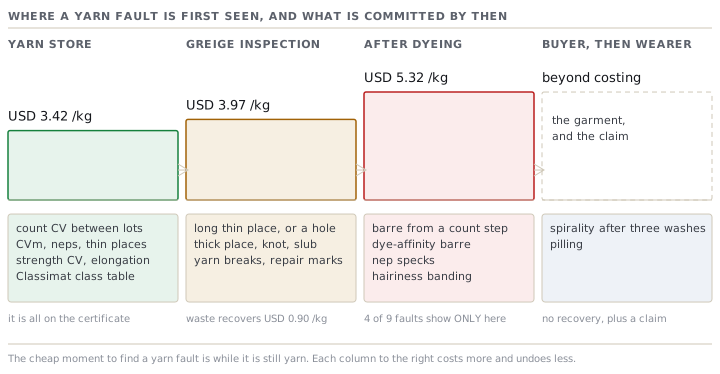
| Yarn fault | What it becomes in the fabric | Where it is found |
|---|---|---|
| Count difference between lots or cones | Barré: a band across the fabric, repeating on the feeder cycle | After dyeing, or at the buyer |
| Micronaire or maturity difference in the mixing | Dye-affinity barré: the same band with every count identical | Only after dyeing |
| Hairiness difference between cones | Soft shade banding, patchy surface reflection | After dyeing, worst in pale shades |
| Long thin place, Classimat class I | A thin streak, or a hole where the needle takes it | Greige inspection |
| Class C or D thick place, or a knot | A slub in the face of the cloth, or a needle break | Greige inspection |
| Neps | White specks in dyed fabric, because a nep takes dye differently | After dyeing |
| Twist multiplier too high | Spirality: the stitch columns lean and the side seam turns | After the third wash, in the buyer's test report |
| Low elongation, high strength CV | Yarn breaks, machine stops, a repair mark at every one | Greige inspection |
| High hairiness H | Pilling | In the buyer's pilling test, or in wear |
Read the third column. Four of these nine faults are invisible until after dyeing — and dyeing is the last point at which the fabric still has options. That is the whole argument for testing yarn on arrival instead of trusting a certificate: the cheap moment to find a yarn fault is while it is still yarn.
The four options, priced
The order is 22,000 pieces at FOB USD 3.95, worth USD 86,900, at a margin of 12 percent — USD 10,428. The fabric in question is 1,080 kg. Yarn costs USD 3.42 per kilo, knitting USD 0.55 per kilo, dyeing USD 1.35 per kilo. Greige waste can be sold on for USD 0.90 per kilo.
| Option | Extra cost | Share of margin | Effect on the ship date | The bet |
|---|---|---|---|---|
| Scrap the 1,080 kg and re-knit from one lot | USD 3,613 | 35 percent | 8 days late | Delta ships 1,080 kg from the same mixing within three days |
| Move the streaky fabric into the navy and charcoal blocks, re-knit only the pale sand | USD 640 | 6 percent | On time | A 2.7 percent count step is invisible in a dark shade |
| Ship the 5,020 affected pieces under a written concession at 8 percent | USD 1,586 | 15 percent | On time | The distribution centre does not band-check a pale shade |
| Ship 16,980 clean pieces by sea, air-freight the 5,020 ten days later | USD 3,090 | 30 percent | 16,980 on time | The buyer accepts a part shipment |
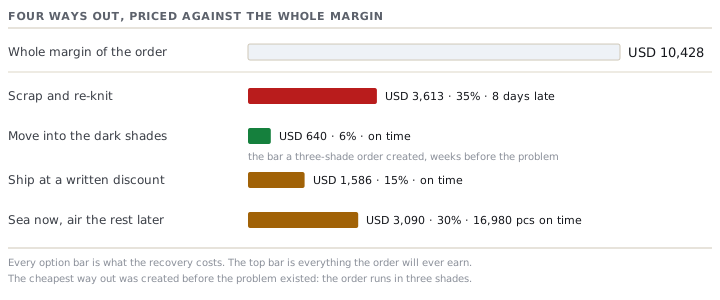
Option one is the honest one, and the expensive one. It means a second 1,080 kg of yarn at USD 3,694, a second knitting charge of USD 594, and the 220 kg of dyeing repeated at USD 297 — less USD 972 recovered by selling the greige waste.
Option two is the right answer. And it exists only because somebody split this order into three shades, weeks ago. The navy and charcoal blocks together take 2,795 kg, so the streaky 1,080 kg disappears into them. The pale sand block needs 1,935 kg, and lot A-7741 holds 3,200 kg — so pale sand can be knitted end to end from one lot. The USD 640 covers a re-dye of the 220 kg, an extra handling and inspection pass, and a machine changeover. Six percent of the margin, against thirty-five.
That is the lesson to carry: the option that saves you was created by a decision made before the problem existed. If HV-3318 had been a single-shade order in pale sand, option two would not be on this table. The choice would then be between losing a third of the margin and asking the buyer for a favour.
Option three deserves one warning. A concession discount is not a settlement unless it says so. The words "in full and final settlement of the shade banding identified in fabric inspection report ZK-0402" must be in it. Without them, the buyer has taken 8 percent off and kept the right to charge you again at the distribution centre.
Running the claim with the spinner
The claim is worth filing. It is also worth being honest with yourself about how strong it is.
What supports it. Lot A-7768 came in with a count CV between bobbins of 2.4 percent, which sits on the Uster 75 percent line, and its imperfections and hairiness are all at or past that line. Two lots 2.7 percent apart in count were delivered against one purchase order, on one delivery note, with no instruction to keep them separate and no warning that the average counts differed.
What weakens it. Neither lot fails its own nominal count tolerance. And your own store mixed them. The spinner's first sentence will be that he supplied two conforming lots and you knitted them together — and he will be substantially right.
What actually wins arguments, in order. The sealed retained cone from each lot, labelled with the delivery note number and the date. A count check on the measuring reel witnessed by both parties, or sent to an independent lab, on cones from the retained samples — not from the machine. And two knitted tubes, one per lot, run through the same dye bath at the same time and shown together. That comparison takes four hours, and it ends the discussion, because the spinner is looking at his own yarn.
What loses them. The sentence "the fabric is streaky". Photographs of dyed fabric with no reference standard beside it. And a claim raised after the yarn has been fully used up — you cannot claim on material you cannot produce.
Then read the yarn purchase order before you build the file, because two clauses decide what the claim is worth.
The first is liability. Almost every yarn supply contract caps the spinner's liability at the invoice value of the yarn supplied. That is 1,080 kg at USD 3.42 — USD 3,694, and only if you win completely. It does not cover the knitting, the dyeing, the delay, or the garment margin. A claim is a partial recovery, never a solution. Treating it as the plan is how a week goes by while the fabric sits in the store.
The second is time. Yarn quality claims usually have to be raised within 8 to 21 days of delivery. Delta's terms say 21 days. The yarn was delivered on 14 March. Today is 2 April — day 19. Two days are left, and the file has to be opened this morning, whatever else happens.
Prompt · Trace a fabric defect back to the yarn
The morning a dyed roll comes off the machine with something wrong in it and everybody in the room has a theory.
Act as a senior knitting and fabric technologist diagnosing a fabric defect. Facts about the fault: what I can see [DESCRIBE IT], direction — across the width or along the length [WHICH], repeat distance if it repeats [MM], where it was first seen — greige inspection, after dyeing, after finishing, at the buyer [WHICH], and whether it is present in every roll or only some [DETAIL]. Fabric: construction [TYPE], [GSM], courses per cm [NUMBER], wales per cm [NUMBER], open width [M], roll weight [KG]. Machine: diameter [INCHES], gauge [GAUGE], number of feeders [NUMBER], machine number [ID], dates knitted [DATES]. Yarn: [COUNT AND TYPE], spinner [NAME], lots issued to this machine [LIST WITH DELIVERY NOTE NUMBERS], and the certificate figures for each lot [PASTE]. Dyeing: shade [NAME], machine [TYPE], batch weight [KG], date [DATE]. Work through it in this order and show your reasoning. First, use the DIRECTION of the fault to eliminate whole families of cause, and say which families are gone and why. Second, use the REPEAT distance against courses per cm and the feeder count to say whether one repeat is one machine revolution, and what that means about where the difference lives. Third, list the surviving causes in order of likelihood for this evidence. Fourth, give me the exact tests that will separate them — what to measure, on what sample, with what instrument, and how long each takes — starting with the cheapest test that can eliminate the most. Fifth, tell me what evidence I must physically preserve today in case this becomes a claim, and against whom. If the evidence genuinely cannot distinguish two causes, say so rather than picking one.
AI can make mistakes — check anything you act on.
Prompt · Cost the options and build the claim on the spinner
The morning a yarn fault has already been knitted into fabric and somebody has to choose a plan before the shift ends.
Act as a senior export merchandiser and a yarn technologist working together. A yarn fault has reached the fabric and I must choose a plan today. Order: buyer [NAME], PO [NUMBER], style [STYLE], [QTY] pcs, FOB [PRICE], order value [VALUE], margin [VALUE AND PERCENT], shades and quantities [LIST], ship date [DATE], today [DATE]. Fabric affected: [KG] and [METRES], of which [KG] is already dyed in shade [NAME]. Rates: yarn [PER KG], knitting [PER KG], dyeing [PER KG], greige waste recovery [PER KG], air freight [PER KG], garment weight [KG]. Yarn: spinner [NAME], lots involved [LIST], delivery date [DATE], invoice value of the affected yarn [VALUE], and the certificate figures [PASTE]. The yarn purchase order says, on liability and on the claim window: [PASTE THE EXACT CLAUSES]. Give me: (1) every option priced in dollars and as a percentage of order margin, including scrap and re-knit, re-allocate the affected fabric into a darker shade block, ship under written concession, and part shipment with the balance by air — and say which options exist only because of a decision already taken on this order; (2) the effect of each on the ship date, with the lead time each step really needs; (3) the strongest honest version of the claim against the spinner, and the strongest honest version of his answer to it, so I know where I am weak before he tells me; (4) the evidence file: what must be sealed, labelled, tested and witnessed, in what order, and by when; (5) the recoverable ceiling under the liability clause and the days remaining in the claim window, stated as a date. Do not present the claim as if it funds the recovery. Tell me plainly what it can and cannot pay for.
AI can make mistakes — check anything you act on.
Check yourselfA dyed single jersey shows a repeating band every 50 mm. The fabric knits at 18 courses per cm on a 90 feeder machine. What have you just learned, and what do you check next?Show the answer
Fifty millimetres at 18 courses per cm is 90 courses, and the machine has 90 feeders — so the repeat is exactly one full turn of the machine. That means the difference is between the cones standing on the creel. Not between one delivery and another, not in the dyehouse, and not in the needle bed: a needle fault would run along the fabric, not across it. The next check is a count test on cones taken off that creel. Wind 120-yard leas on the measuring reel, weigh them, and see whether the creel carries more than one lot. If all the counts match, the same logic points at hairiness, or at a fibre difference between cones — and the next test is a knitted tube from each suspect cone, through one dye bath.
Check yourselfYour spinner accepts the claim in principle. The fabric problem has cost about USD 3,600 to put right, plus the knitting and dyeing on top. How much can you expect to recover, and what does that tell you about the plan?Show the answer
The invoice value of the yarn involved, at most: 1,080 kg at USD 3.42, which is USD 3,694. And that holds only if the claim succeeds in full — which it may not, since neither lot failed its own count tolerance and your own store mixed them. Almost every yarn contract caps liability at the value of the yarn supplied, and excludes the processing cost, the delay and the lost margin. So the claim never funds the recovery. It reduces the loss afterwards. The plan has to be chosen on 2 April on its own merits, with the claim filed in parallel — and before the 21 day window closes — not treated as a source of money that makes the expensive option affordable.