Lessons · Lesson 1 of 3
The certificate that came with the yarn
Read the test report that arrives with a yarn delivery, place its numbers against world production, and decide with reasons whether to sign for the yarn.
Lesson 1 of 3 · 36 min
The situation
Yarn arrives with a test report stapled to the delivery note. In most factories, somebody signs for it without reading it. This lesson teaches you to read it: what the machine measured, and why a fault count on its own means nothing. It also builds towards a trap that no single page can show you. Two batches can arrive on one lorry, each acceptable on its own, and still be far enough apart to print bands across the dyed fabric.
It is 14 March, 08:40, at the yarn store of Zahra Knitting, Tenth of Ramadan City. A truck from Delta Spinning Mills in Mahalla has backed onto the ramp. On it: 4,800 kg of 30/1 Ne combed compact cotton yarn, against yarn purchase order YN-1194 at USD 3.42 per kilo. The invoice is USD 16,416.
The yarn is for order HV-3318 from the buyer Haverkamp: 22,000 men's single jersey T-shirts, style TS-204, in three shades. Pale sand 9,000 pieces, navy 7,000, charcoal 6,000. The price is FOB USD 3.95, so the order is worth USD 86,900. Knitting is booked to start on Monday.
The delivery note names two lots: A-7741 at 3,200 kg, and A-7768 at 1,600 kg. A lot is one batch of yarn, spun from one cotton mixing. Each lot has its own test certificate stapled to the note. The store keeper has a rubber stamp, and a decision that nobody in the building treats as a decision: sign the note, or do not.
Everything that goes wrong in this course goes wrong because that note was signed in eleven seconds.
One machine produces most of the certificate
The top half of a yarn test certificate comes from a single machine: an evenness tester. It runs the yarn through a capacitor — an electrical gate that weighs the yarn as it passes — at 400 m/min, and records the weight of every 8 mm of its length. Ten bobbins from the lot, 1,000 m from each, about two and a half minutes per bobbin. Everything on that half of the page is a different way of describing that one recording.
- U percent and CVm percent say how uneven the yarn is. U percent is the average swing in weight along the yarn. CVm percent is the same information as a coefficient of variation — a percentage that measures spread, where bigger means less even. CVm is roughly 1.25 times U. Quote CVm, because every published statistic uses it.
- Imperfections are counted against thresholds, not measured. A thin place is 1 cm of yarn at least 50 percent lighter than the running average. A thick place is at least 50 percent heavier. A nep is a short lump at least 200 percent heavier. All three are reported per kilometre. Those thresholds are settings on the machine, so a certificate that does not name its settings is not a certificate. The same yarn reads 62 neps per km at the plus 200 percent setting and 210 at plus 140 percent. A spinner who quotes the second number without saying so is not lying, exactly.
- Hairiness H measures the fibre ends that stick out of the yarn: their total length, in centimetres, per centimetre of yarn. CV of hairiness says how much that changes along the length — and that is the number that makes stripes.
- The count check does not come from the evenness tester at all. Fixed lengths of yarn, called leas, are wound on a measuring reel and weighed. The certificate reports the average count and the CV of count between bobbins — how much the bobbins disagree with each other.
Here is the document itself. The four numbered blocks are the four things you just read.
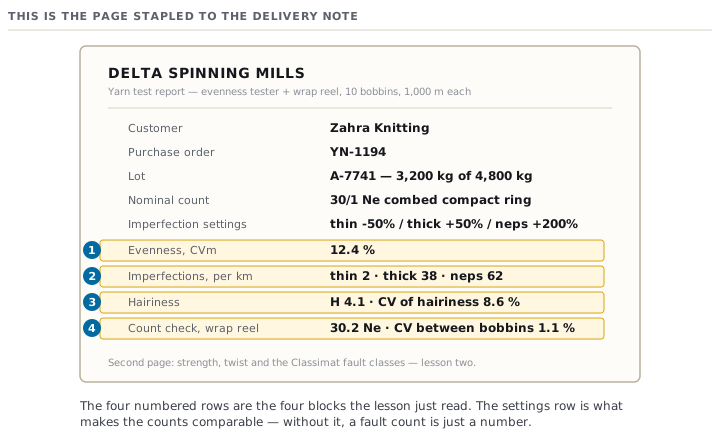
The two certificates
| Measure | Lot A-7741 | Lot A-7768 | Uster 25 percent | Uster 50 percent | Uster 75 percent |
|---|---|---|---|---|---|
| Count, Ne | 30.2 | 29.4 | — | — | — |
| CV of count between bobbins, percent | 1.1 | 2.4 | 1.2 | 1.8 | 2.6 |
| CVm, percent | 12.4 | 13.9 | 11.8 | 13.0 | 14.3 |
| Thin places minus 50 percent, per km | 2 | 9 | 1 | 4 | 12 |
| Thick places plus 50 percent, per km | 38 | 71 | 25 | 45 | 85 |
| Neps plus 200 percent, per km | 62 | 118 | 40 | 70 | 120 |
| Hairiness H | 4.1 | 4.9 | 3.9 | 4.4 | 5.0 |
| CV of hairiness, percent | 8.6 | 11.2 | 8.5 | 9.6 | 11.0 |
Reading a percentile, which most people get backwards
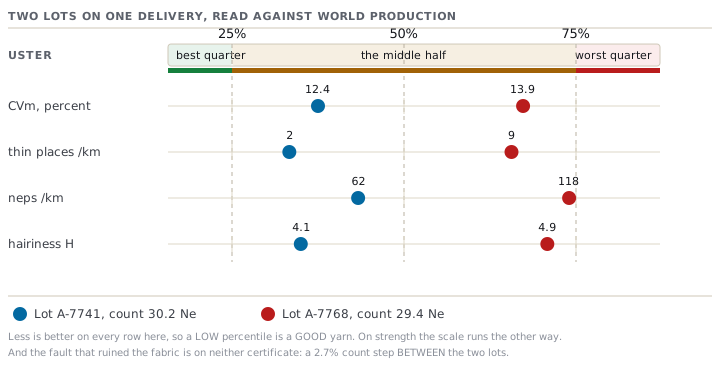
Uster Statistics is a survey of yarn production around the world. It is republished every few years, and it is sorted into percentile lines by yarn type, count and spinning system. The line you read against here is combed compact ring-spun cotton at Ne 30. One sentence matters more than all the rest:
The 25 percent line is the value that only a quarter of the world's production betters. On irregularity, imperfections and hairiness, less is better. So a lower percentile number means a better yarn, and a yarn sitting on the 25 percent line is in the best quarter of world production.
Two mistakes follow when people do not know that.
The first is reading the 50 percent line as "average, so it is fine". Fifty percent is the middle of everything spun on earth. That includes open-end yarn for terry towels and carded yarn for workwear lining. Your fabric is a pale, fine single jersey: pale sand at 150 gsm, knitted on a 24 gauge machine — a fine machine, with many small needles per inch. For that fabric, the middle of world production is not fine. It is the level at which a knitter starts seeing faults.
The second is quoting a percentile without saying which edition of the statistics it came from. The bands move between editions, because world production improves. A lot certified "at the 25 percent level" against a fifteen-year-old edition may sit at the 50 percent level today. Ask which edition. Write it into the yarn specification.
What the two lots actually say
A-7741 sits between the 25 and 50 percent lines on every single row. CVm 12.4 against a 25 percent line of 11.8. Neps 62 against 40 and 70. Count CV between bobbins 1.1, better than the 25 percent line. This is an ordinary, honest, good combed yarn. There is nothing on this page to argue about.
A-7768 is a different story. Thin places at 9 per km sit close to the 75 percent line — the worst quarter. CVm 13.9 is past the middle and nearly at the 75 percent line. Neps at 118 sit on the 75 percent line. Hairiness H 4.9 and CV of hairiness 11.2 are past it. And the count CV between bobbins is 2.4, which for a combed compact yarn is at the 75 percent line on its own.
Now put the two certificates side by side, and look at the row nobody circles.
Count: 30.2 against 29.4. The two lots are 2.7 percent apart. Each lot is inside the normal commercial tolerance of plus or minus 1.5 percent on its own nominal count. Neither certificate is wrong. Neither lot fails its own specification.
But feed a 2.7 percent count step into one knitting machine on different feeders — the points where each cone's yarn enters the machine — and you get barré: a repeating band across the fabric. It appears when the cloth is dyed, and it cannot be repaired afterwards. It is the most expensive defect in this course. And it is not visible on either certificate. It is only visible in the space between them.
The acceptance rule, written before the truck arrives
An acceptance decision at the gate can only be defended if the rule existed before the yarn did. A workable yarn specification for this fabric says all of the following. A purchase order that says "30/1 Ne combed compact, good quality" says none of it.
- Count: the nominal value and its tolerance, plus a maximum CV of count between bobbins and the number of bobbins tested.
- CVm and imperfections at named sensitivities — minus 50, plus 50, plus 200 percent — with a required Uster percentile and the edition it is read against.
- Hairiness H and CV of hairiness, because CV of hairiness is what bands a pale knit.
- Strength, elongation and their CVs — lesson two.
- The Classimat fault-class table for the lot — also lesson two.
- Twist and twist multiplier, because twist makes a single jersey twist on the body after washing.
- Moisture regain at test. Yarn is bought by weight, and cotton holds 8.5 percent moisture at standard conditions. A lot delivered at 6 percent regain is short weight that nobody notices.
- Lot identity, and the sentence that would have saved this order: one lot per machine, and no lot change inside a fabric roll.
- A retained sample — one sealed cone per lot per delivery, held by both the spinner and the knitter for six months.
Prompt · Write the yarn specification and the acceptance rule
Before a yarn purchase order is placed, when you want the acceptance decision written down while it is still cheap to make.
Act as a senior yarn technologist for a knitting mill. I am about to place a yarn purchase order and I want a specification that can actually be enforced at the receiving bay. Fabric facts: construction [SINGLE JERSEY / RIB / INTERLOCK / FLEECE], weight [GSM], machine gauge [GAUGE], machine diameter [INCHES], number of feeders [NUMBER], finished shades [LIST THE SHADES AND QUANTITIES]. Yarn facts: fibre [COTTON / BLEND, WITH PERCENTAGES], spinning system [RING CARDED / RING COMBED / COMPACT / ROTOR / VORTEX], nominal count [COUNT AND SYSTEM], quantity [KG], price [PRICE PER KG], spinner [NAME], intended lots [NUMBER OF LOTS IF KNOWN]. Write me the specification as a numbered list, and for every line state the number I should demand, the test method it comes from, and one sentence saying what goes wrong in the fabric if that line is left out. Cover at least: nominal count and tolerance; CV of count between bobbins and how many bobbins are to be tested; CVm; imperfections with their sensitivities named; the Uster Statistics percentile I should require and which edition it is read against; hairiness H and CV of hairiness; single-end strength, elongation and their CVs; the Classimat class table and which classes must be cleared; twist and twist multiplier; moisture regain at test; lot identification and a retained-sample rule. Then write the acceptance rule as it should appear on the delivery note: exactly what the store keeper checks before signing, what he refuses, and the lot-segregation sentence. Be explicit where my shade or gauge makes a line stricter than the trade default, and say so rather than quoting a general number.
AI can make mistakes — check anything you act on.
Check yourselfA spinner certifies a lot as 'at the 25 percent Uster level for CVm'. What three things do you ask before you accept that sentence?Show the answer
Which edition of Uster Statistics, for which yarn type and count, and at what test settings. The percentile bands move between editions as world production improves, so a lot at the 25 percent level against an old edition can be at the 50 percent level against the current one. The bands are also specific to the spinning system and the count: combed compact ring at Ne 30 is a different table from carded ring or rotor, and quoting a percentile from the wrong table flatters the yarn by a whole band. And imperfections mean nothing without their sensitivities named: the same yarn reads 62 neps per km at plus 200 percent and about 210 at plus 140 percent.
Check yourselfBoth lots on the delivery note pass their own specification. Why is it still wrong to sign for them without a condition?Show the answer
Because the risk is not inside either lot. It is between them. Lot A-7741 is 30.2 Ne and lot A-7768 is 29.4 Ne — a 2.7 percent step that no single certificate shows and that neither lot fails on. Fed to different feeders of the same circular knitting machine, that step becomes a repeating band across the fabric. It shows up when the cloth is dyed, and it cannot be repaired. So sign for the delivery with the condition written on the note: the two lots are stored, issued and knitted separately, one lot per machine, with no lot change inside a fabric roll. That sentence costs nothing on 14 March, and is worth several thousand dollars three weeks later.