Lessons · Lesson 2 of 3
Intimate, plied, union: how the fibres meet
Tell the three blend architectures apart, predict what each one does in a dyebath, and write the tech-pack line that stops a substitution.
Lesson 2 of 3 · 34 min
The situation
Two garments can carry the same fibre content on the label and still be different cloths. The label says what is in the fabric. It never says where the two fibres met. There are three ways they can meet. This lesson is about that difference. It is invisible on paperwork, and it decides what happens in the dyehouse. Only one of the three arrangements hides the small colour mismatch that always remains.
It is 26 April, 07:40, at the inspection frame at the end of the dyehouse in Mahalla. The Kellermann order went ahead on PC 65/35 at FOB 3.47. The mill bought 8,400 kg of single jersey at 180 g/m² for the 26,400 pieces. It dyed the fabric in six lots of 1,400 kg, to navy 19-4024 TCX.
Lots 1 and 2 passed. Lot 3 is on the frame now, and the shift leader has stopped the roll.
The shade is right. The lab reads it at DE 0.62 against the approved lab dip — DE is the measured distance between two colours, and the buyer allows up to DE 1.0. So the instrument is happy. The fabric is not. Hold it up to the light and you see a fine grain running through it. A faint salt-and-pepper. From two metres it reads as a navy that has been washed once too often.
The shade passed and the fabric failed. Those are two different tests. A spectrophotometer — the lab's colour-measuring instrument — reads through a small opening and averages everything under it. It tells you the average colour of the area. It cannot tell you whether that colour arrived as one shade, or as two shades sitting next to each other. In a blend, that difference is the whole subject.
Three ways two fibres can meet
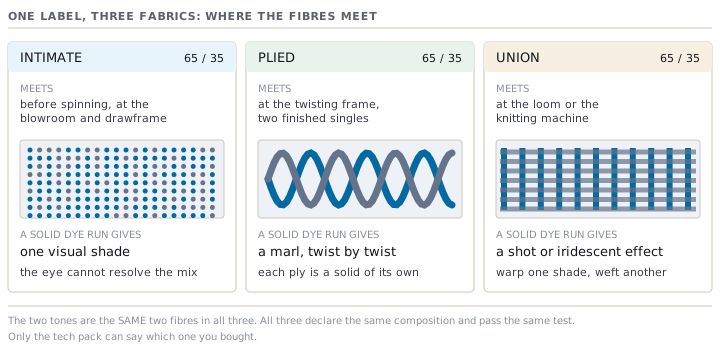
The label on all three says 65 percent polyester, 35 percent cotton. The fibre content is identical. What differs is where in the process the two fibres were introduced to each other. That decides everything about how the fabric dyes.
| Architecture | Where the fibres mix | What a solid dye run produces | Where you find it on purpose |
|---|---|---|---|
| Intimate blend | Before spinning, at the blowroom and drawframe, so both fibres run through every yarn's cross-section | One visual shade — the two dye classes average at fibre scale, below what an eye resolves | Almost every poly-cotton and CVC jersey, poly-viscose suiting |
| Plied blend | At the twisting frame, where two finished singles of different fibres are twisted together | A marl: each ply is a solid of its own colour, so the yarn is a two-colour barber pole | Marl jersey, mouliné sweaters, heather sock yarn |
| Union fabric | At the loom or the knitting machine, as different yarns in different places | Warp one shade and weft another, unless the recipe is built to bring them together | Polyester-warp and viscose-weft suiting, cotton-back polyester-face fleece |
There is a fourth kind, and it behaves differently again. A core-spun yarn has one fibre running as a continuous core, with another fibre wrapped around it as a cover. The usual one is an elastane core inside a cotton cover. The core never dyes and never shows — until the cover wears away, or the core snaps. Then it shows as white specks. A buyer's QA calls that grin-through.
Why the dyehouse cares more than anyone
Cotton and polyester do not take the same dye, and nothing can make them.
Cotton is dyed with reactive or direct dyes, in water, alkaline, at around 60 degrees. Polyester is a closed fibre that repels water. It takes disperse dyes, and those have to be forced into it at 130 degrees under pressure, or at normal pressure with a chemical carrier. Neither dye class works on the other fibre. So a solid poly-cotton is dyed in sequence. Disperse first, at 130 degrees. Then a reduction clear — a cleaning bath of sodium hydrosulphite and caustic — strips the loose disperse dye off the cotton surface. Then reactive on the cotton at 60 degrees. Then wash off.
Skip the reduction clear and the loose disperse dye stays sitting on the cotton, fixed to nothing. It comes off on a white collar the first time somebody sweats. That is the rubbing-off failure the dyer gets blamed for. It is really a missing process step.
Now put those two dyed parts back into the three architectures.
In an intimate blend, the dyed polyester fibres and the dyed cotton fibres are shuffled together at the scale of microns. Even if the two shades do not match perfectly, the eye merges them and reads one colour. The blend hides a small mismatch. That is why it is the default.
In a plied blend, the polyester lives in one strand and the cotton in the other. Each strand is a solid colour. A small shade difference between them is not hidden. It is displayed, twist by twist, as a marl. From two metres it reads as grain.
In a union fabric, the two fibres sit in different yarns in different directions. A mismatch reads as a two-tone shimmer. That is either a beautiful suiting or a rejection, depending entirely on whether anyone asked for it.
Tracing it back
The mill's yarn store issued lot 3 from a second spinner. The first spinner ran short in week 16. Procurement covered the gap. The packing list said what every packing list says: P/C 65/35, Ne 30/1. The storekeeper matched on fibre content and count. That is what a storekeeper is asked to match on. So the yarn was issued.
The technical data sheet stapled to the back of the delivery note said two-fold, plied construction. Nobody read it, because nothing in the specification told anybody that it mattered.
Look at what the tech pack actually said:
Body fabric: single jersey, 180 g/m², 65 percent polyester / 35 percent cotton, Ne 30/1, solid dyed, 19-4024 TCX.
Every word of that is true of the yarn that failed. The fibre content is right. The count is right. The fabric construction is right. The colour reference is right. The specification described a fibre content and never described a fibre architecture. A yarn that satisfies it completely produced a fabric the buyer will not take.
Here is the line that would have prevented it:
Body fabric: single jersey, 180 g/m², 65 percent polyester / 35 percent cotton intimate blend, Ne 30/1 ring spun. Plied, core-spun or melange yarn is not an acceptable substitution without written approval. Solid dyed to 19-4024 TCX; shade assessed under D65 and TL84.
One word carries most of that: intimate. It is the word that turns a fibre content into a fibre architecture. And it is missing from most tech packs in this industry.
What it cost
| Line | Amount |
|---|---|
| Fabric written off | 1,400 kg |
| Garments it would have cut | 4,400 pcs |
| Replacement fabric at USD 5.14 per kg | USD 7,196 |
| Split shipment: second booking, documents, handling | USD 2,180 |
| Total absorbed by the mill | USD 9,376 |
| Margin on the whole order, 0.37 per piece on 26,400 | USD 9,768 |
| Share of the order's margin consumed | 96.0 percent |
The order still shipped, and the buyer was reasonable in the end: a twelve-day second delivery on 4,400 pieces, and no chargeback. The mill kept the customer and made USD 392 on 26,400 garments.
Re-dyeing was considered and rejected in about ninety seconds. It is worth understanding why. Dyeing darker covers a shade error. It does not cover a marl, because a marl is not a shade error. It is two shades, each sitting correctly on its own fibre in its own place. Make both darker and you get a darker marl. The grain survives every recipe you can throw at it. That is exactly why this failure is structural, not cosmetic.
Prompt · Write the fabric line so a yarn cannot be substituted
Before a tech pack is released, and again the first time a spinner reports a shortage.
Act as a senior fabric technologist. I am writing the body fabric line of a tech pack and I want it to survive a yarn shortage. Here is what my tech pack says today, word for word: [PASTE THE LINE]. Style [STYLE], buyer [BUYER], colour standard [REFERENCE], quantity [QTY] pcs, mill [NAME], spinner [NAME OR UNKNOWN]. Do the following. First, list every yarn or fabric a supplier could legitimately deliver that satisfies my wording exactly but is not what I intended — include blend architecture (intimate, plied, core-spun, melange), spinning system, ply, and any fibre substitution the wording permits. Second, for each of those, say what the reader would see in the finished garment and at what stage it would be found. Third, rewrite my line so that the fibre content, the fibre architecture, the spinning system and the substitution rule are all stated, in the shortest wording that does the job — I want a line a storekeeper can check against a delivery note, not a paragraph. Fourth, tell me which single word or clause in your rewrite is doing the most work, and what happens if it is deleted. Fifth, give me the incoming check I should run on the first delivery from any new spinner, in steps somebody on the floor can do in under five minutes without a laboratory. Do not add requirements my construction does not need: an over-specified line gets ignored as thoroughly as a vague one.
AI can make mistakes — check anything you act on.
Metamerism, the other blend shade problem
There is a second failure that only blends have. It survives the lab.
Two dye classes on two fibres can be matched to one shade under one light, and drift apart under another light. The reason is that the two colourants reflect light differently across the spectrum. This is called metamerism. The lab approves the bulk against the lab dip under D65, a standard daylight lamp. The buyer's store runs TL84 fluorescent tubes. On the rail, the garments read faintly two-tone.
On this order the mill checked for it, because a poly-cotton navy is where metamerism lives. Lot 3 was DE 0.62 under D65 and DE 1.84 under TL84. The polyester side of the blend held its depth while the cotton side lifted. That is why a blend specification names the lights, not just the colour. A lab dip approved under one light is half an approval.
Prompt · Diagnose a blend shade or uniformity failure
The morning a dyed lot is stopped on the frame and nobody can say whether it is a shade problem or a yarn problem.
Act as a senior dyeing and finishing manager. A dyed lot of blended fabric has been stopped and I need a diagnosis before I commit to re-dyeing, replacing or shipping it. Facts: fabric [CONSTRUCTION AND WEIGHT], declared composition [RATIO], yarn [COUNT AND SPINNING SYSTEM IF KNOWN], colour standard [REFERENCE], lot size [KG], lot number [NUMBER], dye route used [PASTE THE RECIPE AND SEQUENCE]. Laboratory readings: [DE VALUE] against the approved lab dip under [ILLUMINANT], and [DE VALUE] under [SECOND ILLUMINANT] if measured. What the fabric looks like by eye, in my own words: [DESCRIBE — grain, cloudiness, listing edge to centre, ending head to tail, streaks in the machine direction, two-tone at distance]. Earlier lots from the same fabric order: [PASS OR FAIL AND ANY READINGS]. Yarn supplier for this lot versus the others: [SAME OR DIFFERENT]. Do this. First, separate the possible causes into shade error, uniformity error and fibre architecture error, and say which group the evidence actually points to and what in the evidence points there. Second, name the specific tests that would tell those groups apart, including anything I can do on the bench with a needle and a flame in ten minutes. Third, say whether re-dyeing can fix what you believe this is, and be explicit where it cannot — a structural two-tone does not respond to a darker recipe. Fourth, if the cause is a yarn substitution, tell me exactly what to ask the spinner for and what document settles it. Fifth, price my options against each other: re-dye, replace, sell as a different shade or effect, or ship with a written concession. Say plainly when the honest answer is that the fabric is lost.
AI can make mistakes — check anything you act on.
Check yourselfA poly-cotton navy comes off the frame with a fine grain, but the spectrophotometer reads DE 0.62 against the lab dip, inside a tolerance of DE 1.0. Has the fabric passed?Show the answer
No. The two instruments answer different questions. The spectrophotometer averages everything under its opening and reports the average colour. So it confirms the fabric is the right navy on average. Uniformity is a separate property. It is judged by eye, at a distance, against a standard, under the specified lights. A blend can be exactly on shade and visibly two-tone at the same time. The usual cause is that the two fibres were not intimately blended, so each dye class is displayed on its own instead of being averaged at fibre scale.
Check yourselfYour tech pack says 65 percent polyester / 35 percent cotton, Ne 30/1, single jersey, solid dyed. A spinner offers a plied yarn at 4 cents per kg less. Can they?Show the answer
On the wording as written, yes. That is the problem — not the spinner's ethics. A plied two-fold at that fibre content and that count satisfies every word of the specification. The substitution is compliant, cheaper, and invisible on a packing list. It becomes non-compliant only when the specification names the architecture: intimate blend, ring spun, no plied or core-spun substitution without written approval. Write the word before the shortage. During the shortage, nobody is reading the tech pack.