Lessons · Lesson 3 of 3
The ratio is a legal claim
Check a declared composition against the manufacturing tolerance, the test method and the tariff line before a label is printed.
Lesson 3 of 3 · 33 min
The situation
The percentages on a fibre label are not a description. They are a legal statement. A laboratory tests it, and a border enforces it. This lesson works out how much room that statement really leaves you. It is less than the published tolerance suggests, because the laboratory adds an official water allowance first. The same ratio also decides how customs classifies the garment. So a small change can move it to a different duty line.
It is 9 June, 16:05. An email arrives from Kellermann's compliance office, forwarded without comment.
Style LS-338 is a women's cotton-elastane rib long-sleeve. 14,800 pieces at FOB USD 5.65. Order value USD 83,620. It arrived in Hamburg on the 2nd. A market-surveillance check pulled three pieces for fibre composition. The report is attached: SGS HH-2611447, tested to ISO 1833-20 — the solvent method used for elastane mixtures.
The label sewn into the side seam says 95 percent cotton, 5 percent elastane.
The report says 91.8 percent cotton, 8.2 percent elastane.
The consignment is detained. Nobody at the mill did anything they would call wrong. And the order is about to lose money.
Here is the report itself, as it arrives. Four lines on it decide everything:
- The method — ISO 1833-20, which names the solvent that dissolved the elastane out.
- The found composition — what the laboratory actually weighed: 91.8 and 8.2.
- The declared composition — what the label claims: 95 and 5.
- The conclusion — conform or does not conform. The border reads only this line.
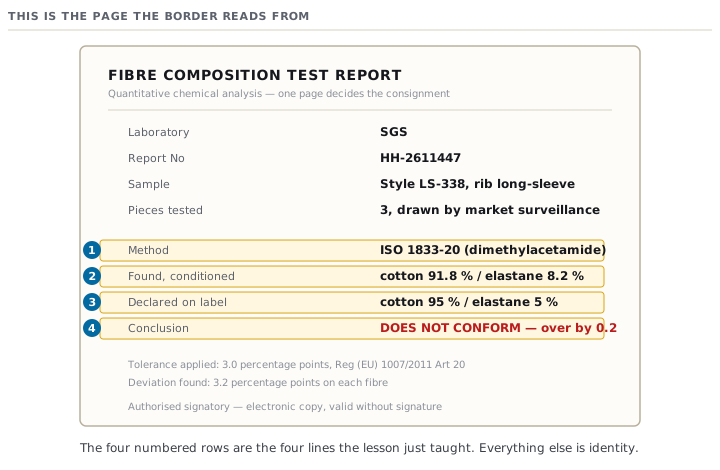
The tolerance is written down, and it is small
A fibre content is not a description. It is a claim, made under a regulation, in three places at once: on the sewn label, on the commercial invoice that drives the customs entry, and in the vendor agreement that lets a buyer charge you for being wrong.
In the European Union the rule is Regulation (EU) No 1007/2011 on textile fibre names and labelling. Full composition, by weight, in descending order, on the product. Article 20 sets the tolerances. Two of them matter to you.
- A manufacturing tolerance of 3 percentage points between the stated percentage and the percentage the analysis finds. Declare 95 and the test may return anything from 92 upward.
- Extraneous fibres — stray fibres that got in by accident — up to 2 percent of weight need not be declared. That rises to 5 percent for products made by the carded process.
The United States reaches much the same place by a different road. The Textile Fiber Products Identification Act and the FTC's rules at 16 CFR Part 303 require the fibre content by weight. They permit a similar 3 percent deviation where it comes from unavoidable variation in manufacture. Fibres present below 5 percent may be grouped as other fibre — but not where the fibre has a function the consumer is being sold. Elastane always does, because it decides how the garment is washed.
Now put the numbers side by side.
| Declared | Tested | Deviation | |
|---|---|---|---|
| Cotton | 95 percent | 91.8 percent | 3.2 points |
| Elastane | 5 percent | 8.2 percent | 3.2 points |
| Permitted | 3.0 points |
It failed by two tenths of a percentage point. There is no partial credit and no discretion at the border. The label states a composition the goods do not have, by more than the regulation allows.
The 1.5 points you lose before anything goes wrong
Before blaming the knitter, understand how much of that tolerance was already spent.
A fibre composition is measured by chemical separation — ISO 1833 in Europe, AATCC 20A in the United States. One fibre is dissolved. The other is weighed. For cotton and polyester, sulphuric acid takes the cotton away. For elastane, the solvent is dimethylacetamide. What is left is weighed dry. Then the laboratory adds back a standard allowance for moisture. Why? Because fibres are sold and worn with their natural moisture in them, not oven-dry, and different fibres hold very different amounts of water.
| Fibre | Allowance |
|---|---|
| Cotton | 8.5 percent |
| Viscose | 13.0 percent |
| Wool | 17.0 percent |
| Nylon | 6.25 percent |
| Polyester | 1.5 percent |
| Elastane | 1.5 percent |
Work one through. A spinner blends a poly-cotton to exactly 65 and 35 by dry weight. That is the ratio the blending equipment controls. Now apply the allowances. The polyester becomes 65 times 1.015, which is 65.975. The cotton becomes 35 times 1.085, which is 37.975. The total is 103.95. So the declared percentages are 63.5 and 36.5.
A yarn that is exactly 65/35 on the blowroom floor is 63.5/36.5 on the label. That is 1.5 points of a 3 point tolerance gone before a single thing has drifted. And it comes entirely from the fibres chosen — cotton holds nearly six times the moisture polyester does. On a wool blend, with an allowance of 17.0 percent, the effect is bigger again.
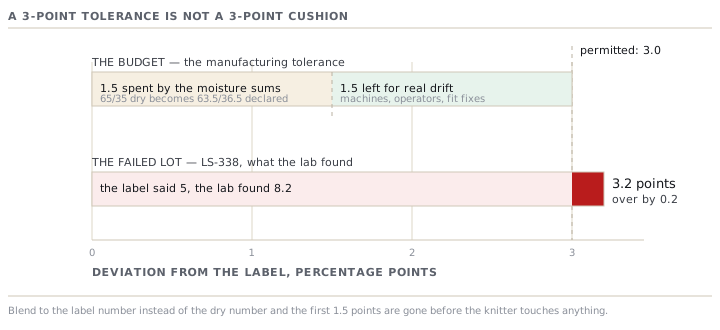
This is why a mill that blends to the label number, instead of the dry number, fails tests it thinks it should pass. And it is why an experienced spinner asks which basis you are quoting before agreeing a ratio.
How a fit comment became a border problem
The audit trail on LS-338 took twenty minutes to reconstruct. It is depressingly ordinary.
Fit sample 1 went to Düsseldorf in February. The comments came back asking for more recovery at the cuff, and less bagging at the elbow after wear. A normal, reasonable fit request on a rib. The knitter's answer was the obvious one: raise the elastane feed. Fit sample 2 was approved in March, with a note that read hand and recovery now correct.
Nobody translated that fit fix into a number. The elastane went from a nominal 5 percent to a nominal 8. The fabric got denser and heavier. Three things should have moved and did not: the cost sheet, the consumption, and the composition on the label artwork. That artwork had been approved in January. It was already printed.
The specification changed and the claim did not. That is the mechanism behind almost every composition failure in this industry. It is not fraud. It is rarely even a shortcut. It is a fit correction, made by a technician who owns the fabric and does not own the label.
What it cost
| Line | USD |
|---|---|
| Relabelling 14,800 pieces in bonded warehouse at 0.46 each | 6,808 |
| Storage and demurrage, 9 days detained | 1,930 |
| Markdown allowance, 7 percent of order value, promotional week missed | 5,853 |
| Total | 14,591 |
| Order margin, 0.56 per piece on 14,800 | 8,288 |
| Result on the order | a loss of 6,303 |
Relabelling was the cheap option. It is worth seeing why it was available at all. The goods were not illegal — they were mislabelled. A garment that really is 91.8 and 8.2 can be sold all day with a label that says so. What cannot happen is selling it with a label that says something else. So the fix was a new content label, sewn in, in a bonded warehouse, at a labour rate nobody in Egypt sets.
Then comes the part that outlasts the order. Kellermann's vendor manual moved this factory from one composition test per four lots to one test per lot. That is 22 lots a season at USD 185 a report — USD 4,070 where it used to be USD 1,110. So USD 2,960 more every season, for as long as the rating stands.
The ratio is also a tariff line
The commercial invoice carries a fibre content too, and customs uses it to classify the goods. Under the Harmonised System, a garment of mixed materials is classified by the material that predominates by weight. That rule has no taste in it, and no room for a discussion about hand.
For knitted t-shirts and singlets: heading 6109.10 is cotton, heading 6109.90 is other textile materials. A tee that is 55 cotton and 45 polyester is a cotton tee. Move it to 45 and 55, and the same garment, on the same machine, from the same yarn store, becomes a synthetic tee.
That matters enormously in one market, and barely at all in another.
| 100 percent cotton | PC 65/35 | |
|---|---|---|
| FOB | 3.58 | 3.47 |
| United States duty rate | 16.5 percent | 32 percent |
| Landed, duty paid, into the United States | 4.17 | 4.58 |
| European Union duty rate | 12 percent | 12 percent |
| Landed, duty paid, into the European Union | 4.01 | 3.89 |
Read the two bottom lines together. Into Germany, the poly-cotton is the right answer by 12 cents a piece — exactly as lesson 1 concluded. Into the United States, the cheaper fabric is the dearer garment by 41 cents. That is USD 10,824 on this order. A ratio that crossed 50 percent moved the goods onto a tariff line that costs almost twice as much.
The same ratio decision has opposite answers in Düsseldorf and in Dallas. A cost sheet that stops at FOB cannot see it. This is the single best argument for why the blend ratio is not a designer's preference. It is a number with a duty rate attached.
Prompt · Check the composition claim before the label is printed
At label artwork approval, and again after any fabric change, however small it looked at the time.
Act as a senior compliance and merchandising manager for apparel exports. I am about to commit a fibre composition claim and I want it checked before it is printed and sewn in. Facts: buyer [BUYER], style [STYLE], quantity [QTY] pcs, FOB [PRICE], destination market or markets [COUNTRIES], garment [DESCRIPTION]. The composition I intend to declare: [RATIO, FIBRE BY FIBRE]. The composition my fabric supplier states on their side: [RATIO AND BASIS IF KNOWN, DRY OR CONDITIONED]. Last bulk test result if I have one: [PASTE THE REPORT NUMBER, METHOD AND FIGURES]. Every change made to this fabric since the label artwork was approved: [LIST THEM, INCLUDING FIT CORRECTIONS]. Do the following. First, state the tolerance that applies in each destination market and cite the instrument, then say how much of that tolerance my declared figures have already spent before any drift, taking conventional moisture allowances into account and showing the arithmetic. Second, name the test method a laboratory would use for this fibre pair and what it dissolves, so I know what I am being measured by. Third, review my list of fabric changes and tell me which of them should have changed the declared composition, the cost sheet or the consumption, and flag any that changed one and not the others. Fourth, give me the customs classification consequence: the heading this composition falls under in each destination, the duty rate, and how far the ratio is from a threshold that would move it. Fifth, list every place this claim appears — label, care label, invoice, packing list, buyer system, certification paperwork — and what has to happen in each if the number changes. If any of my figures are internally inconsistent, say so first and stop.
AI can make mistakes — check anything you act on.
The claim a test cannot check
One family of blend claims has no laboratory behind it at all.
Recycled polyester is chemically the same polymer as virgin polyester. No instrument can look at a fibre and tell you where the bottle came from. So a recycled-content claim can never be verified the way a 65/35 can. The only evidence is a paper chain. Under the Global Recycled Standard, a product needs at least 20 percent recycled content to be certified at all, and at least 50 percent to carry the logo on the product. The Recycled Claim Standard covers blends from 5 percent upward.
The control that actually matters is the transaction certificate. A scope certificate proves a supplier is certified to handle the material. A transaction certificate proves that this shipment, of this weight, is the material claimed. Buyers who audit this find the two confused constantly. A supplier presenting a scope certificate for a shipment has presented nothing.
Check yourselfA declared 95/5 cotton-elastane tests at 93.5 and 6.5. Does it pass, and what would you do?Show the answer
It passes. The deviation is 1.5 percentage points against a permitted 3, so the label stands and the goods clear. What you do is treat it as the warning it is. A drift of that size on a nominal 5 percent means the elastane feed is running about a third above nominal. The next lot, on a different machine or with a different operator, can easily reach 8.2 and fail. Find out whether it is a machine setting or an unrecorded fit correction. If it is the second, the label is wrong in intention even though it passed in fact. The costing and the consumption will be wrong too.
Check yourselfYour buyer wants to change a 55 cotton / 45 polyester tee to 45 cotton / 55 polyester to save 4 cents of FOB. The programme ships to the United States. What do you tell them?Show the answer
That the saving is a rounding error against the duty. Crossing 50 percent moves the goods from heading 6109.10, cotton, to heading 6109.90, other textile materials. The United States rate goes from 16.5 percent to 32 percent. On an FOB near 3.50, that is roughly 55 cents a garment against a 4 cent saving. Say it in landed terms and show the two tariff headings, because the answer changes with the destination: into the European Union both headings carry the same rate, and there the change genuinely does save 4 cents.