Lessons · Lesson 1 of 3
What a blend ratio actually buys
Cost four candidate blends line by line to an FOB per piece, and say what each ratio buys and what it costs to buy it.
Lesson 1 of 3 · 32 min
The situation
Mixing two fibres is a trade, never a free upgrade. You give up part of what one fibre does well. In return you buy what the other fibre does well. The ratio is the price you agreed to pay. This lesson shows a surprise: the cheaper yarn often makes the dearer fabric, because two fibres that refuse the same dye must be dyed twice. It ends with elastane, the stretch fibre — the most under-costed item in the whole trade.
It is 4 March, 11:20, in the costing room above the knitting floor. The mill is a vertical knitter in Mahalla al-Kubra — it spins, knits, dyes and sews under one roof. On the table: a fit sample, four fabric hangers, and a two-line email from Kellermann Textil in Düsseldorf.
LS-330, women's long-sleeve crew tee. 26,400 pieces. Cotton hand, holds its shape after twenty washes, target FOB USD 3.55.
Three demands, and the middle one fights the first. Cotton has the best hand in the business — "hand" is how a fabric feels when you touch it. But cotton does not hold its size. A 100 percent cotton single jersey relaxes and shrinks. After twenty home washes, a body length that left the factory at 66 cm is close to 63 cm. Polyester is the opposite. It holds its measurements almost perfectly, and next to cotton it feels like a plastic bag.
That gap is the whole reason blending exists. Nobody mixes fibres for fun. A blend is a purchase. You spend some of one fibre's virtues to buy some of the other's. The ratio is the price you agreed to pay.
Four reasons a blend exists
Price. Polyester staple — polyester cut into short lengths so it can be spun like cotton — is cheaper than cotton, and its price moves far less. A poly-rich blend protects you against the cotton market as much as it changes the fabric. A merchandiser who has watched a cotton contract move 40 cents in one season knows why a buyer asks for one.
A property no single fibre has. Cotton with a little elastane springs back after a knee bends. Cotton alone does not. Wool with nylon survives a heel. Wool alone wears through in a season. Neither of those is a compromise. The blend does something neither fibre can do on its own.
Spinnability. Short, weak or slippery fibres spin badly on their own. Blending them with a stronger fibre is often the only way to get a yarn at all. That is why you rarely see 100 percent of anything short.
A claim. Recycled content, cotton-rich, wool-rich. Some ratios exist because a label, a standard or a customs duty line demands them. Those are the ratios that get people into trouble. They are lesson 3.
The four candidates, priced
The mill quotes yarn at Ne 30/1, combed where it is cotton.
| Yarn | USD per kg |
|---|---|
| Cotton, combed | 3.55 |
| Polyester staple | 2.05 |
| Viscose staple | 3.10 |
| Elastane, 20 denier bare | 12.40 |
A blend yarn costs what its parts cost, weighted by the ratio. That is the only line in a blend cost that is a simple average. It is also the line where most people stop.
- 100 percent cotton: 3.55
- CVC, 60 cotton / 40 polyester: 0.60 times 3.55 plus 0.40 times 2.05, which is 2.13 plus 0.82, so 2.95
- PC, 65 polyester / 35 cotton: 0.65 times 2.05 plus 0.35 times 3.55, which is 1.33 plus 1.24, so 2.58
- Cotton / elastane, 95 / 5: 0.95 times 3.55 plus 0.05 times 12.40, which is 3.37 plus 0.62, so 3.99
Do not stop there. Yarn is not fabric. The fabric still has to be knitted, dyed and finished, and it loses weight on the way. Those cost lines are not the same for every blend. A cotton fabric is dyed once, with reactive dye in an alkaline bath at 60 degrees. A polyester-cotton fabric is dyed twice. Disperse dye goes onto the polyester at 130 degrees under pressure. A cleaning step called a reduction clear then strips the loose disperse dye off the cotton. Then reactive dye goes onto the cotton. Two dyebaths. Twice the water and steam. Two chances to miss the shade.
| Line | 100 cotton | CVC 60/40 | PC 65/35 | Cotton / elastane 95/5 |
|---|---|---|---|---|
| Yarn | 3.55 | 2.95 | 2.58 | 3.99 |
| Knitting | 0.55 | 0.55 | 0.55 | 0.72 |
| Dyeing and finishing | 1.10 | 1.75 | 1.75 | 1.45 |
| Process loss | 0.26 | 0.28 | 0.26 | 0.38 |
| Finished fabric, per kg | 5.46 | 5.53 | 5.14 | 6.54 |
Read the CVC column again. The blend with the cheaper yarn made the dearer fabric. The yarn saved 0.60 per kg against cotton. The second dyebath cost 0.65 per kg. So CVC 60/40 lands 0.07 per kg above 100 percent cotton. And every year, somebody offers it to a buyer as a saving.
Where the ratio flips, and why
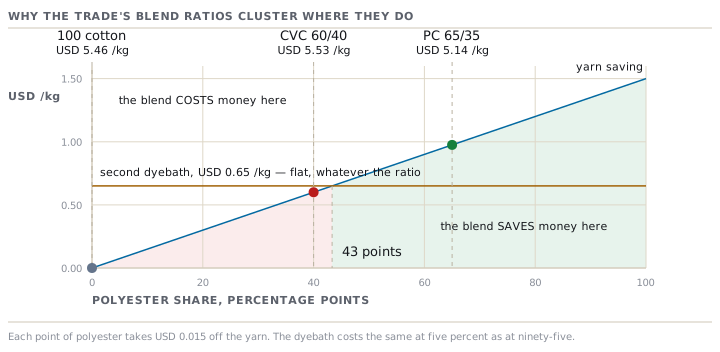
Each percentage point of polyester that replaces cotton takes USD 0.015 off the yarn cost of a kilogram, because the two yarns are 1.50 apart. The second dyebath costs 0.65 per kg, and it costs that whether the fabric is 5 percent polyester or 95. So the fabric only becomes cheaper than cotton once the yarn saving covers the dyebath. That point is 0.65 divided by 0.015, which is a little over 43 percentage points of polyester.
That one number explains why the trade's ratios sit where they do.
- Below about 43 percent polyester, a blend is never a price decision. It is a performance or a labelling decision, and it costs money.
- CVC, at 60 cotton / 40 polyester, sits on the expensive side of the line on purpose. Cotton is the majority fibre, so it can be named first on the label. CVC means chief value cotton — literally, the ratio at which cotton is the chief value. You are buying a cotton-first label and some shape retention, and you pay for it.
- 65 polyester / 35 cotton sits well on the cheap side, at 5.14 against cotton's 5.46. It is the ratio for workwear, uniforms, hotels and institutions: cheaper, stable, wrinkle-resistant, and it feels like what it is.
The ratio does not flip because a mill liked a different number. It flips at the point where the arithmetic changes sign.
Per piece, and then per order
This style needs 0.31 kg of finished fabric per piece, cutting waste included. The elastane version needs 0.34 kg. Elastane fabric relaxes on the cutting table and is cut narrower, so the marker — the cutting plan that fits the pattern pieces onto the fabric — eats more.
| Line | 100 cotton | CVC 60/40 | PC 65/35 | Cotton / elastane 95/5 |
|---|---|---|---|---|
| Fabric | 1.69 | 1.71 | 1.59 | 2.22 |
| Trims | 0.34 | 0.34 | 0.34 | 0.34 |
| CMT | 0.95 | 0.95 | 0.95 | 0.95 |
| Overhead and finance | 0.22 | 0.22 | 0.22 | 0.22 |
| Cost | 3.20 | 3.22 | 3.10 | 3.73 |
| FOB at 12 percent | 3.58 | 3.61 | 3.47 | 4.18 |
The target is 3.55. Exactly one candidate clears it: PC 65/35, at 3.47, with 8 cents to spare. Cotton misses by 3 cents. CVC misses by 6. The elastane version misses by 63.
Five percent of the fibre, seventeen percent of the price
Sit with the elastane column. It is the trap in this whole subject. Elastane went in at 5 percent of the yarn's weight. It came out at 0.60 per piece, which is 16.8 percent on top of the cotton FOB of 3.58. On 26,400 pieces that is USD 15,840.
It is not a 5 percent cost change, because almost none of the money is the fibre itself.
| Line | USD |
|---|---|
| The elastane fibre itself | 0.14 |
| Slower knitting, more machine stops, elastane feed | 0.05 |
| Heat-setting the fabric before dyeing | 0.11 |
| Higher process loss | 0.04 |
| The extra 0.03 kg of fabric each piece now needs | 0.20 |
| Subtotal | 0.54 |
| Margin at 12 percent | 0.06 |
The biggest single line is not the elastane. It is the fabric you did not know you had to buy. An elastane knit is heat-set, relaxed and cut narrower than the raw width suggests, so each piece eats more fabric. The second biggest line is heat-setting itself — a hot pass that fixes the elastane before dyeing. Skip it and the fabric keeps shrinking after the dyebath.
Prompt · Cost the candidate blends properly, not just the yarn
At the fabric decision, when somebody has proposed a ratio and the only number on the table is a yarn price.
Act as a senior fabric and costing merchandiser at a vertical knitter. I am choosing a blend for a style and I need each candidate costed to an FOB per piece, not to a yarn price. Style facts: buyer [BUYER], style [STYLE], order quantity [QTY] pcs, target FOB [PRICE], destination market [COUNTRY], fabric [CONSTRUCTION] at [GSM] g/m2, yarn count [COUNT]. Candidate blends: [LIST THE RATIOS]. Yarn prices per kg delivered to my floor: [PASTE THE LIST]. My knitting rate and machine stop rate per construction: [PASTE OR SAY UNKNOWN]. Dyeing and finishing cost per kg for a single-class dye and for a two-class dye: [PASTE OR SAY UNKNOWN]. Greige to finished loss: [PERCENT OR UNKNOWN]. Consumption per piece for the base construction: [KG]. Trims [PRICE], CMT [PRICE], overhead [PRICE], margin [PERCENT]. Do this. First, build the yarn cost per kg for each candidate and show the weighting arithmetic. Second, build the finished fabric cost per kg line by line, and state explicitly which candidates need a second dyebath and what you charged for it. Third, adjust consumption per candidate rather than holding it constant, and say why it moved. Fourth, give me the FOB per piece for each candidate and the gap to my target. Fifth, find the break-even ratio at which a polyester-rich blend becomes cheaper than the all-cotton option, and show that calculation. Where I have told you a figure is unknown, say so in the output and give the range you assumed instead of hiding it. Do not present a yarn-price saving as a fabric saving.
AI can make mistakes — check anything you act on.
The blends that exist, and the reason each one does
| Blend | Usual ratio | What it buys | Where it goes wrong |
|---|---|---|---|
| Polyester / cotton | 65 / 35 | Price, shape retention, wrinkle resistance | Two dyebaths, pilling, a hand nobody calls soft |
| Cotton / polyester, CVC | 60 / 40 or 55 / 45 | A cotton-first label with some stability | Costs more finished than 100 percent cotton |
| Cotton / elastane | 95 / 5 or 92 / 8 | Recovery, fit, a knee that does not bag | Cost out of all proportion; chlorine and dry heat destroy it |
| Polyester / viscose | 65 / 35 | Drape and moisture handling with strength | Viscose loses strength wet; pilling on a suiting face |
| Wool / polyester | 55 / 45 | Crease recovery and a machine-washable price | Hand suffers; too little wool for a wool-rich claim |
| Wool / nylon | 80 / 20 | Abrasion where a garment dies: heel, elbow, cuff | Nylon takes acid dye differently, so shade risk at the seam |
| Tri-blend | 50 / 25 / 25 cotton, polyester, rayon | Hand and drape for a fashion tee | Three dye classes and three shrinkage rates in one fabric |
| Recycled content | 50 / 50 rPET and cotton | A claim a buyer's programme requires | The claim is paperwork, not a property a test can find |
Two of those rows are not fabric decisions at all. Wool at 45 percent cannot be called wool-rich. A recycled blend is bought for a certificate. Both are in the table because you will meet them as fabric problems, and you have to see that they are not.
Check yourselfA buyer asks you to move a jersey from 100 percent cotton to CVC 60/40 to save money. Using this mill's numbers, what do you tell them?Show the answer
Tell them it does not save money. It costs 0.07 per kg more finished, about 2 cents a garment. The yarn is 0.60 per kg cheaper, but the polyester adds a second dyebath at 0.65 per kg, and a dyebath costs the same whether the fabric is 40 percent polyester or 90. Below about 43 percent polyester, a blend is never a price decision. If the buyer wants CVC anyway, that is a good decision for shape retention or for a cotton-first label. Cost it as one.
Check yourselfYour cost sheet moves from 95/5 cotton-elastane to 92/8. Elastane is 3 percentage points more of a yarn that costs 12.40 against cotton's 3.55. Is that the whole cost change?Show the answer
No, and it is usually less than half of it. Three points of elastane at that price gap is about 0.27 per kg of yarn, roughly 9 cents a garment. But more elastane means a tighter, heavier fabric. More shrinkage as it relaxes. A narrower usable width, so more grams per piece. Slower knitting. Maybe a different heat-setting recipe. The fibre line is the small half. Reprice the consumption and the knitting rate as well, or the quote is wrong before it is sent.