Lessons · Lesson 6 of 8
- 01 · The six questions a record has to answer
- 02 · The prefix everybody stopped typing
- 03 · Two owners, and therefore none
- 04 · A permission with more verbs than the reason
- 05 · What a version is for, and what it has to keep
- 06 · Both edits were right; one of them is gone
- 07 · Six people, one record, and who pays for the tidying
- 08 · What a rule costs to keep
Both edits were right; one of them is gone
See why the collision you can spot is the cheap one, measure how long your forms stay open, and cut an overwrite risk you cannot otherwise detect.
Lesson 6 of 8 · 15 min
Two people, one record, eleven minutes apart
At 10:02 on a Wednesday, Zeyad Zaghloul opened WB-2607. He changed the carton quantity from 24 to 20 pieces, because Halverton had revised its packing. At 10:09, Hanadi Naguib opened the same record. She moved the ex-factory date from 11 April to 18 April, because the mill had confirmed a later dye slot. Zeyad saved at 10:21. Hanadi saved at 10:33.
Both edits were right. Both people had the authority. Neither knew the other was there. And at 10:33 the carton quantity went back to 24. Hanadi's form had loaded it at 10:09, when it still said 24, and the system writes the whole record back.
Nothing looked wrong afterwards. The record was complete, it agreed with itself, and one field was quietly a week out of date. The packing list was built from it eighteen days later. It was 78 cartons out.
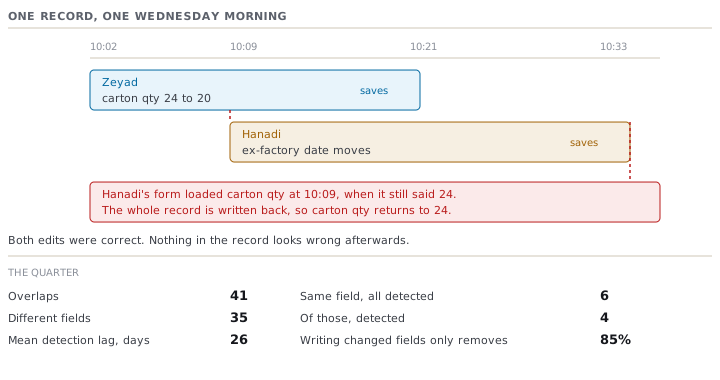
Forty-one overlaps, and the quiet ones are the frightening ones
Hanadi pulled the record-open and record-save times for the quarter. She counted every case where two people had the same record open at the same time.
| What the two people did | Overlaps | Detected at the time |
|---|---|---|
| Edited the same field | 6 | 6 |
| Edited different fields of the same record | 35 | 4 |
| Total | 41 | 10 |
Read that table twice. It is the opposite of what everybody worries about.
The same-field collision is the cheap one. All six were caught straight away. Two people changed one value, one of them saw it change under him, and there was an argument. An argument is governance working. It cost ten minutes and a decision.
The different-field collision is the expensive one, and you cannot see it. Thirty-five happened. Four were noticed, and all four only because somebody remembered typing something. The other thirty-one left no trace at all. The reason is worth saying plainly: a field that quietly reverts does not damage the record. The record is not corrupt, or contradictory, or incomplete. It has gone back to a value that was true an hour ago, and that value is valid in every sense. No query finds it. No report flags it. No reviewer spots it, because there is nothing to spot.
The nine that mattered
Of the thirty-one overwrites nobody noticed, nine were found in the end, because something further down the line contradicted them.
| Field that reverted | How it surfaced | Cost, USD |
|---|---|---|
| Carton quantity | Packing list short by 78 cartons | 612.00 |
| Colourway split | 148 pieces cut in the wrong colour | 2,045.73 |
| Ex-factory date | Freight booked in the wrong week | 340.00 |
| Ordered quantity | 340 pieces over-cut | 714.00 |
| Packing instruction | 41 cartons repacked | 386.00 |
| Trim colour | 6,000 labels reprinted | 288.00 |
| Size ratio | A size set remade to the wrong ratio | 214.00 |
| Wash standard | One wash trial repeated | 178.00 |
| Mill delivery date | One chase email nobody minded | 0.00 |
| Total | 4,777.73 |
The average time from the overwrite to the discovery was 26 days. The range was three days to seventy-one. And every discovery came from outside the record. The mill said something different, a carton count did not match, a colour arrived that nobody had ordered. Not one was found by reading the record. Reading the record is exactly the thing that cannot find it.
Arrival order is not decision order
The system settled the conflict with the only rule it has: whoever saves last wins. That is an ordering of keystrokes. What matters is the order of decisions — which person made their change knowing about the other's. The system holds no information about that at all.
At 10:33, Hanadi did not know about the carton quantity. Her save was not a judgement that 24 was better than 20. It was not a judgement at all. Last write wins is not a decision. It is the absence of one. It quietly puts the timing of two people's typing above what either of them intended.
So the fix that really works belongs to whoever builds the system, not to you: write back only the fields that changed. Send the carton quantity only if the person touched the carton quantity. That removes thirty-five of the forty-one overlaps at once — 85% of them — and leaves only the six honest same-field conflicts, which are visible and get argued about. If you are ever in a room where this is being specified, that is the sentence to say.
What you can do this week, without touching the system
Your risk is roughly proportional to how long you leave the form open. That is the one thing entirely under your control.
Somebody edits a Tanvara style record about every forty-seven minutes during office hours. So a form left open for a given number of minutes has a rough collision chance of that number divided by forty-seven.
| Form open for | Rough chance somebody else edits meanwhile |
|---|---|
| 5 minutes | 11% |
| 20 minutes | 43% |
| 34 minutes | 72% |
The average open time in a session that collided was thirty-four minutes. The average across all sessions was nine. So the habit — read, close, decide, reopen, change, save — moves you from the bottom row of that table to the top one. In this simple model it cuts the risk about 6.8 times, which is thirty-four divided by five. It costs nothing.
Check yourselfWhy not just lock the record while somebody is editing it?Show the answer
Because a lock converts an invisible problem into a visible obstruction, and people route around obstructions. A record locked for thirty-four minutes at the mill cut-off produces a phone call, an override, or a value written into a spreadsheet and copied in later — which is worse than the overwrite, because now there are two records. Locking works where edits are short and rare; a style record is neither. Field-level writes solve it without blocking anybody, and shorter sessions are the version of that you can do yourself today.