Lessons · Lesson 2 of 8
- 01 · The six questions a record has to answer
- 02 · The prefix everybody stopped typing
- 03 · Two owners, and therefore none
- 04 · A permission with more verbs than the reason
- 05 · What a version is for, and what it has to keep
- 06 · Both edits were right; one of them is gone
- 07 · Six people, one record, and who pays for the tidying
- 08 · What a rule costs to keep
The prefix everybody stopped typing
See how a correct naming scheme turns ambiguous the season a second category arrives, and choose between a fix people must remember and one they cannot forget.
Lesson 2 of 8 · 15 min
A scheme that was right for four years
Tanvara's style codes were designed in a single afternoon in 2022, and they are good. A code has three parts: a two-letter category, a two-digit year and a two-digit sequence. So WB-2604 is the fourth woven-bottoms style of the current year.
For four years the factory made woven bottoms and nothing else. So the category letters only ever had one value. That means they carried no information at all. And that means — this is the whole lesson — they stopped being spoken, written and printed, one artefact at a time, without anybody taking a decision.
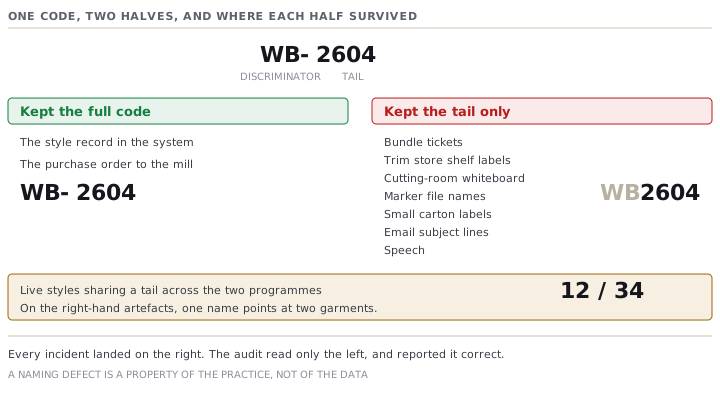
Nobody dropped the prefix. It fell off. On the cutting-room whiteboard it was a waste of chalk. On the trim store's shelf labels it was two characters that told nothing apart from nothing. In the sampling room's folder names it made every folder start with the same two letters, so sorting was easier without it. In speech it went first and fastest: everyone at Tanvara says twenty-six-oh-four.
Then in September the Ellendale knitted-tops programme was won, and in January KT-2604 came into existence.
| Artefact | Carries the category letters? |
|---|---|
| The style record in the system | Yes, always, mandatory field |
| The purchase order to the mill | Yes |
| Bundle tickets printed at the cutting table | No |
| Trim store shelf labels | No |
| The cutting-room whiteboard | No |
| Shared-drive folder and marker file names | No |
| Carton labels, small format | No |
| Email subject lines and messages | No |
| Speech | No |
Twelve of the thirty-four live styles share a four-digit tail with a style in the other programme, because each programme numbers its sequence from 01. So twelve styles have a twin. And every artefact in the lower half of that table calls both of them by the same name.
Nine incidents in eleven weeks
| What happened | Where the name was ambiguous | Cost, USD |
|---|---|---|
| Two rolls of interlining, 240 m, issued against the wrong 2604 | Shelf label | 468.00 |
| Bundles tagged 2607 ran a full shift on the wrong line, then 940 pieces unpicked | Bundle ticket | 1,559.60 |
| One lay cut from the wrong 2611 marker, 180 pieces re-cut | Marker file name | 2,488.05 |
| Trim store re-counted after the mis-issue | Shelf label | 58.80 |
| A mill delivery booked against the wrong 2609, an unnecessary short-order top-up | Goods-in note | 436.50 |
| Carton labels reprinted for 2602 | Carton label | 103.50 |
| Two mis-picks caught the same day | Shelf label | 31.36 |
| Fit comments filed against the wrong 2603, six days of the fit calendar | Email subject | 0.00 |
| A Halverton shade approval sent to Ellendale | Email subject | 0.00 |
| Total | 5,145.81 |
The re-cut is the one to look at. Wesam Fahim opened the marker for 2611 from the shared drive, made a lay, and cut 180 pieces of a garment that was not the garment on the cutting docket. He did nothing wrong. He opened the file whose name matched the docket. Two files could match that docket, and the folder had no way to tell him which.
The audit that was right and useless
In February Tanvara ran a data-quality check on the style master. Every one of the thirty-four styles had a correct, complete, unambiguous code. Compliance was 100%, and the report was accurate.
This is the part to carry out of the lesson. The system was never wrong. The ambiguity lived entirely in the artefacts the system does not hold: chalk, shelf labels, file names, speech. No query you can write against your own database will ever find it. A naming defect belongs to the practice, not to the data, so it is invisible to every tool that looks at the data.
You find it a different way. Take the name as it is actually spoken on your floor, and ask whether it points to exactly one thing. Not the name in the field. The name in the sentence.
Two fixes, and the cheaper one is the one that failed
In November, before any of this was priced, Tanvara did the obvious thing. Nabeeh Kolthoum retagged thirty-four shelves, the whiteboards were re-headed, folders were renamed, and everyone was asked to use the full code. Twenty-one hours of store time: USD 205.80. It worked immediately.
Then it decayed. The decay was measured afterwards by pulling bundle tickets out of the archive.
| Week after the briefing | Tickets carrying the full code |
|---|---|
| Week 1 | 100% |
| Week 5 | 62% |
| Week 11 | 9% |
Nobody rebelled. The prefix went back to carrying no information most of the time, because twenty-two styles out of thirty-four have no twin. So it went back to feeling like a waste of chalk. And the twelve that did have twins did not look any different from the twenty-two that did not.
The second fix costs more and cannot decay. Renumber so that the four-digit tail is unique on its own: one running sequence across both programmes. Then 2604 is one style and only one, whatever anybody drops.
| Item | Cost, USD |
|---|---|
| Carton labels already printed for two packed styles, 2,860 at 0.09 | 257.40 |
| Bundle tickets in flight, three lays reprinted | 62.00 |
| Twenty-six hours of merchandising and sampling time | 369.20 |
| Total | 688.60 |
688.60 against 5,145.81 in a quarter: the fix paid for itself 7.5 times over in eleven weeks. The rule it shows is worth more than the number: prefer a fix that removes the chance of the mistake over one that asks people not to make it. The retagging was six times cheaper and bought five weeks. The renumbering cannot be forgotten, because there is nothing left to forget.
The general shape, so you can find yours before it costs anything
A meaningful identifier is a prediction about the future shape of your business. WB predicted that categories would matter, and that there would be more than one. The prediction was right, and the scheme was still correct on the day it broke. The failure was not in the scheme. It was in four years of practice quietly dropping the part that was not yet earning its place.
So the question to ask of your own codes is not is this scheme unambiguous? It is: which part of this code currently has only one value? That part is being deleted right now, everywhere at once, and it will be gone on the day a second value appears. A colour suffix on a one-colourway programme. A factory letter when you have one plant. A season code before you sold a carry-over. The list is short, and you can write it in ten minutes.
Prompt · Find the part of my code that nobody types
When your codes are right in the system, but confusing on the floor.
I want to find the part of our code that people have quietly stopped using. I want to find it before a second value makes it matter.

Here is our style and order code scheme. It has an example, and it says what each part means: [PASTE]. Here is a list of the places the code shows up outside the system: bundle tickets, shelf labels, whiteboards, file names, carton labels, email subject lines, and the way people say it out loud. Mark each place. Does it carry the FULL code, or a SHORT form? [PASTE].

Do four things.
1. Tell me which part of the code has only ONE value across all our live records. That is the part practice is deleting right now.
2. List every place the short form is used. For each one, say why shortening it makes sense to the person using it.
3. Tell me how many of our live records would share the same short form if a second value appeared in that part tomorrow.
4. Give me two fixes, with what each really costs. Fix one: make that part carry real information everywhere. That is a change in behaviour, so tell me how fast it decays. Fix two: make the short form unique on its own. That is a one-off re-code, so list every printed and external place the old code already exists.

Do not tell me to train people harder. Rank the two fixes by one question: which one can be forgotten?
AI can make mistakes — check anything you act on.
Check yourselfYour codes are unique in the system, so is renumbering just tidiness?Show the answer
It is not tidiness if the name people actually use is shorter than the name in the field. Uniqueness has to hold for the spoken and printed form, because that is the form the mistake is made in. Test it by walking to the cutting table and asking somebody what they are running. If the answer points to two live styles, your codes are ambiguous, whatever the master data says. The fix is either to make the short form unique or to make the long form carry information everywhere — and only the first survives a busy week.