Lessons · Lesson 4 of 6
Infrastructure is a spread, not an average
Why two origins with the same average transit time are not the same origin, how to price the difference from your own despatch record, and the improvement that bought nothing.
Lesson 4 of 6 · 18 min
Two origins, one number, and it is the wrong number
Norforth's map carried one figure for the block between a factory's door and its warehouse in Ambernay: port, sailing, arrival, clearance, inland. For Tamsett it said 30.0 days. For Oskavia it said 30.0 days.
Both figures are correct. They are the mean of the last forty shipments from each, and the arithmetic was done properly.
| Days | Tamsett, shipments | Oskavia, shipments |
|---|---|---|
| 24 | — | 21 |
| 27 | 14 | — |
| 28 | — | 9 |
| 30 | 16 | — |
| 32 | — | 6 |
| 33 | 6 | — |
| 36 | 4 | — |
| 51 | — | 2 |
| 75 | — | 2 |
| Mean | 30.0 | 30.0 |
| Thirty-six of forty arrived within | 33 | 32 |
| Longest | 36 | 75 |
The means are identical. The ninetieth percentiles are almost identical too. Thirty-six shipments in forty arrived within 33 days from Tamsett and within 32 from Oskavia. So a planner who moved from the average to a service level would still see two origins that look alike.
They are not alike. The difference is entirely in what happens on the days the answer is wrong.
The cost of a delay is not proportional to the delay
Norforth books its ex-factory dates against the figure on the map: 30.0 days. When a shipment will miss the date the goods are needed, its rule is to air-freight enough units to cover selling until the sea shipment lands. Air costs 3.85 a sweatshirt over sea, plus a fixed 4,200.00 of handling, documentation and re-planning for each emergency, whatever its size. Norforth sells 263.01 sweatshirts a day.
Booked at 30 days, both origins are late on exactly ten shipments in forty. Same mean, same rate of failure.
| Tamsett | Oskavia | |
|---|---|---|
| Shipments late | 10 | 10 |
| Total days late across the forty | 42 | 144 |
| Units flown | 11,046.6 | 37,874.0 |
| Air premium | 42,529.32 | 145,814.79 |
| Emergency handling | 42,000.00 | 42,000.00 |
| Cost, a shipment | 2,113.23 | 4,695.37 |
2.22 times, out of two origins whose lead time is the same number and whose failure rate is the same number. On Norforth's four drops a year the difference is 10,328.55, which is 0.1076 a sweatshirt. That is a seventh of the entire distance between the best and worst origin median in lesson 1, sitting inside a row that reads "30 days" on both sides.
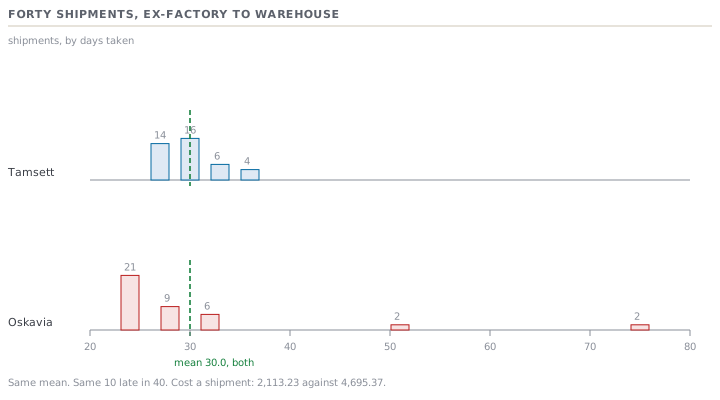
Here is the general form, and it is worth more than the numbers. The cost of the average delay is zero, and the average cost of the delay is not. A shipment that takes exactly the mean is never late and costs nothing. The entire bill lives in the shipments that are not the mean. Any cost that is flat up to a threshold and then rises behaves like this: air freight past a booking, a penalty past a date, a markdown past a selling week. Pricing it at the average always understates it, and the steeper the tail, the worse the understatement.
The improvement that bought nothing
In April, Almiraz shortened its make block from 23 to 17 days. It was real, it was measured over two quarters, and it came from a line rebalance and a second cutting shift. Nadia Ferrell sent Norforth the figures.
Norforth's on-time record from Oskavia did not move. Its booked lead time did not move either. By July, Almiraz believed the improvement had been ignored, and Norforth's planner believed Almiraz had not improved.
Both were reading the same fact and neither could see it. Norforth books to a service level, and a service level is set by the tail. Six days off the mean of the make block moved the mean of the pipeline. It left the two seventy-five-day shipments exactly where they were, so the date that has to be promised to a shop did not change. The six days went into the buffer and disappeared.
Now price the alternative. Suppose Almiraz had spent the same effort on the two worst shipments instead — the two that took 75 days — and brought them to 51, changing nothing else.
late-days across the forty      144  ->   96
cost a shipment            4,695.37  ->  3,480.25
saving a shipment                       1,215.12
saving a year, four drops               4,860.49
24 days removed from two shipments in forty beat 6 days removed from all forty. The make-block improvement moved 240 shipment-days and returned nothing on this measure. The tail repair moves 48 and returns 4,860.49 a year.
That is not an argument against improving production. It is an argument for knowing which block is binding before you spend the effort, and the binding block is almost never the one you control most easily.
Check yourselfYour factory has cut its production lead time by a week and the buyer has not shortened its booking. Is the buyer being unreasonable?Show the answer
Probably not. A booking is set so that most shipments land before the date, so it is decided by the spread rather than the average, and a week off the average leaves the worst case untouched. Two things fix it. Show the buyer the last twenty deliveries as a list, and let it see that the tail has narrowed as well as the mean — if it has. If it has not, the week is real and you cannot bank it, and the work worth doing next is on whatever produced the worst two.
The part of the grid that arrives as factory overhead
Almiraz recorded 41 hours of power failure last quarter and ran its generator through all of them, at 62.40 an hour in fuel and maintenance. That is 2,558.40 a quarter and 10,233.60 a year, or 0.1066 on every sweatshirt it makes.
It appears in the quotation as factory overhead. That is where the cost sits in Almiraz's accounts, and there is nowhere else honest to put it.
So a buyer comparing the overhead line of four quotations is comparing four electricity grids and does not know it. That is lesson 1's error, one layer down. Ferrand, in a place with a stable supply, carries none of that cost and looks like the better-run factory. It may also be the better-run factory. Nothing in a quotation separates the two, and only asking does.
What would have to change
Ports, roads, customs procedure and power are the rows with the longest horizons on the whole map, and the ones a factory can do least about. But the sort matters more than it looks, because the tail is not always the port.
Of Oskavia's four worst shipments in forty, Norforth's own file says two were a berth shortage and two were a document that reached the broker late. The first is public investment, measured in years. The second is a Tuesday afternoon, and it belongs to a person in a building with a name on it.
So before an origin's variance is written off as infrastructure, split the tail by cause. It is nearly always partly the country and partly somebody's process, and the second half is available now.