Lessons · Lesson 2 of 6
Does this place make its own cloth?
The deepest structural difference between apparel origins, what it does to price, days, minimum quantity and category, and why the nearest origin ended up with the longest pipeline.
Lesson 2 of 6 · 19 min
One question that answers four others
If you may ask an origin only one question, ask where its cloth starts.
The chain runs fibre, yarn, cloth, colour, garment. A place can join it at any point. Where it joins is not a small detail of the fabric price. It decides four things at once, and three of them never appear on a quotation:
- What the cloth costs at the factory gate, which is not the mill's price.
- How many days pass between ordering cloth and cutting it, which is usually the largest single block in the whole pipeline.
- The smallest quantity of one colour that can be bought, which decides how many colours a range may have.
- Which categories can be made there at all, which is lesson 5.
The same cloth, four gates
NRF-3160 takes 0.62 kg of brushed loop-back fleece. On 96,000 sweatshirts that is 59,520.0 kg of cloth a year. It is by a distance the largest line in the quote.
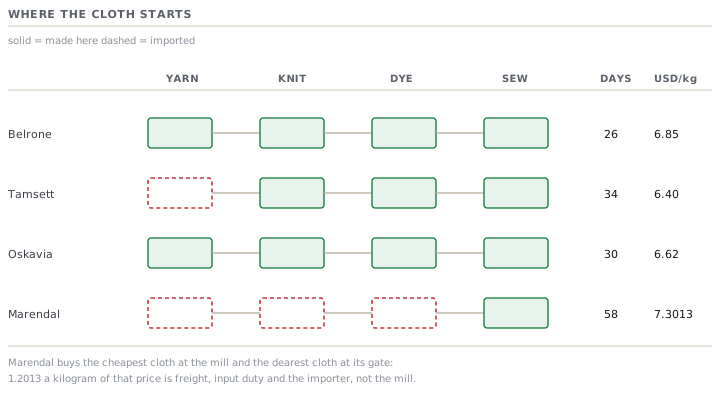
Belrone spins, knits, dyes and finishes inside the country. Tamsett knits and dyes locally from imported yarn. Oskavia knits and dyes locally from local yarn. Marendal has no knitting and no dyehouse, so its factories buy finished cloth abroad and import it.
Marendal's mill is the cheapest of the four. Watch what happens to it on the way in.
| Belrone | Tamsett | Oskavia | Marendal | |
|---|---|---|---|---|
| Price at the mill | 6.85 | 6.40 | 6.62 | 6.10 |
| Freight and clearing in | — | — | — | 0.46 |
| Input duty on cloth | — | — | — | 0.3936 |
| Importer's margin | — | — | — | 0.3477 |
| At the factory gate | 6.85 | 6.40 | 6.62 | 7.3013 |
| Cloth in one sweatshirt | 4.247 | 3.968 | 4.1044 | 4.5268 |
Marendal buys the cheapest cloth in the comparison and puts the dearest cloth into the garment. Its gate price is 0.9013 a kilogram above Tamsett's, which is 0.5588 on the sweatshirt. And 16.45% of what a Marendal factory pays for its fleece is not the mill's price at all. It is freight, an input duty and a trader who took the container risk.
That is the first structural fact about an origin with no textile base. It does not import a fabric price. It imports a fabric price plus a chain of charges that grow with it. A factory there cannot negotiate them away, because none of them belongs to the factory.
The days are bigger than the money
| Stage, days | Belrone | Tamsett | Oskavia | Marendal |
|---|---|---|---|---|
| Cloth ordered to cloth in the store | 26 | 34 | 30 | 58 |
| Cut, make, trim, finish | 24 | 21 | 23 | 19 |
| Ex-factory to warehouse | 27 | 30 | 30 | 9 |
| Total pipeline | 77 | 85 | 83 | 86 |
Norforth added Marendal to its base for one reason, and the reason was true. 9 days from the factory door to the warehouse, against 27 from Belrone. Marendal is also the fastest of the four at making, at 19 days.
And it has the longest pipeline of the four.
Nothing in that sentence is a mistake by anybody. The transit really is nine days. The sewing really is the quickest. The failure is that the comparison started where the cloth arrives, because that is where a factory's own lead-time quote begins. And in Marendal the cloth has to cross a border before it can start.
The mistake nobody made
Reconstruct it and there is no bad decision in it.
Ivo Halvard, Norforth's sourcing merchandiser, asked all four origins for a production lead time. He got four honest answers. None of them included buying cloth, because a factory quoting production lead time is quoting production. He asked for transit times and got four honest answers. He added them, correctly. He proposed Marendal for the drops that need to be latest. Rina approved it, correctly, on the arithmetic in front of her.
The cloth line was not left out through carelessness. It was left out because the question "how long is your lead time" is answered from the cut, in every factory in the world. The two origins where that habit is harmless are the two that make their own cloth.
The second bill nobody adds
Marendal's freight advantage on finished goods is real: 0.24 a sweatshirt against Belrone's 0.42.
But the cloth travelled too. At 0.46 a kilogram and 0.62 kg a garment, bringing the fleece into Marendal costs 0.2852 a sweatshirt. So the total freight bill on a Marendal sweatshirt is 0.5252, against Belrone's 0.42. The near origin pays 0.1052 a garment more to move things than the far one does.
A garment made where the cloth is made crosses the water once. A garment made where the cloth is not made crosses it twice. The second crossing is invisible, because it happens before the order exists.
The smallest colour decides the range
NRF-3160 runs in four colours: charcoal 42%, navy 27%, ecru 19%, moss 12%. On four drops a year the moss shade needs 1,785.6 kg of fleece a drop.
The minimum a supplier will run for one shade: Belrone 500 kg, Oskavia 900 kg, Tamsett 1,200 kg, Marendal 2,500 kg. And Marendal's is not a machine minimum at all. It is a lot size, because an importer buys rolls by the container, and nobody will break one for a quarter of an order.
So a Marendal factory buys the whole year of moss at once: 7,142.4 kg, worth 52,148.81, drawn down over four drops. Averaged across the year that is 32,593.00 of cloth financed at the factory's own 11.5%, which is 3,748.20 a year. That is 0.3254 on every moss sweatshirt, and nothing on the other three colours.
The consequence is not the money. It is that an origin with no mill has a coarser grain. A range with eight colours, or a mid-season shade change, is a different proposition there than in Belrone. Course 26.1 lesson 5 shows what happens when a volume split walks a shade under a mill's minimum. This is the same cliff, sitting at a different height in every origin, before anybody splits anything.
Check yourselfA factory in an origin with no textile base tells you it can beat the incumbent's fabric price. What do you ask?Show the answer
Where the cloth is made, what it costs at the mill, and what is added between the mill and its own gate: freight, clearing, input duty, and whoever carried it. Then ask for the fabric lead time measured from the day it orders, not from the day the roll lands. The price may well be true, and it is the smaller half. The four charges are usually the part nobody can negotiate. The days are the part that decides whether the factory can take a repeat at all.
What would have to change
This is the row on a sourcing map with the longest horizon and the largest effect. That is an uncomfortable combination.
A dyehouse and finishing line is capital and years, not a decision. A spinning mill is more of both. And the order matters. Dyeing and finishing usually arrive before weaving or knitting, because colour is what the buyer reacts to and finishing is where the lead time hides. An origin that gains one dyehouse can shorten every knit programme in the country by weeks, without owning a single knitting machine.
Lesson 5 puts numbers on what it takes to start that, and finds the reason it so rarely starts.