Lessons · Lesson 1 of 6
A comparison has three units, and only one of them is a country
Why a country ranking can be almost right and still decide nothing, and the ten-second test that sorts every row of a comparison into the unit it belongs to.
Lesson 1 of 6 · 19 min
The sheet everybody builds first
Norforth sells mid-market jersey and shirting into one market, Ambernay. In February its head of sourcing, Rina Solheim, asked for something reasonable. She wanted a standing view of the origins Norforth buys from, so the same argument would not start from scratch every season.
Her team built it properly. Eight rows. Weights agreed in a meeting. Each origin scored out of five, and every score researched and referenced. Four origins: Belrone, Tamsett, Oskavia and Marendal.
| Row | Weight | Belrone | Tamsett | Oskavia | Marendal |
|---|---|---|---|---|---|
| Duty treatment into Ambernay | 20 | 5 | 2 | 2 | 5 |
| Currency and banking | 10 | 4 | 2 | 3 | 4 |
| Export procedure | 5 | 4 | 3 | 3 | 4 |
| Labour cost | 20 | 2 | 5 | 4 | 2 |
| Fabric availability | 15 | 5 | 3 | 4 | 1 |
| Port and inland | 10 | 4 | 3 | 2 | 5 |
| Quality reputation | 15 | 5 | 2 | 3 | 4 |
| Lead time | 5 | 3 | 2 | 3 | 5 |
| Weighted score | 81.0% | 58.0% | 61.0% | 70.0% |
Belrone first, Marendal second, Oskavia third, Tamsett fourth. Nobody argued with it. Nobody should have. The research behind every cell was sound.
Then the quotes came in
Norforth sent one style to twenty-four factories, six in each origin. NRF-3160 is a loop-back sweatshirt in brushed cotton fleece, 96,000 units a year in four drops. Same tech pack — the document that specifies the garment — same quantity, same terms. Each factory quoted FOB its own port. FOB is the price with the goods loaded on the ship; the buyer pays for everything after that.
Now land them. Ambernay charges 11.0% duty on the FOB value of goods from Tamsett and Oskavia. It charges nothing on Belrone or Marendal, which hold access under agreements Norforth did not negotiate. Freight and insurance on a sweatshirt: 0.42 from Belrone, 0.61 from Tamsett, 0.55 from Oskavia, 0.24 from Marendal.
| Belrone | Tamsett | Oskavia | Marendal | |
|---|---|---|---|---|
| Cheapest of the six | 9.52 | 9.6565 | 10.096 | 9.94 |
| Median of the six | 10.145 | 10.7388 | 10.9285 | 10.665 |
| Dearest of the six | 11.47 | 12.376 | 12.649 | 12.04 |
| Spread inside the origin | 1.95 | 2.7195 | 2.553 | 2.10 |
Rank the medians and you get Belrone, Marendal, Tamsett, Oskavia. The scorecard said Belrone, Marendal, Oskavia, Tamsett.
It got the top two right and swapped the bottom two. For a document built from eight researched rows and a committee's weights, that is a good result. It is also worth almost nothing. And the reason is not that the scorecard was wrong.
The number that ends the argument
Look at the last two rows of that table together.
The whole distance between the best origin's median and the worst origin's median is 0.7835 a sweatshirt. The average distance between the best and the worst factory inside one origin is 2.3306.
The spread inside an origin is 2.97 times the spread between the origins. On 96,000 units a year, picking the right origin is worth 75,216.00. Picking the right factory inside it is worth 223,740.00.
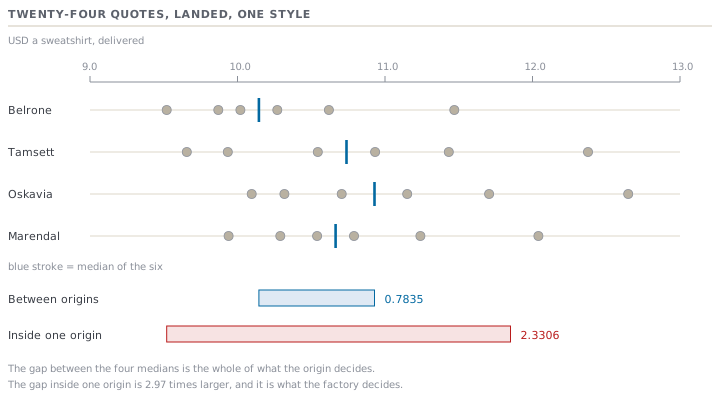
The extremes are blunter still. The best factory in Tamsett — the origin the scorecard ranked last — lands at 9.6565. The worst factory in Belrone — the origin it ranked first — lands at 11.47. That gap is 1.8135. It is 2.31 times the entire distance between the best and worst origin.
So the scorecard described the medians fairly. And a median is not a thing you can buy. You buy one factory. Choosing Belrone changes the odds. It does not choose a cost.
Check yourselfIf the country ranking is nearly right, what exactly is wrong with using it?Show the answer
Nothing is wrong with it as a description. The error is in what it is asked to do. A ranking of medians tells you which group has the better centre. A purchase order goes to one member of that group, and the members are spread nearly three times as widely as the centres are. So the ranking answers "where should we go looking?" It never answers "where should this order go?" Course 26.1 owns the second question and answers it order by order.
Where the score actually went wrong
Sort the eight rows by one question: would this number be the same for all six factories we quoted in that origin?
- Duty treatment. Identical for all six. It is a fact about the origin and the destination, and no factory can move it.
- Currency and banking. Identical for all six.
- Export procedure. Identical for all six.
- Labour cost. Not identical. Two of Tamsett's six are in the capital and four are four hours away. Their wage bills and their staff turnover are not the same number.
- Fabric availability. Not identical. One of Oskavia's six sits inside a knitting district. Two are three hundred kilometres from the nearest dyehouse.
- Port and inland. Not identical. An origin can have two ports and one good road.
- Quality reputation. Not identical. It is not even a property of a place. It is a property of a management.
- Lead time. Not identical, for all of the reasons above at once.
Three rows are country facts. Five are not. And the five carry 65 of the 100 weight points.
65% of the score was a country average of something that is not a country fact. That is the defect. It survives any amount of careful research, because each of those cells was researched correctly — as an average.
The three units
Every row in an origin comparison belongs to exactly one of three units. The unit decides what the row can be used for.
- Country. Duty treatment and agreement membership. The currency, and whether it converts. The legal working week and the public-holiday calendar. The export procedure and its documents. The law the contract sits under. These are the same for every factory in the country, whatever else differs.
- Cluster. The cloth within reach. The trim market. The operator pool of a town, and how fast it turns over. The port and the road to it. The reliability of the power. The machine-repair trade. This is the unit almost nobody uses, and it decides the most. It varies enormously inside one country. It also runs across borders: two towns either side of a frontier can share a labour market and a dyehouse while sharing no duty rate at all.
- Factory. Efficiency. The standard minutes this plant needs for this garment. The on-time record. Minimum quantity. Development capability. The terms it can offer, and what its bank charges it.
This cuts across a sort you may already know. Course 26.6 sorts a factory's position into what a government granted, what a location gave and what the factory built. That is a sort by who can change it. The three units here sort by what the number is a fact about. They are not the same cut, and you need both. A duty rate is granted, and country-level. A dyehouse forty minutes away is given, and cluster-level. Efficiency is built, and factory-level — except for the part of it that is not, which is lesson 3.
What this course is for
The rest of these lessons build the standing map Rina actually wanted. They build it row by row, at the right unit.
- Lesson 2 takes the deepest cluster row there is: whether the place makes its own cloth.
- Lesson 3 takes labour as a market rather than a wage, and finds a large piece of "efficiency" that is not a factory attribute.
- Lesson 4 takes infrastructure, and shows that the number you need is the spread and not the average.
- Lesson 5 explains why category specialisations form in particular places, why they are so hard to move, and what starting one costs.
- Lesson 6 puts it on one page, with a date, an evidence class and a horizon against every row.
Prompt · Sort my origin comparison into its three units
When somebody hands you a country scorecard, or when you are about to build one.
Act as a sourcing analyst. I will give you the rows of an origin comparison and you will sort each one, and you will not add any number of your own. My comparison: the origins under consideration [LIST], the product [CATEGORY], the destination market [MARKET], and my rows with their weights and scores [PASTE THE ROWS]. For every row do five things. First, classify it COUNTRY, CLUSTER or FACTORY using this test: would two factories four hundred kilometres apart in the same country have the same number (COUNTRY), would two factories on the same street have the same number but not two four hundred kilometres apart (CLUSTER), or neither (FACTORY). Second, say where the number would have had to come from to be true at that unit, and whether the number I have gave you can be that. Third, add up the weight sitting on rows that are not COUNTRY rows and tell me that total as a percentage — that is the share of my score that is a country average of something that is not a country fact. Fourth, for every CLUSTER and FACTORY row, write the question I should be asking a named factory instead of the question I asked a country. Fifth, list any row where I have no evidence at all and mark it UNKNOWN rather than guessing. Do not use any market share, average wage, factory count, export value or growth rate for any country, even one you are confident of, and if I have used one, say so and tell me what to replace it with.
AI can make mistakes — check anything you act on.