Lessons · Lesson 4 of 6
Correct at every step, and wrong for two seasons
Follow a sensible move from CMT to FOB into two losing seasons, and find the one number that predicted it in advance.
Lesson 4 of 6 · 20 min
Five decisions, and nothing wrong with any of them
Nabhani took Brindlecote's FOB order in March 2026. Here is every decision that led there, with the person who made it and the reason they were right.
- The commercial manager costed it properly. Margin per line-day, after the cost of the money: USD 210.44 for FOB against USD 169.38 for CMT. That is 24.2% better. He did the arithmetic from lesson 2 instead of looking at the revenue. Almost nobody does that, and he did.
- The general manager accepted a nominated mill. Brindlecote had bought from Sarikaya for six years. It had the shade continuity and it had the price. Refusing a mill the buyer has used successfully for six years, on your first order, is not a serious negotiating position.
- The finance director arranged the facility before signing. USD 450,000.00, agreed on the strength of the contract, and in place before the fabric deposit went out. He also turned down a third FOB customer that summer, because the facility was already committed. That was exactly right.
- Nobody built a fabric laboratory. For eleven CMT years, cloth arriving out of specification had been Vaudreuil's problem and had never once cost Nabhani money. There was no evidence in the building that a laboratory was needed. And a light box, a shade file and an inspector are a fixed cost, set against a single order.
- The FOB price was fixed in November for a February purchase. That is how the trade quotes. That is what Brindlecote's range planning requires. Every competing quotation was on the same basis.
Five decisions. Each one defensible in the room on the day. Two losing seasons.
Autumn 2026
The order shipped complete and on time. The cost sheet said it would earn USD 43,872.00, which is USD 0.914 a piece on 48,000 pieces.
The cost of the money: USD 22,828.34. Known in advance, calculated in lesson 2, and a surprise to nobody.
The shade band: USD 7,276.00. Sarikaya delivered 4,410 metres outside the approved band. Nabhani found it after cutting had started, because it had no inspection to find it before. It could not separate the bad cloth from the good: the off-standard rolls had already been laid across the same markers as the good ones, so the variation was spread piece to piece instead of staying inside one batch. Brindlecote accepted the delivery with an allowance of USD 0.34 a piece on the 21,400 pieces in that shipment. This is the part factories keep underestimating. A fabric fault does not stay inside the fabric it came from.
Air freight: USD 11,900.00. Nabhani rejected 1,600 metres outright and Sarikaya replaced them by air, at USD 4,780.00. Then 3,900 finished pieces went to Brindlecote's distribution centre by air, at USD 7,120.00, to hold a launch date.
Overtime: USD 9,340.00. The mill was nineteen days late. Under CMT that delay would have pushed the ship date and been Vaudreuil's problem. Under FOB the ship date was in Nabhani's contract, so the sewing window got shorter and the factory bought the difference in Saturdays and evenings.
| USD | |
|---|---|
| Margin on the cost sheet | 43,872.00 |
| Cost of the money | -22,828.34 |
| Shade allowance | -7,276.00 |
| Air freight | -11,900.00 |
| Overtime on a shortened window | -9,340.00 |
| Result | -7,472.34 |
| The same line-days, as CMT | 16,938.26 |
| Swing | -24,410.60 |
Spring 2027
Nabhani fixed the thing that had gone wrong. That is the part that makes this lesson worth reading.
It hired a fabric inspector, bought a light box and built a four-point inspection table. The running cost is USD 0.06 a metre, which on 52,000 pieces is USD 4,742.40. It was the right decision and it worked: not one shade claim.
Then the other risk arrived. Nobody had thought about it, because under CMT it had never existed.
Nabhani quoted Brindlecote's spring FOB in November at the same USD 10.05. It bought the cloth in February. Between those two dates, Sarikaya's price for the same twill moved from USD 4.35 to USD 4.78 a metre.
At 1.52 metres a piece, that is USD 0.6536 more per garment. On 52,000 pieces it is USD 33,987.20, against a costed margin of USD 47,528.00.
| USD | |
|---|---|
| Margin on the cost sheet | 47,528.00 |
| Cost of the money | -24,730.70 |
| Fabric inspection | -4,742.40 |
| Fabric price above the quotation | -33,987.20 |
| Result | -15,932.30 |
| The same line-days, as CMT | 18,349.79 |
| Swing | -34,282.08 |
Two seasons together: USD -23,404.63. The same line-days sold as CMT would have earned USD 35,288.05. The move cost USD 58,692.68 over two seasons, and every decision that produced it was defensible.
The number that said so in March
Now the part that makes this arithmetic rather than bad luck.
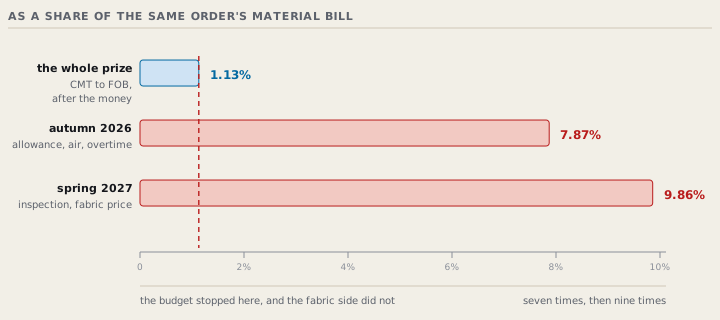
The whole prize for moving from CMT to FOB was USD 0.0855 a piece, the difference between USD 0.4384 and USD 0.3529. The material bill Nabhani took onto its own books to earn it was USD 7.552 a piece.
Divide one by the other. The FOB premium is 1.13% of the material bill.
That is the whole finding of this course in one number. Nabhani was being paid 1.13% of the value of the cloth to buy it, hold it, finance it, inspect it, insure it, chase it, claim against it and be wrong about its price. Every fabric-side cost, of every kind, forever, had to fit inside 1.13%.
Then measure what actually turned up.
- Autumn 2026's fabric-side costs — the allowance, the air freight and the overtime — were USD 28,516.00. That is 7.87% of that season's material bill.
- Spring 2027's — the inspection and the price move — were USD 38,729.60. That is 9.86%.
Seven times the budget, then nine times the budget.
There is a second way to say the same thing, and it is the one to keep in your head. USD 0.0855 a piece over 1.52 metres is USD 0.0563 a metre, on cloth at USD 4.35. A 1.29% move in the fabric price, in either direction and from any cause, is the entire prize. A cotton market that does not move by more than 1.29% between a November quotation and a February purchase is not a cotton market anybody has seen.
What changed that was not on any sheet
There is a quieter change underneath the two seasons. It is worth naming, because it is permanent.
Under CMT, Nabhani paid its bills out of what Nabhani earned. Wages went out, invoices came in, and the gap was weeks. Under FOB, a large bill is paid by rolling a bank facility and repaying it out of one buyer's single payment, months later. Economists separate exactly these two positions: does a business cover its commitments from its own cash flow, or must it refinance to stay solvent? The difference is not a matter of degree. It is a change of kind, and it happened on the day the model changed — before anything went wrong, and whether or not anything did.
That is why the facility question in lesson 3 is not a detail of the deal. It is the deal.
What Nabhani should have done
Not "refused". Four repairs, in order of how easy they are to get.
- Ask the mill for a quotation valid to the same date as your FOB quotation. Sarikaya would probably have held the price for a firm order and a deposit. Nobody asked, because under CMT nobody had ever needed to.
- Put a fabric price band in the FOB. A clause that reopens the price if the mill's price moves by more than an agreed percentage. Course 16.4 is how to ask for it. The point here is knowing that 1.13% is what makes it worth asking.
- Build the inspection before the first order, not after the first claim. It cost USD 0.06 a metre and it was the cheapest line in either season.
- Or take the fabric handling without the fabric ownership. The buyer keeps the invoice. The factory manages the mill, the inspection and the calendar for a fee. All of the control, none of the balance sheet. Buyers offer this more often than factories ask for it.
Prompt · Work out my budget for owning the fabric
Before you answer a buyer who has asked you to quote FOB (you buy the fabric and sell a finished garment) on a mill she named herself.
Act as a sourcing director who has watched factories lose money moving from CMT to FOB. Work out what I am really being paid to own the cloth, and what has to fit inside that payment. My CMT price for this garment is [AMOUNT] a piece and my CMT cost is [AMOUNT]. My proposed FOB price is [AMOUNT]. My FOB cost splits into materials [AMOUNT], conversion [AMOUNT] and other direct costs [AMOUNT]. Fabric use [METRES] a piece at [PRICE] a metre. I pay the mill on [TERMS] and the buyer pays me on [TERMS], with the date of each movement if I have it. My facility rate is [PERCENT] a year. The mill is [DISTANCE AND COUNTRY]. It was [NAMED BY THE BUYER OR CHOSEN BY ME]. I will buy [AMOUNT] a year from it and the buyer buys [AMOUNT OR UNKNOWN]. My fabric inspection today is [DESCRIBE, OR SAY I HAVE NONE]. Now do six things. First, give me the margin per piece under both models after the cost of the money, and the difference between the two. Second, show that difference as a percentage of my material cost per piece, and as the move in the fabric price that would wipe it out. State both numbers plainly. Third, list every obligation that arrives with the fabric invoice: quality, delivery, price, quantity, currency. For each one, estimate in money what a single bad event would cost me on this order. Fourth, compare that total with the budget from step two and give me the ratio. Fifth, use the two yearly purchase figures to tell me what my pull with that mill is worth next to the buyer's. Sixth, give me the three contract changes that would make this deal safe, in the order I should ask for them, and say which one I should turn the order down over. Be blunt if the budget is smaller than one ordinary season's noise.
AI can make mistakes — check anything you act on.
Check yourselfYour FOB premium after the cost of the money works out at 4.8% of your material bill, and your mill is in the next town. Does the same conclusion apply?Show the answer
No, and both halves of that sentence are doing work. A budget of 4.8% is four times Nabhani's. That is enough to absorb an ordinary claim, an ordinary inspection cost and a modest price move. A mill in the next town also cuts the size of every one of those events: a shade problem is a visit, a re-dye takes days, a claim is settled by somebody who wants next year's orders. Here the budget goes up and the exposure goes down, and that is exactly the case where FOB really is the better model. The lesson is not "FOB is bad". The lesson is that the answer is a division, and you have to do it.
What to take away
- A chain of defensible decisions can still produce two losing seasons. Test the decision, not the decision-makers.
- The FOB premium as a percentage of your material bill is the one number that decides the model. For Nabhani it was 1.13%, and the fabric side came in at 7.87% and 9.86%.
- A fabric fault does not stay inside the fabric. Off-standard cloth laid across the same markers put an allowance on 21,400 pieces, not on the 4,410 metres.
- Fixing last season's risk does not fix the model. Nabhani fixed quality and lost more money to price, because both were bought with the same 1.13%.
- Moving to FOB changes the character of your finance, not only the amount. Bills that used to be paid out of operations are now paid by rolling a facility. That change is permanent, and it happens on day one.