Lessons · Lesson 2 of 6
The same order, costed four ways
Cost one garment under all four models, down to a margin per line-day after the cost of the money, and watch the two rankings disagree.
Lesson 2 of 6 · 20 min
One garment, four columns
The general manager gives the merchandiser a week and one instruction: cost CN-5140 four ways, and bring me one number I can compare.
That last part is the hard part. The obvious number is useless.
Margin percentage cannot compare CMT against FOB, because the two are percentages of very different things. Margin per piece cannot compare a seasonal order against a year-round programme. What Nabhani is really short of is line-days. It has eight lines and twenty-six working days a month, and the order book is never quite full. A line-day is one sewing line running for one day, and it is the thing the factory cannot make more of.
So the number to compare is margin per line-day. Everything in this lesson walks towards it.
The manufacturing, which is the same in all four columns
Style CN-5140, a men's cotton-elastane chino. The sewing does not care which model is written on the purchase order.
- Standard minutes: 24.5 a piece. Standard minutes are the work content of the garment — how long it takes to sew at a normal pace.
- Nabhani's rates: direct labour USD 0.0300 a standard minute, factory overhead USD 0.0220 a standard minute. Together that is USD 0.052 a minute, so USD 1.274 a piece. This is the conversion cost: the cost of turning cloth into a garment.
- Other direct costs — finishing, packing, inland carriage to Rades, testing: USD 0.31 a piece.
- Standard minutes a line earns in a day: 11,760. On a 24.5 minute garment that is 480 pieces a line-day.
Materials, when Nabhani buys them: fabric at 1.52 metres a piece from Sarikaya at USD 4.35 a metre, so USD 6.612. Trims USD 0.94. Materials USD 7.552 a piece.
The four offers on the table
CMT — Vaudreuil, 48,000 pieces. Eleven years of it. Price USD 1.98 a piece against a cost of USD 1.584. Margin USD 0.396, which is 20.00%. That is the best percentage in this lesson and, as it turns out, the worst answer.
FOB — Brindlecote, 48,000 pieces. Price USD 10.05 against a cost of USD 9.136. Margin USD 0.914, which is 9.09%.
ODM — Halstrom, 14,000 pieces. A Nordic outdoor brand that buys what it is shown. Price USD 11.40. Nabhani's studio developed 34 offers this season at USD 3,180.00 each. Halstrom and two other buyers adopted 6 of them. So every adopted style has to carry the development cost of the ones nobody bought: USD 108,120.00 spread over 6 styles at 14,000 pieces each is USD 1.2871 a piece. Cost USD 10.4231, margin USD 0.9769, which is 8.57%. Lesson 5 is about that load and how sensitive it is.
Private label — Pellworth, a forecast of 180,000 a year. A German discount chain, its own brand on the label, repeat orders every month. Price USD 9.98. At that volume the fabric comes on a contract at USD 4.12 a metre and the trims at USD 0.86, so materials are USD 7.1224. After the second repeat the operators know the garment, so standard minutes fall to 22.8 and a line earns 12,540 minutes a day. Conversion is then USD 1.1856 and the line makes 550 pieces a day. Other direct costs USD 0.29. Cost USD 8.598, margin USD 1.382, which is 13.85%.
Stop there and the ladder is already broken. By margin percentage the order is CMT, then private label, then FOB, then ODM. The model everybody calls the bottom rung has more than twice the percentage of the model everybody calls the top one. And the model the trade treats as the destination comes last.
Then charge each model for its money
None of those four margins is real yet. Each model asks the factory to lay out a different amount of cash, for a different length of time. Nabhani's overdraft facility with its bank costs 13.8% a year. That rate is Nabhani's own. It is used here as an illustration, not as a market figure.
The rule is one line: money out, times days out, times the rate.
CMT. Nabhani funds only its own conversion and other direct costs — USD 76,032.00 on this order — from the average date it spends the money to the day Vaudreuil pays, forty-five days after the bill of lading. That is 72 days on average. Cost: USD 2,069.74, or USD 0.0431 a piece.
FOB. Now the cloth is Nabhani's. Sarikaya takes 30% with the order and the rest against its shipping documents. Brindlecote pays sixty days after the bill of lading.
- Deposit USD 95,212.80, out for 188 days.
- Balance USD 222,163.20, out for 133 days.
- Trims USD 45,120.00, out for 140 days.
- Conversion and other direct costs USD 76,032.00, out for 87 days.
Multiply each amount by its days and add them up: 60,379,296.00 dollar-days. At 13.8% that is USD 22,828.34, or USD 0.4756 a piece. Eleven times the CMT figure. It eats slightly more than half the extra margin the move was supposed to earn.
ODM. The same materials, plus the development spending itself, which goes out an average of 210 days before any of it comes back. That adds USD 0.1022 a piece, so USD 0.5778.
Private label. Steady repeat business shortens everything. Fabric is called off monthly against a contract, and the cycle runs about 96 days on the full cost. That is USD 0.3121 a piece. But a programme carries two costs an order does not. First, a full-time technologist and the annual audits: USD 46,400.00 between them. Second, a safety stock of 12% of the forecast — 21,600 pieces sitting in Nabhani's warehouse at Nabhani's expense. Together, USD 0.4382 a piece. Lesson 6 is about what else that programme carries.
The table the general manager asked for
| USD a piece | CMT | FOB | ODM | Private label |
|---|---|---|---|---|
| Price | 1.98 | 10.05 | 11.40 | 9.98 |
| Materials | — | 7.552 | 7.552 | 7.1224 |
| Conversion | 1.274 | 1.274 | 1.274 | 1.1856 |
| Other direct | 0.31 | 0.31 | 0.31 | 0.29 |
| Development load | — | — | 1.2871 | — |
| Cost | 1.584 | 9.136 | 10.4231 | 8.598 |
| Margin on the sheet | 0.396 | 0.914 | 0.9769 | 1.382 |
| Margin percentage | 20.00% | 9.09% | 8.57% | 13.85% |
| Cost of the money | 0.0431 | 0.4756 | 0.5778 | 0.3121 |
| Programme overhead | — | — | — | 0.4382 |
| Margin after both | 0.3529 | 0.4384 | 0.3991 | 0.6318 |
| Pieces a line-day | 480 | 480 | 480 | 550 |
| Revenue a line-day | 950.40 | 4,824.00 | 5,472.00 | 5,489.00 |
| Margin a line-day | 169.38 | 210.44 | 191.55 | 347.47 |
What the bottom row says
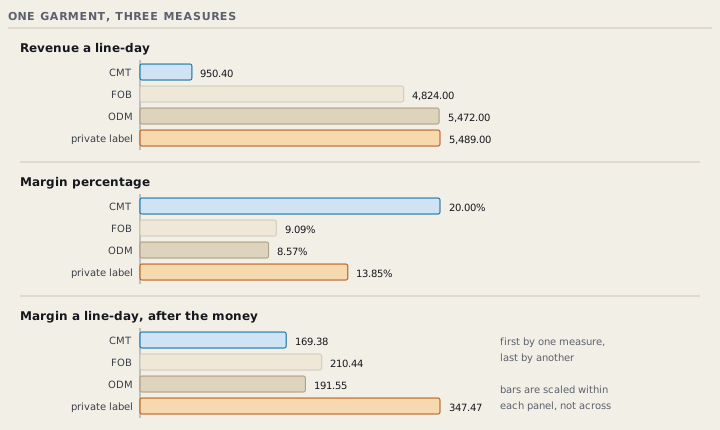
Moving from CMT to FOB does not raise the margin. It raises the revenue. Revenue a line-day goes from USD 950.40 to USD 4,824.00, a factor of 5.08. Margin percentage falls from 20.00% to 9.09%, well under half. And margin a line-day rises from USD 169.38 to USD 210.44 — 24.2%.
That last number is the honest answer to "should we take FOB?". It is much smaller than the revenue figure and much larger than the percentage figure. Both of the numbers a factory usually looks at are misleading, in opposite directions.
Now read the columns against each other:
- By margin percentage: CMT, private label, FOB, ODM.
- By margin a line-day: private label, FOB, ODM, CMT.
Nothing is in the same place except FOB. CMT is first by one measure and last by the other. The rankings are not a ladder in either direction. Any sentence beginning "we are moving up to…" describes a picture that does not exist in this table.
Why the boundary sits where it sits
There is an older question underneath all this, and it is not a garment question. Deciding whether to buy the fabric yourself, or have somebody hand it to you, is a decision about where your firm stops. Firms exist at all because using the market has costs of its own: finding the supplier, agreeing the terms, policing the contract, arguing about the fault.
That is the useful way to read the table above. Every column moves work across the boundary of the firm, and every move has a price on both sides. When Brindlecote pushes fabric buying down to Nabhani, it is not giving Nabhani an opportunity. It has decided that doing that job itself, for forty suppliers, costs more than paying somebody else to do it badly. Whether it is an opportunity depends entirely on whether Nabhani can do it well. That is lesson 3.
Check yourselfA colleague argues that the private-label column proves Nabhani should chase programme business and drop CMT. Using only this lesson's table, what is wrong with that conclusion?Show the answer
The table compares margins per line-day, and it compares them under an assumption nobody has tested: that every line-day is sold. Private label's advantage comes from volume, contract fabric and a line that has learned the garment. All three need the programme to actually run at the forecast volume, and none of the four columns has yet been charged for the risk that it will not. CMT is last by this measure and carries almost no risk, which is exactly why a factory with no balance sheet keeps doing it. The conclusion the table really supports is narrower and more useful: measure in line-days, and never compare two models by percentage.
What to take away
- Compare models in margin per line-day. Never in margin percentage, and never in revenue. Percentage and revenue have different denominators in every column.
- Moving from CMT to FOB here multiplied revenue by 5.08, cut margin percentage by more than half, and improved margin a line-day by 24.2%. All three statements are true about the same decision.
- Charge every model for its own money. The cost of the cash went from USD 0.0431 to USD 0.4756 a piece between two columns — more than half of the extra margin FOB was supposed to deliver.
- The four models rank differently on every measure you choose. There is no ladder. A factory that believes there is one will keep climbing past its own best column.
- Every number here is before risk. A margin per line-day that has not been charged for the model's own risk is a quotation, not a result.