Lessons · Lesson 1 of 6
Five questions, not four labels
Define a business model by the obligations it moves, not by its name. And see why a factory's revenue can multiply without one extra garment being made.
Lesson 1 of 6 · 18 min
The question in the room
It is Wednesday 4 March 2026, in the sample room at Nabhani Confection in Menzel Jamil, twenty minutes south of Bizerte. Eight sewing lines. Three hundred and forty people. Eleven years of work for the French workwear brand Vaudreuil, who send the cloth and take the garments away.
That arrangement has a name: CMT, cut-make-trim. The buyer supplies the fabric. The factory cuts it, sews it, finishes it, and charges for the work.
Across the table sits the sourcing director of Brindlecote, a British mid-market chain. It has been buying chinos from Turkey and wants a second supplier. She asks one question: would you quote this on an FOB basis?
In the trade, FOB means the factory buys the materials itself and sells a finished garment.
The general manager's first thought — and it is everybody's first thought — is that this is an offer to move up a step. CMT is where you start. FOB is where you get to. ODM is where the good factories end up: the factory designs the garment itself and offers it to buyers. Private label is the top rung: the retailer's own brand name goes on the label. That picture is wrong, and being wrong costs money. This course takes it apart.
Start with the words. The four words are not four rungs. They are four different answers to five separate questions. And a factory can answer those questions in almost any combination.
The five questions
Forget the labels for a moment. Every deal between a factory and a buyer settles these five questions, one at a time. The answers are what you are really agreeing to.
- Who pays for the cloth, and out of whose money? Not who is billed in the end. Who writes the cheque to the mill, on which date, and whose bank balance is smaller afterwards.
- Who chose it? Who picked the mill, who approved the shade and the handle, who agreed the price per metre, and who agreed the delivery date.
- Who carries a fault in it? Six rolls arrive outside the approved band. Whose loss is that? Who holds the contract with the mill? Who has to explain the late ship date?
- Whose design is it? Who drew it, who paid to develop it, and who may sell it to somebody else next season.
- Whose name is on the label? Which brand the shopper sees, and who answers to the regulator if the garment is recalled.
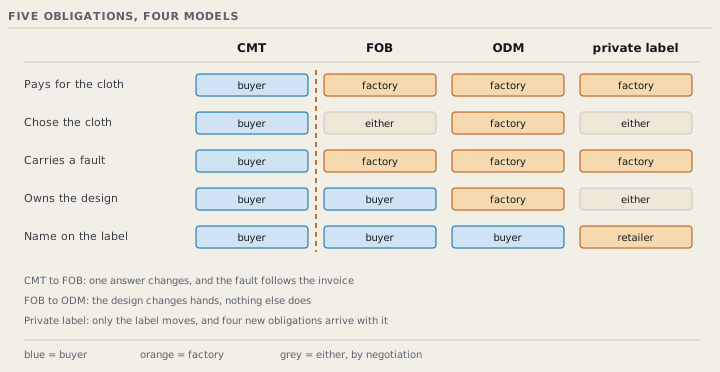
| CMT | FOB | ODM | Private label | |
|---|---|---|---|---|
| Pays for the cloth | buyer | factory | factory | factory |
| Chose the cloth | buyer | either | factory | either |
| Carries a fabric fault | buyer | factory | factory | factory |
| Owns the design | buyer | buyer | factory | either |
| Name on the label | buyer | buyer | buyer | retailer |
Read the table down the columns and the ladder disappears. Between CMT and FOB, exactly two answers change: who pays, and who carries the fault. The second follows from the first. Between FOB and ODM, one answer changes, and it is a completely different one: the design. Private label changes none of the first four. It changes the fifth. It is not further along the same road. It is a turning off it.
The word that means two things
One piece of housekeeping first. It catches every merchandiser in their first year.
The trade's FOB and the Incoterms rule called FOB are not the same thing. Incoterms are the delivery rules published by the International Chamber of Commerce. The rule called FOB is a sea-freight delivery term. It says where risk in the goods passes from seller to buyer. It says nothing at all about who bought the fabric.
The trade's "FOB" is a business model: the factory buys the materials and sells a finished garment. The two travel together so often that the words have merged. But they can come apart. A factory can sell CMT work on FOB delivery terms, and does, whenever the buyer's own fabric is made into garments the buyer collects at the port.
Course 8.3 covers the Incoterms rules and what each one moves. Here it is enough to know this: when a buyer says FOB, ask which of the two she means. The answer is usually both at once.
Nominated FOB, which is neither
Now look at what Brindlecote is really offering. It has a name in the trade: nominated FOB.
Brindlecote will not let Nabhani choose the mill. It has bought this twill from Sarikaya Tekstil in Turkey for six years. It has a price agreed with Sarikaya, based on its own yearly volume. It will hand Nabhani that mill, that quality and that price. What Nabhani gets is question one: it pays.
Go back to the five questions and mark what has actually moved:
- Who pays for the cloth: moved to the factory.
- Who chose it: did not move. Brindlecote picked the mill, approved the quality and set the price.
- Who carries a fault: moved to the factory, because the invoice is in Nabhani's name.
- Whose design: did not move.
- Whose label: did not move.
One decision moved, and one liability moved with it. Nabhani has been given the fabric's bills and none of the fabric's authority. Lesson 3 is about what that costs. It is not obvious, and it is not small.
Name it plainly rather than complain about it. Nominated FOB is legitimate and very common, and the buyer has good reasons to want it. It keeps the mill relationship and the shade continuity the buyer spent years building. And it moves a large lump of working capital — the cash tied up between paying suppliers and being paid — off the buyer's books. It is a financing arrangement wearing a sourcing name. There is nothing dishonest in it, as long as both sides know that is what it is.
Why the revenue quintuples and nothing changes on the floor
Here is the number that makes factory owners say yes before they have finished the arithmetic.
Nabhani's CMT price to Vaudreuil for a similar garment is USD 1.98 a piece. Brindlecote's FOB price for style CN-5140, a men's cotton-elastane chino, will be USD 10.05. The order is 48,000 pieces.
- As CMT, that order is revenue of USD 95,040.00.
- As FOB, the same order, the same garment, the same operators, the same eight lines, is revenue of USD 482,400.00.
A factor of 5.08, and not one extra garment. The whole difference is the cloth and the trims: USD 362,496.00 of materials that used to arrive in Vaudreuil's containers and now arrive against Nabhani's own purchase order.
The accounting standards say exactly this. Whether a company reports the full amount it charges, or only its own fee, depends on whether it controls the goods before they reach the customer. A factory holding fabric it never owned does not control it, so the cloth appears neither in its sales nor in its cost of sales. Take the invoice into your own name and it appears in both.
What the four models are for
One last framing before the arithmetic. It prevents a whole category of bad decision.
Each model exists because it solves a problem for somebody. It is worth knowing whose. CMT exists because a brand that develops its own fabric, and buys cloth in volume across many factories, can hold quality and price better than any one of those factories can. FOB exists because that same brand eventually finds that holding fabric for forty suppliers is a full-time business it does not want to be in. ODM exists because a buyer with a gap in its range and no design team will pay to be shown an answer. Private label exists because a retailer who owns the customer would rather own the brand margin too.
None of those four reasons is about the factory. They are the buyer's reasons. That is why the model on offer tends to be the one that suits the buyer's balance sheet that year. And it is why the factory has to do its own arithmetic, instead of accepting the ladder as a compliment.
Prompt · Cost my garment four ways, down to a margin a line-day
The week a buyer asks you to quote on a different basis from the one you are used to.
Act as the commercial manager of a garment export factory. Cost one style under every business model on offer, and finish at a margin per line-day. My factory: [NUMBER] sewing lines, [NUMBER] working days a month, [NUMBER] earned standard minutes a line-day, working-capital facility [AMOUNT], facility rate [PERCENT] a year, shareholders' funds [AMOUNT]. My style: [DESCRIPTION], standard minutes [NUMBER], fabric use [METRES] a piece at [PRICE] a metre, trims [AMOUNT] a piece, direct labour [RATE] a standard minute, factory overhead [RATE] a standard minute, other direct costs [AMOUNT] a piece. Then the offers on the table, one row each, naming the model and leaving out anything that does not apply: model, buyer, price a piece, order or yearly programme quantity, when the buyer pays me, when I pay the mill, and any development or programme cost I carry. Now do six things. First, build a column for each model: price, materials, conversion, other direct, any development or programme load, cost, margin a piece, margin as a percentage. Second, price the money in each column on its own. Money out, times days out, times my rate. Show the days you used. Third, turn every column into pieces a line-day and margin a line-day. Say whether the pieces a line-day differ between columns, and why. Fourth, rank the columns twice: once by margin percentage, once by margin a line-day. Name every column that moves. Fifth, tell me the peak cash each column ties up, as a percentage of my facility and of my shareholders' funds, and how many of each I could run at once. Do not tell me which model is better until you have shown me all five. Do not use the word ladder.
AI can make mistakes — check anything you act on.
Check yourselfA buyer offers you 'FOB', nominates the mill, fixes the price per metre with that mill directly, and tells you the fabric delivery date. Which of the five questions has actually changed, and what have you agreed to?Show the answer
Only the payment question, and the fault question that follows it. You have agreed to buy, hold and finance cloth whose supplier, specification, price and delivery date are all decided by somebody else. And you have agreed to be the party who must claim against the mill if any of those four turns out to be wrong. That can still be a good deal. But you price it by comparing the extra margin against the cost of the money and the cost of the risk — not by noticing that the invoice got bigger. Lessons 2 and 3 do that comparison for this exact order.
What to take away
- The four models are not four rungs. They are four different answers to five questions: who pays, who chose, who carries the fault, whose design, whose label.
- Between CMT and FOB only the payment question genuinely moves, and the fabric-fault question moves with it. Everything else can stay exactly where it was.
- The trade's FOB is a business model. The Incoterms rule called FOB is a delivery term. They usually travel together, and they are not the same thing. Ask which one is meant.
- Nominated FOB gives a factory the fabric's bills without the fabric's authority. It is common and legitimate. It has to be priced for what it is.
- A jump in revenue from a change of model is a bookkeeping result of taking control of the cloth, not a commercial achievement. The question is always what happened at the bottom of the column.