Lessons · Lesson 5 of 6
- 01 · One shipment, seven documents, and eighty-five pairs of boxes
- 02 · What each document proves, and what everybody assumes it proves
- 03 · The twenty-minute cross-check
- 04 · Two correct documents that disagree
- 05 · The same correction, at six prices
- 06 · The document calendar, built backwards from the vessel
The same correction, at six prices
Price one correction at six stages of the document chain, and learn the order in which an amendment must propagate.
Lesson 5 of 6 · 22 min
One correction, six prices
The quantity box from lesson 4 is a fifteen-second retype. What it costs depends entirely on when somebody notices. And the difference between the cheapest moment and the dearest one is not a matter of degree.
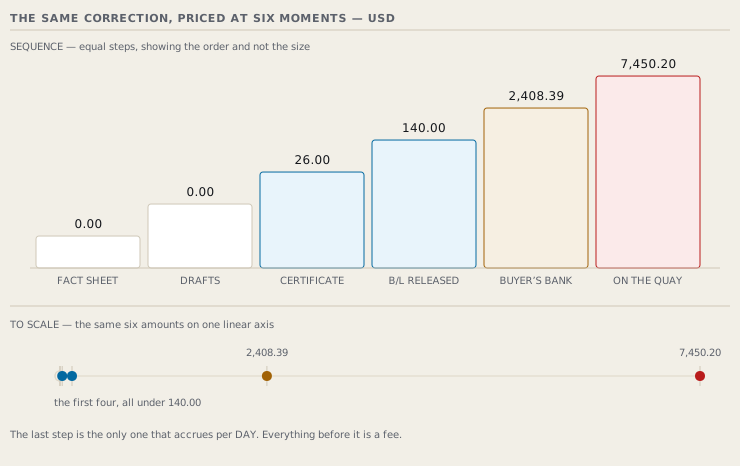
| Caught | What it takes | Cost |
|---|---|---|
| At the fact sheet, before a document exists | Agree the unit and the pack ratio | USD 0.00 |
| On the drafts, before the certificate is applied for | Retype one box | USD 0.00 |
| After the certificate is issued, before the file leaves Egypt | Cancel and re-issue at the chamber, one day | USD 26.00 |
| After the bill of lading is released and the file is lodged locally | Re-issue, courier twice, re-lodge, four days | USD 140.00 |
| At the buyer's bank, on examination | Discrepancy fee, and payment delayed 25 days | USD 2,408.39 |
| At Halstrand, with the containers on the ground | Everything in lesson 4 | USD 7,450.20 |
Two things in that table are worth more than the numbers.
The first is that the largest single step is the last one: USD 5,041.81 between the bank's desk and the quay. That is the step where the goods themselves start costing money for standing still. It is also the only step where the cost accrues per day rather than per event. Everything before it is a fee. The last one is a meter.
The second is that stages one and two are both free, and they are free for different reasons. Stage one is free because nothing has been written yet. Stage two is free because everything written so far is still a draft, and a draft belongs to the person who wrote it. The moment a document is issued by a third party, or released to one, it stops being yours to change.
Who owns each document once it exists
| Document | Who can change it | What it takes |
|---|---|---|
| Commercial invoice | Zohara | Re-issue. Free, until the bank has it |
| Packing list | Zohara | Re-issue — but only to say what was actually packed |
| Certificate of origin | The Damanhur chamber | Cancellation against surrender of the original, then a fresh certificate |
| Bill of lading, before release | Tessala Line, on the draft | An email |
| Bill of lading, after originals are released | Tessala Line | Surrender of the full set of originals, wherever they are, and an amendment fee |
| Export declaration | Zohara, to Egyptian customs | A lodged amendment, which customs may accept or refuse |
| Import entry | Krevold, to Norvedal customs | An amendment, and any re-examination it triggers |
Two rows decide most timelines: the certificate of origin and the released bill of lading. They share one mechanism. The original has to come back. Not a scan. Not a copy. A document that exists in physical originals cannot be amended remotely. And if the originals are in a courier bag over the Mediterranean, the amendment is at least a week away, however simple the change is.
A legitimate amendment, handled badly
Now a change that is nobody's error. On 13 October, two days after sailing, Roskvist writes: the goods are to be consigned to its new import entity in Norvedal, rather than to the retail company. It is a normal corporate change, and Roskvist is entitled to ask.
Zohara's export coordinator does the obvious and helpful thing. She re-issues the commercial invoice to the new consignee that same afternoon, and sends it.
That single helpful act is the same failure as lesson 4, created deliberately this time. There are now two documents in the file naming one consignee and three naming another. And the invoice — the document everything else is supposed to correspond to — is the odd one out.
The propagation order
An amendment moves in one direction only: upstream first, then re-derive downstream. Never patch a downstream document to match a change you have not made to its parent. Next season somebody re-derives from the parent, and the patch silently disappears.
- Change the fact sheet. If the fact sheet is not changed, the amendment does not exist. Some documents have simply been edited.
- Re-issue the documents typed directly from it: the commercial invoice, and the packing list if what was physically packed has changed.
- Re-issue the documents typed from those: the certificate of origin, the export declaration.
- Amend the transport document last. It is the hardest to recall, and the one whose amendment other parties must consent to.
- Send the whole re-issued set in one transmission, with a covering note saying what changed and which documents were replaced. A set that arrives in pieces over three days will be assembled wrongly by whoever receives it.
Reverse that order and you will amend the bill of lading first, because it feels the most urgent. Then you will discover that the change you made to it is not the change the invoice needed.
The decision rule
When a discrepancy is found there are only ever three answers, and picking the wrong one is expensive in both directions.
- Amend, when the fact on the documents is wrong and the correct fact is provable. This is the case in lesson 4: the shipment really is 18,000 sets.
- Explain, when the documents are individually right and only look inconsistent. A covering declaration stating the pack ratio, accepted by the reader, is faster and cheaper than a re-issued certificate. But only a reader can decide that, and asking costs one email.
- Accept the consequence, when amending costs more than the discrepancy. A buyer's waiver on a documentary credit, sought early and granted, can be cheaper than a re-issued transport document. That is a commercial judgement, and it belongs with whoever is carrying the cost.
What is never an answer is amending some of the set.
Check yourselfA certificate of origin has been issued with the wrong container number, and the originals are already with the buyer's bank. What do you do first?Show the answer
Find out whether the container number matters to any reader of that certificate. Do that before starting an amendment that requires the original back from another country. Often it does not matter — the certificate's job is origin, and the transport details on it are supporting information. Ask the broker and the bank whether they will take the set with a covering declaration. If either says no, then start the amendment. And start it by correcting the fact sheet, not by asking the chamber for a new form.
Prompt · Price the correction at the stage I am actually at
An error has been found in a document set and somebody is about to start amending things one at a time.
Act as an export documentation manager who has paid for this mistake before. An error has been found in a document set. I need to know what it costs to fix now, what it costs to fix later, and whether to fix it at all. The error: [DESCRIBE THE FACT THAT IS WRONG OR INCONSISTENT, AND ON WHICH DOCUMENTS]. Where we are: [WHICH DOCUMENTS ARE DRAFTS, WHICH ARE ISSUED, WHICH HAVE BEEN RELEASED TO A THIRD PARTY, AND WHERE THE ORIGINALS PHYSICALLY ARE]. Shipment status: [NOT YET LOADED, ON BOARD, IN TRANSIT WITH ARRIVAL ON THIS DATE, OR ARRIVED AND WHERE]. Money: [ORDER VALUE, PAYMENT TERMS, MY BORROWING RATE, THE CARRIER'S FREE TIME AND DETENTION TARIFF, THE TERMINAL'S STORAGE TARIFF, MY BANK'S AND THE BUYER'S BANK'S FEES, THE ISSUING BODY'S RE-ISSUE FEE, COURIER COST AND TRANSIT TIME]. Do the following. First, list every document in the set that carries the wrong fact, and for each one say who can change it, what changing it physically requires, and how long it takes. Second, tell me plainly whether ALL of them can be changed — and if any cannot, say so first, because a partial amendment manufactures a conflict where there was none. Third, price the correction at every remaining stage between now and delivery, as a table, separating one-off fees from anything that accrues per day. Fourth, give me the propagation order, starting with the fact sheet or contract and ending with the transport document. Fifth, tell me whether to amend, to explain with a covering declaration, or to accept the consequence, and name what the choice depends on that is not in my numbers. Sixth, draft the two messages: one to the party that has to change a document, one to the party that has to accept the set. Do not recommend amending some of the documents.
AI can make mistakes — check anything you act on.